New Immersive Theatre Production Tackles Mental Health and Misperceptions
Mixed Metaphors Productions and QC Family Tree present It Be Like That Sometimes

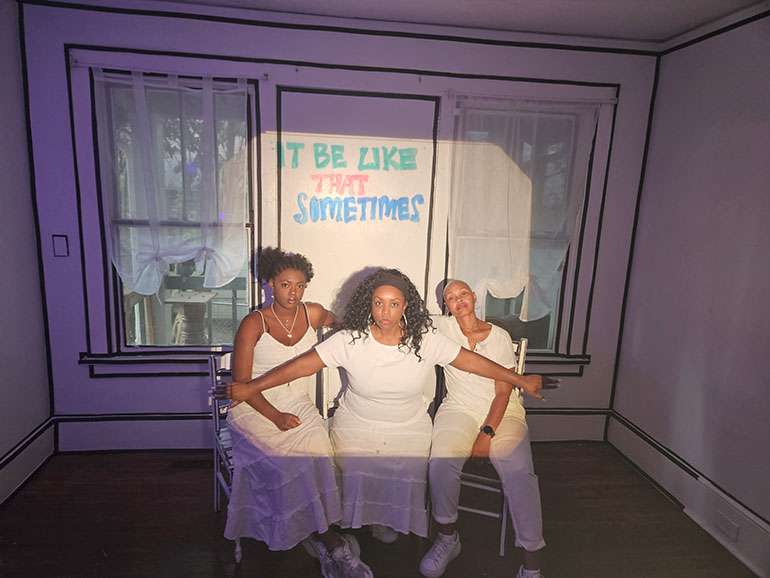
The Reynolds are your typical 21st-century family.
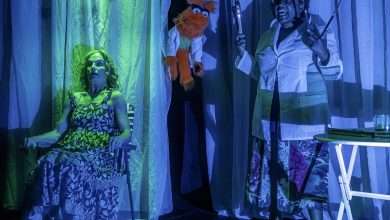
Natasha Reynolds, the matriarch, suffers from insomnia and anxiety related to her struggles with unemployment. Her daughter Kasey, a recent graduate of East Mecklenburg High School, feels intense pressure to be perfect going into college. Then there’s Auntie Torie, who’s fully burnt out from hosting the aforementioned mother-daughter duo while Natasha searches for a job.
And it’s in this context that you’re invited to visit the Reynolds family at their home in west Charlotte.
That’s the idea behind Mixed Metaphors Productions’ (MMP) newest play, It Be Like That Sometimes, which dissects how systemic narratives are projected onto individuals and the ways folks can find joy by rejecting them.
“We’re looking at mental health, but we’re really looking at it through this lens that a lot of what we consider as individual mental health issues are actually systemically related,” said MMP founder Kat Martin.
“We feel like the lack of attention that gets put on the systemic component of mental health is erasing a really big part. It’s something really personal for us inside of our ensemble and inside of our collective.”
Read More: ESSAY: A Call to Black Artists on the Experience of Homelessness and Belonging
As with past MMP productions, It Be Like That Sometimes is an immersive experience, bringing a select number of patrons through Aunt Torie’s home to spend time with each member of the family, hearing their struggles and learning their coping techniques.
Running from July 24-Aug. 3, the performances will take place at the QC Family Tree’s Big Blue House in Enderly Park, where the company also performed Kudzu: A Story of Belonging last year.
The Reynolds family is a composite of all the interviews and information Martin and her team compiled while doing research for the play.
“It’s in a very Mixed Metaphors-y way,” she said. “It’s a blend where we’re drawing from actual interviews, actual real-life people’s stories.”
Martin found during her research that more than 20% of Mecklenburg County residents report having eight or more days a month of “not good” mental health, and that it takes on average 11 years from when a person first experiences mental health symptoms to receive treatment.
“It shouldn’t take much imagination to realize that when folks are threatened, denied resources, displaced from housing, and restricted from adequate health care, their mental health is negatively affected. This is the reality of many of our neighbors and community members in Charlotte,” said Helms Jarrell, co-director of QC Family Tree. “These issues are as real as the COVID pandemic, when a threat to our bodies, our families and our communities’ survival also took a toll on our mental health.”
Martin said that it’s easy for people to internalize their negativity surrounding their circumstances and ignore that so much of this isn’t in their control.
She said she hopes that anyone who “ever had the kind of day that drained you, where lists of demands felt overwhelming, where you felt the shame of not being enough” leaves the play feeling seen and renewed.
“We really want this piece to be a place where when you leave, you feel like you let some of those narratives go,” she said. “You can take a deep breath and you can say, ‘Hold on a second, that’s not me, that’s the system.’”
Setbacks and searching for solutions
Martin said the title of the play has a two-fold intention. The first is tied to the fact that a simple phrase like “It be like that sometimes” can be something that connects community members, even complete strangers, whether in line at the DMV or in some other situation where the struggle is real but it’s out of your hands.
It’s a fully relatable sentiment, but it’s also a nod to the fact that some things are systemic, not based on the behavior of the person going through it.
“These are things that are outside of what we can control. These are things that are outside of our normal self-care routines,” Martin said.
“So we think that it’s connecting us and it’s pointing the finger and pointing the mirror at the way that a lot of what people deal with that’s labeled as mental health is things that are much larger and way outside of the control that one person can ‘work on it or fix it,’” she continued, using air quotes. “Or these are much larger things, and sometimes it does be like that sometimes.”
Last winter, MMP went through its own situation in which the team just had to make one of those “visceral shrugs,” though they didn’t realize it at the time.
In December 2024, the company lost its rehearsal space and most of its set pieces and inventory when a driver careened into the front of Martin’s house.
Read More: Local Production Company Pushing On After Costly Car Wreck
Prior to the accident, MMP had just announced a new partnership with QC Family Tree and Martin felt the company was about to hit full stride “where you’re like, ‘We’re solid. We’re together. We’re hitting all of our personal benchmarks.’ And then boom, something happens that’s outside of control, and it involves a lot of systemic issues.”
The driver who hit Martin’s house was under the influence and one can only wonder what was going on in their life that led them to crash into someone’s home. Still, that one action led to a domino effect for MMP, which has continued to experience setbacks and barriers in the wreck’s wake.
“The aftermath of that with insurance companies, which is another part of systemic barriers to being good and solid and feeling secure, and then working with CMPD – it’s been this whole additional layer,” she said.
“And if you are also systemically underemployed and underpaid, if your housing was insecure, all those things on top of each other is exactly the thing that can lead to mental health crises.”
MMP hosted a fundraising gala in April to help rebuild what was lost and Martin said they were able to successfully reach their goal to put on this production, though they are still accepting donations to allow them to fund future projects.
“We’re really proud of the whole team for — I hate to use the phrase because it’s a part of the systemic thing that leads to our bad mental health, but I don’t have better language for it — we really had a bootstrap moment of being like, ‘We’re going to put this together because it’s important and we want this story to be told,’” she said.
“And we really want the community to have a space where we can start to question and push back on some of these things that are written onto us.”
It do be like that sometimes.
Getting immersive in theatre
To achieve the full effect of what they’re trying to accomplish, MMP, true to form, will employ a number of immersive components into the production.
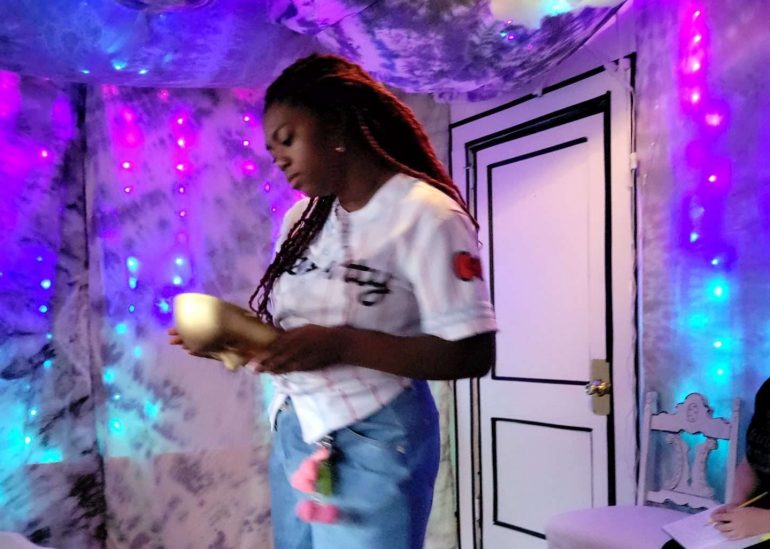
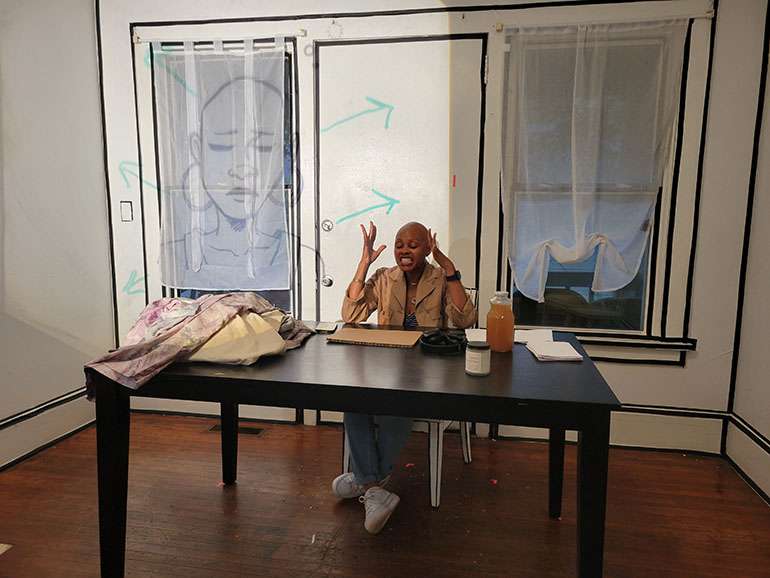
As patrons journey through the QC Family Tree’s Big Blue House, each room will center on a different member of the Reynolds family. There will be recordings from some of the interviews conducted during MMP’s research and projections of live sketches by one of MMP’s visual artists, Bambi.
There will also be moments of participation by the audience to create dialogue between performer and patron.
The company has prepped the house by creating interior designs that make everything appear as a 2-dimensional sketch, which plays into the motif that the home is the space where the family is able to write its own narratives and express internal truths.
Martin said all of these facets will allow people to enter the minds of the characters while stepping into this space will conjure “that feeling that when you enter into the home, you’ve left the outside room behind and you’ve come into the domestic space that’s supposed to be our safe space and protect us.”
Martin said that she hopes people feel a sense of connection with their fellow audience members at the end of the piece, which will help foster conversation and more empathy and understanding.
She also hopes the production will provide people with new coping mechanisms to help protect their peace and mental health.
Read More: ‘Kudzu: A Story of Belonging’ Explores the Impact of Gentrification
“We really hope that people, through going through this very hyper-intimate theatrical experience, that you feel connected to each other, that you feel like, ‘I heard you mention that you also dealt with anxiety. Me too,’” she said. “So that people leave having taken that breath but also having some tools that, when they’re in those moments where it be like that, sometimes they can reflect and say, ‘Hold on, I almost let that into my mental space. I almost let that into me. And I need to actually remember that it’s not. I don’t have to put this into myself. I can set this aside.’”
While the topics that It Be Like That Sometimes are built on have depth and weight, Martin emphasizes that there’s a light at the end of the tunnel, one just has to take the journey through to find joy and authenticity on the other side.
“It’s not just about the things we have to fight against,” she said, “but also about the beauty and how we do that.”
Sometimes, it doesn’t always have to be like that — it can be better.
It Be Like That Sometimes will run from Aug. 24-Aug. 3 at the QC Family Tree’s Big Blue House, 2916 Parkway Ave. Find tickets here.