Council Quickies: Trump’s Model Cities Initiative Meets Resistance
Council members raise red flags about CMPD grant application


Charlotte City Council returned from its summer recess with a business meeting on Monday, with two action preview items taking up much of the evening.
Council discussed potential changes to the city’s teen curfew that it’s expected to vote on later this month and a federal grant for CMPD that would come from the Trump administration with strings attached.
On the agenda:
- Teen curfew
- Model Cities Initiative
Teen curfew
CMPD kicked off the evening with a presentation on its recommendation to enact a 9 p.m. curfew for all minors throughout the city in response to recent incidents that city leaders are referring to as “teen takeovers.”
The presentation mirrored one given to the city’s Safety Committee on July 14, as we reported at the time.
Following the presentation, Dimple Ajmera started the council discussion by clarifying what exceptions would exist for the proposed curfew. She said she has gotten a lot of questions around employment and organized activities like sports, which are both exceptions to the curfew.
Other exceptions include running an errand at a parent or guardian’s direction or responding to an emergency.
Chief Estella Patterson said the new curfew will be used as a tool to address large gatherings that have a potential to turn violent or chaotic. She insisted that police will not be out looking for teens hanging out past 9 p.m., whether leaving the movies or involved in some other innocuous activity, but only in specific situations.
LaWana Mayfield pointed out that youth today don’t have the same access that she had as a kid who “lived at Park & Rec.” She said you need to pay to go to county rec centers these days and it becomes expensive. She pushed for more access to facilities and events for teens.
Kimberly Owens asked for clarification as to how parents would be held liable for their children’s behavior. She voiced her concern that language in the proposed changes that says parents can be held responsible and cited/charged if they know their child is out in violation of the curfew is in conflict with the exceptions stating that teens can be out with permission from parents.
CMPD attorney Jessica Battle said parents wouldn’t be held responsible if teens are doing something excepted by the new ordinance, as is the case with running errands, but can be charged if their children are out in violation of the curfew at a teen takeover or taking part in some other disturbance.
Owens said she’s heard that a violation could start an official investigation into a more serious neglect charge for the parent, which she would not be comfortable with. Patterson denied that would be the case.
Ed Driggs said he’s concerned that the small percentage of teens who are taking part in this type of activity are the ones who are already out of the control of their parents.
Deputy Chief Jackie Bryler said police will communicate with parents to learn when that is the case, as they do in cases of truancy. Diversion programs might be recommended in those situations but police do not plan to charge parents whose child is defiant or insubordinate to both house rules and laws.
“I don’t support increasing interactions with our youth and police on a negative basis or possibly impacting their criminal record and their future if there’s something more that we can do,” said Renee Johnson. “So I think we should take a look at other options before we proceed.”
JD Mazuera Arias added, “I take the recent youth takeovers and safety concerns seriously, but I do believe we should target harmful conduct and not make simply being young and outside after 9 p.m. grounds for police intervention.
He called the curfew an overly broad response considering CMPD has responded to only six “teen takeovers.”
Model Cities Initiative
CMPD is seeking a Model Cities grant from the US Department of Justice. As part of its presentation to city council, one slide presented a number of things the department hopes to fund with the grant, including expanding the use of Flock cameras, drones, AI and other tech.
With the tagline “Make America Safe Again,” the Model Cities initiative will award $300 million in “grants” to two to four cities to carry out broad public safety measures in partnership with the federal government.
LaWana Mayfield said she’s concerned that the grant — funded by Donald Trump’s so-called Big, Beautiful Bill — would lead to increased surveillance and the militarization of local police at the behest of the Trump administration.
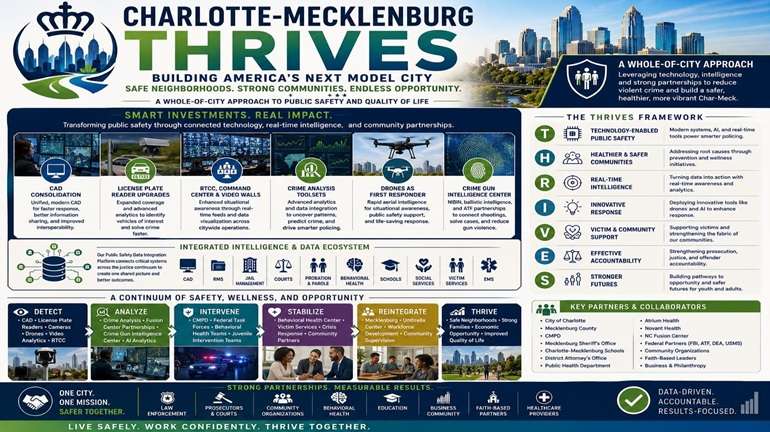
CMPD attorney Jessica Battle said there is a clause in the grant application stating that if there is a “surge in violence” in a grantee city that requires a deployment of federal resources or personnel during the three-year duration of the grant, the city would be financially responsible to reimburse the federal government for the cost of that deployment.
Victoria Watlington pulled up a National League of Cities article about the initiative and read off some language that raises red flags, including that “the solicitation includes provisions related to federal immigration information-sharing requirements.”
The piece also points out that the program will be administered through “cooperative agreements rather than traditional grants,” which will allow the DOJ “to play a more active role in project planning, implementation, and oversight” throughout the grant’s duration.
“What I’m reading here is extremely concerning for me,” said Watlington.
“I just don’t think we as a city who is welcoming to immigrants and people from different backgrounds should sign a blank check for a federal operation whose trigger, scope and cost have not been defined,” said JD Mazueria Arias.
“This is not a traditional federal grant … It is a cooperative agreement that gives DOJ substantial involvement in Charlotte’s implementation plan, the budget, the selection of partners, program milestones” and other aspects of the initiative, he continued.
If council were to give CMPD the green light to apply for the grant, the application would be due on Sept. 1, but any such approval from council looks highly unlikely.
All council members who spoke during the discussion voiced some level of reservation with the Model Cities initiative, mostly involving a lack of trust for the Trump administration and not wanting to be forced into a partnership with federal immigration enforcement.
Kimberly Owens also spoke about her reluctance to expand the use of the Flock system.