
Tracking Vehicle-Related Deaths on Charlotte Streets in 2025
Recently published Vision Zero report gives glance at CDOT priorities

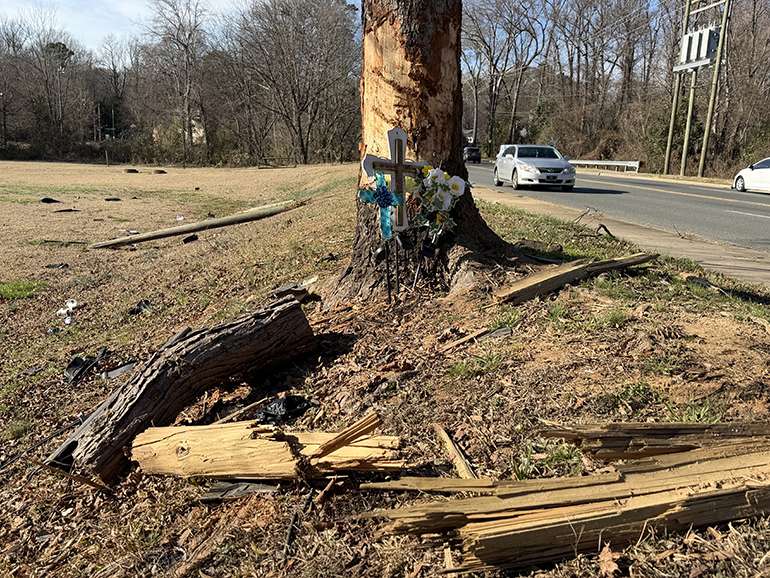
Queen City Nerve’s mapping of traffic-related deaths on Charlotte streets, which we’ve carried out each year beginning in 2022, documented 63 fatalities resulting from car wrecks in the city in 2025. That’s a 20% drop compared to 2024 and the lowest total we’ve tracked in one year since 2022, which saw 60 deaths.
Much of the decrease came in the category of collisions involving cars and trucks, which saw a drop from 50 confirmed fatalities in 2024 to 25 in 2025. Last year also saw a drop in pedestrian deaths from 24 to 21 and deaths involving motorcycles and mopeds from 14 to nine.
Fatal incidents involving micro-mobility vehicles such as bicycles, scooters, skateboards and wheelchairs rose from five to seven.
In the above map of deaths due to traffic-related incidents in Charlotte in 2024, red markers signify a person killed in their car; black markers signify pedestrian deaths; purple markers signify deaths involving motorcycles and mopeds; green markers signify deaths involving micro-mobility vehicles such as bicycles, scooters, skateboards and wheelchairs; and yellow markers signify pedestrians killed by trains, incidents that were not included in our final count.
The recent release of the 2025 Vision Zero report, which tracks the Charlotte Department of Transportation’s (CDOT) efforts to reduce fatal car wrecks within the city, has brought road safety to the forefront for some city leaders.
The report, which was made public in January, tracks traffic data inside Charlotte during Fiscal Year 2025 — from July 1, 2024 to June 30, 2025, as opposed to Queen City Nerve’s tracking, which covered the calendar year from Jan. 1-Dec. 31, 2025.
The Vision Zero report found that the total number of traffic crashes in Charlotte declined during FY25 compared to the previous fiscal year but crashes resulting in fatal and serious injuries increased.
District 6 Charlotte City Council rep Kimberly Owens raised concerns about the report during a Jan. 12 council meeting, calling on city leaders to approach road safety concerns with the same vigor that they approach public safety related to crime.
“Those aren’t just numbers,” she said of the 81 deaths documented in the Vision Zero report, “those are people, those are families, and those are families living with grief that shouldn’t be part of their story.”
What the Vision Zero report shows
While the data in the Vision Zero is months old, it does provide a more comprehensive picture of traffic dangers including data Queen City Nerve doesn’t have access to such as the causes behind each car wreck.
The report found that speeding (34%) or improper vehicle operation (30%) accounted for more than 60% of the fatal and serious injury crashes reported in FY25. Improper vehicle operation refers to unsafe and illegal behavior such as reckless driving.
Other causes included disregarding traffic control devices like red lights and stop signs (16%), distracted driving (11%), impaired driving (4%), and other unnamed causes.
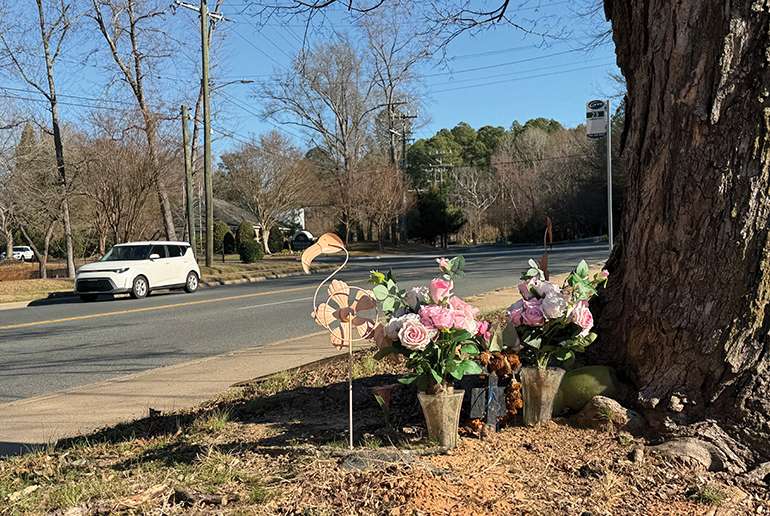
The report also highlighted the dangers that pedestrians and cyclists face if involved in a collision with a car, finding that while pedestrian and bicycle crashes made up only 1.5% of all crashes that occurred, they accounted for 29% of all serious/fatal injuries.
Notably, 19% of all pedestrian crashes involving a motor vehicle and 7.7% of all bicycle crashes resulted in a serious or fatal injury compared to just 0.4% of other crashes.
There were also disproportionate impacts found in the data. For example, Black Charlotteans make up 34% of the city’s population but accounted for 44% of injuries or deaths due to crashes. Also, men represent 48% of the population but 71% of those seriously/fatally injured in FY25.
Another of the disproportionate impacts documented in the report involves something that CDOT officials have been vocal about since Charlotte City Council adopted its Vision Zero plan in 2019: the High-Injury Network.
Used as a tool for identifying where safety improvements are most urgently needed, the High-Injury Network is a map of the streets where the most fatal and serious injury crashes have occurred based on five years of crash data.
Though it makes up just 13% of Charlotte’s streets, 80% of all fatal and serious injury crashes have occurred on the High-Injury Network during that span.
What is the city doing to make streets safer?
While the city’s Vision Zero Action Plan aims to address safety concerns by funding infrastructure projects with a focus on the High-Injury Network, CDOT’s hands can often be tied when it comes to roads that are maintained by the state.
Last year, Queen City Nerve mapped how many fatal incidents occurred on streets owned and maintained by the city and how many occurred on state-owned streets. While 2024 saw a relatively equal amount on both, our 2025 stats showed a gaping disparity between the two.
According to our 2025 tracking, 19 of the fatal wrecks involving cars or trucks in 2025 occurred on state-maintained roads compared to just five on city roads. Also, 13 fatal wrecks involving pedestrians occurred on state-maintained roads compared to eight on city roads.

This can complicate efforts to make some of Charlotte’s most dangerous streets safer. Many of the city’s most dangerous corridors — Independence Boulevard, North Graham Street, Freedom Drive, Wilkinson Boulevard —- are maintained by the NC Department of Transportation (NCDOT), which are marked orange in this map.
“Historically, [NCDOT] has not been willing to make the design changes needed to prioritize safety over speed and in some cases are still trying to widen roads to accommodate even more vehicles and higher speeds, moving us in the wrong direction,” said Shannon Binns, executive director at Sustain Charlotte, when we spoke to him about our 2024 map.
Still, the city remains focused on carrying out the projects that it can.
Working with a record-high $20-million allotment to the Vision Zero program over a two-year period thanks to a November 2024 bond referendum, CDOT carried out dozens of road projects in FY25 that included creating safer crossing areas, lowering speed limits, adding speed cushions, improving street lighting and building infrastructure such as sidewalks, which the city added 4 miles of in FY25.
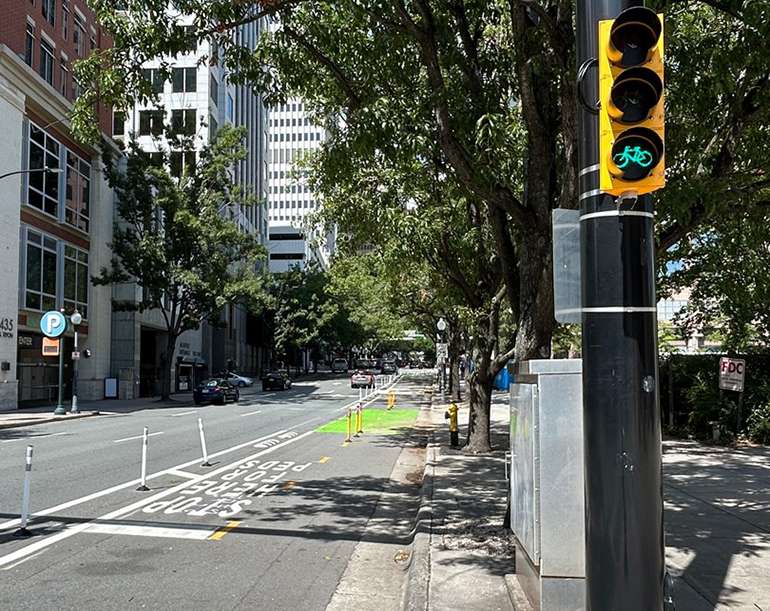
Early in 2025, CDOT launched an interactive Vision Zero dashboard to allow residents and city staff access to historical crash data and analytics tools. At Monday’s meeting, Charlotte City Council member JD Mazuera Arias asked for that project to be updated.
“Currently it’s outdated, the data is hard to read, it doesn’t seem very accessible to the average citizen,” Mazuera Arias said of the dashboard.
Council members Renee Johnson and LaWana Mayfield also suggested the city consider slowing growth on certain corridors such as Mallard Creek Road and Mount Holly Huntersville Road until infrastructure can catch up with the increasing density.
Monday night’s meeting also saw council take action on a few items related to traffic enforcement and safety, including approving a $50,000 grant from the NC Governor’s Highway Safety Program that will provide overtime pay for CMPD officers to increase enforcement of traffic violations such as aggressive driving, organized street racing or takeovers, and “special traffic operations including Vision Zero,” according to the agenda.
This year, the Vision Zero team is working on analyzing all crash data from the High-Injury Network to date, identifying the most dangerous street segments and intersections and developing potential countermeasures for those segments.
The city is also exploring options to implement more automated enforcement, including speed cameras in school zones, as is now allowed thanks to the passage of Senate Bill 391 in July 2025.
Read more: Vision Zero Faces Challenges in Eliminating Traffic Fatalities in Charlotte (2021)
During Monday’s meeting, Owens called on the city manager to create an action plan for the High-Injury Network that allows council members and residents to see what exactly the city has planned in terms of projects along those corridors.
She also asked that city staff create a “rapid response protocol” to be implemented following any fatal crash to see what measures could have been taken to prevent it.
“I think this is important when we’ve been focusing on public safety and I’ve been constantly trying to shift the lens and not have it be uniquely on crime safety but also on the safety of our streets,” Owens said.
“We’ve got a big responsibility now particularly with our new Transit Mobility Plan and the number of things that we’re doing,” she continued. “I don’t want to take away focus from the violent crime numbers but I do want to widen that lens.”




Hello,
Really enjoyed your article on Charlotte and the danger pedestrians and cars are subjected to while out for a ride to the grocery store. Curious if you have a name or suggestion for someone to get in touch with to discuss a way to slow people down? We live between C
Sharon Amity and Rama. Both have gotten out of control with some cars approaching highway speeds. Any help would be greatly appreciated.