
Tracking Vehicle-Related Deaths on Charlotte Streets in 2024
Incidents continue to climb as population grows

According to Queen City Nerve’s tracking of traffic deaths on Charlotte streets throughout 2024, the total number of people killed in vehicle-related incidents on Charlotte roads last year reached 85, the most to occur since we began tracking such vehicle-related fatalities in 2022.
The 2024 total was a more than 20% increase compared to 2023, which saw 70 vehicle-related deaths. The previous year saw 60 such deaths, according to our tracking.
In the above map of deaths due to traffic-related incidents in Charlotte in 2024, red markers signify a person killed in their car, black markers signify pedestrian deaths, purple markers signify motorcycle deaths, yellow markers signify pedestrians killed by trains, and green markers signify deaths involving micro-mobility vehicles such as bicycles, scooters, skateboards and wheelchairs.
According to our data, while deaths involving cars and trucks stayed nearly flat, increasing by just one, the city saw a jump in pedestrian deaths from 20 to 24 and an increase in deaths of motorcyclists from nine to 14. Six pedestrians were also struck and killed by trains last year compared to just one in 2023.
Fatal incidents involving micro-mobility vehicles such as bicycles, scooters, skateboards and wheelchairs stayed at five.
Victims ranged in age from 11-year-old Hendrix Truesdale, struck and killed by a driver while crossing a road in a sparsely populated part of northwest Charlotte on Dec. 13, to 87-year-old Carl Gardner, who died from his injuries three days after rear-ending an SUV in his pickup truck on Providence Road in Myers Park on Dec. 7.
For the first time this year, we broke our data down to see how many fatal incidents occurred on streets owned and maintained by the city and how many occurred on state-owned streets.
We found that the exact same amount of fatal wrecks involving cars, trucks and motorcycles (25) happened on each, though out of the 29 pedestrians and cyclists struck and killed by cars, 18 of those incidents occurred on streets owned and maintained by the NC Department of Transportation (NCDOT).
Queen City Nerve’s map only tracks incidents that occur on Charlotte streets under the jurisdiction of CMPD. That does not include highways such as I-77 and I-85, which are patrolled by the North Carolina Highway Patrol.
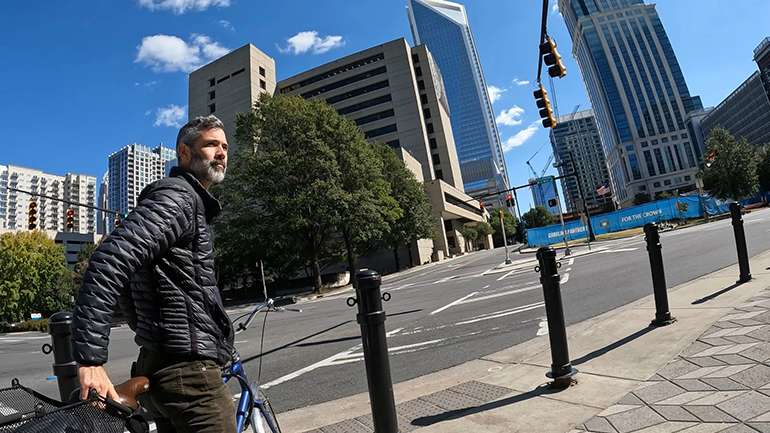
We shared our data with Shannon Binns, executive director at Sustain Charlotte, who called last year’s increase in vehicle-related deaths “heartbreaking but not surprising.”
Binns pointed out that, while the city has made investments in pedestrian infrastructure and street design changes to improve safety, much more is needed and at a faster pace. He added that, as our population continues to grow, our transit system has lagged behind, forcing more cars and pedestrians onto our streets.
“Without a more aggressive and comprehensive approach, the number of fatalities is likely to continue to rise, sadly,” Binns said.
Learn more: Nooze Hounds: Dianna Ward and Shannon Binns on Bicycling in Charlotte (2023)
Binns suggested a number of ways the city and state could address the situation effectively, starting with redesigning more of Charlotte’s most dangerous streets, known as the “High Injury Network,” to bring down vehicle speeds on each one.
He acknowledged that such a measure would take the type of political will and funding the city does not see at the moment and suggested less expensive measures such as painting more crosswalks and adding more signalized crossing beacons for pedestrians.
He added that a no-right-on-red policy could be implemented in certain areas such as Uptown, though he pointed out that speed limits are rarely enforced around the city as they are now.
Between 2012-’16, 238 people were killed on Charlotte’s streets, an average of about 48 people each year, which was an increase from the average of 39 traffic fatalities in the previous five years. Then in 2017, 71 crashes resulted in 74 deaths on Charlotte streets. It was the third consecutive yearly increase in traffic fatalities, and that’s without including the 27 pedestrians killed that year.
In 2018 the city developed its Vision Zero plan in response to the hike in vehicle-related deaths, setting a goal to reduce the number of fatal car crashes in our city to zero by 2030. Charlotte City Council adopted Vision Zero in 2019. While much of the first year of the program consisted of research and analysis, CDOT began implementing safety measures on city streets in 2020.
Though the Charlotte Department of Transportation (CDOT) did not answer our request to interview someone on the Vision Zero team for this story, the agency did publish a Vision Zero Action Plan update in July 2024 that gives a glimpse at some of the work that’s been done.

According to the report, between 2021-2023, the Vision Zero team installed 22 pedestrian hybrid beacons and 19 rectangular rapid flashing beacons for safer road crossing, placed 15 new school zone flashers and 80 new Leading Pedestrian Intervals at key signalized intersections, constructed 40 miles of new sidewalks, established 29 miles of dedicated bike lanes, reduced speed limits on 275 streets, and installed 4,600 streetlights along the High Injury Network — 2,600 new lights and 2,000 LED upgrades.
Queen City Nerve visited 10 locations where the city has installed pedestrian hybrid beacons, often strung across busy streets of about four lanes, as well as rectangular rapid flashing beacons, which are installed on the side of the road and usually implemented on two- to three-lane streets.
Though the small sample size renders our research anecdotal, we found that traffic reliably yielded to the crossing pedestrian at all six pedestrian hybrid beacons we used, but at all four rectangular rapid flashing beacons we attempted to use, drivers simply ignored the flashing lights on the side of the road and kept driving through the crossing.
Only one car stopped for a rectangular rapid flashing beacon compared to dozens that drove through at normal rates of speed while the beacons were flashing.
During a public safety update for Charlotte City Council on Jan. 6, CDOT director Debbie Smith cited data showing that adding street lighting can reduce crashes on a road by 20-50%.
“Lights provide that reassurance for pedestrians and cyclists,” Smith said. “They provide that sense of security for people traveling at night, which increases the likelihood that more people will choose to walk or bike because they can do so at night.”
Smith stated that CDOT is currently in the planning stages of a project that will install and/or upgrade street lights on an 8-mile stretch of W.T. Harris Boulevard from I-77 to I-85 in northeast Charlotte. It’s the largest street-lighting project CDOT has undertaken in terms of distance, Smith said.
That news grabbed the interest of council members, some of whom requested meetings with Smith to discuss areas in their district where better or more street lighting is desperately needed.
It’s not just CDOT that’s responsible for traffic safety, however. A majority of traffic-related deaths occurred on state-owned streets in 2024, and as Binns pointed out, NCDOT is less responsive to public safety concerns when it comes to traffic.
“Historically, [NCDOT] has not been willing to make the design changes needed to prioritize safety over speed and in some cases are still trying to widen roads to accommodate even more vehicles and higher speeds, moving us in the wrong direction,” he said.
Read more: How Lawmakers Could Make Cycling Safer for North Carolinians (2023)
In the meantime, he hopes to see the city do what they can by ramping up the installation of new crosswalks and new sidewalks, among other measures to help keep up with the demands of a growing city.
All of that will take more funding, of course, which is why Binns and the Sustain Charlotte team will spend the new year lobbying for the city’s plan to increase the sales tax as a way to invest in transit and traffic infrastructure, which Charlotte leaders hope to place on the ballot this year if allowed to do so by the NC General Assembly.




I know it wouldn’t be popular, but Charlotte needs to install red light and speed cameras. The cost of installation would be covered within a matter of weeks by the overwhelming number of folks who will have to pay fines.
Not sure if you’ve noticed, but Charlotte drivers do what I have started to call the Charlotte pause. They wait a few seconds at a green light before moving in anticipation of the inevitable red light runner in cross traffic. I’ve lived in 7 other states (and on 4 continents) and I have never seen anything like it. Fines will fix that and pay to improve dangerous intersections. Honestly, as we are learning on a macro level, laws without enforcement are meaningless.
I agree. as a New Yorker, Charlotte is worse. My daughter has had three accidents in Charlotte. Two rear enders and the third by the Grace of God she survived when her car was totaled. and we are from NY. Those would be great ideas!