OPINION: There’s Still Time to Reverse Our Car Dependency
The Week Without Driving Challenge was just the start

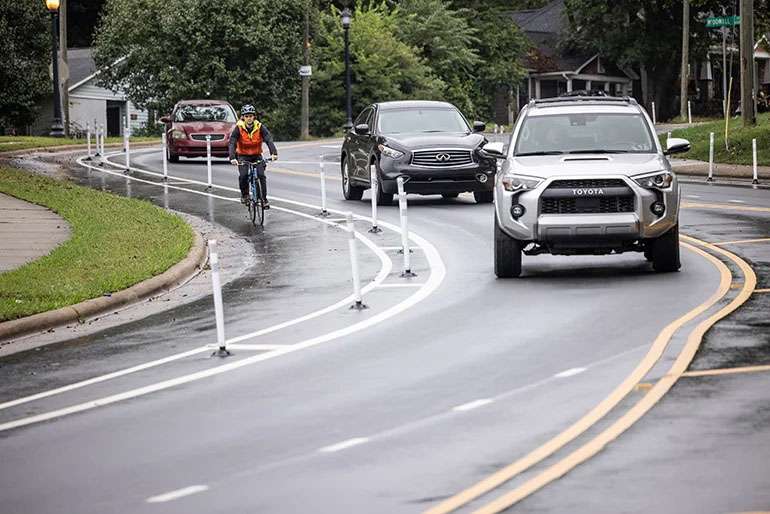
NASCAR. Daily traffic jams on Interstate 77. Getting stuck in school lines. Roads that intersect with roads of the same name. Charlotte is a car city.
If you can afford a motor vehicle and are able to drive, it’s hard to imagine getting around without one. You may not be able to fathom what it’s like to rely on walking, mobility devices, public transportation and ride-sharing.
However, for nearly a third of Americans — people with disabilities, young people, seniors, low-income families and those who have simply made an environmentally minded decision — that is the everyday lived experience.
The effects of man-made climate change threaten the livelihood of all Americans, and that reality came into stark relief for our neighbors last month with the arrival of Hurricane Helene, which devastated communities many of us hold dear, including my hometown of Asheville.
Despite all the roads-first policies, sprawl and a lack of mass transit or pedestrian/cyclist-friendly infrastructure in some cities, North Carolina is home to millions of folks who don’t drive. That’s why the national Week Without Driving Challenge, which ended on Sunday, is so important for our auto-dependent community and remains so year-round.
As its name suggests, Week Without Driving challenges participants to commit to better mobility choices while highlighting the need for more transportation options.
Investment in public transportation and bicycle and pedestrian infrastructure is essential for our community. It drives economic growth and opportunity by connecting people to jobs. It’s also impossible to address the climate crisis without expanding these options.
Trains, buses and accessible walking and bike routes give us healthy, clean and affordable ways to get around. Just think of all those people sitting alone in their cars for hours in traffic dumping incredible amounts of pollution into our environment.
Three in 10 people in our country rely on public transportation, so our level of investment in transit infrastructure and operations needs to be more equitable. Mecklenburg County voters will hopefully have the opportunity to support our transit system next year and increase our investments in bus and rail to match the number of people who depend on them.
Read more: Red Line Deal Starts to Take Shape
While these investments are rarely a priority for policymakers, we’re making progress in changing that.
In observance of Week Without Driving, local organization Sustain Charlotte, which focuses on building healthy, equitable and vibrant communities through smart growth, hosted Day Without Driving on Oct. 3 to highlight the need for more investment in transportation choices here in Charlotte.
Charlotte City Council members Dimple Ajmera and James “Smuggie” Mitchell joined Mecklenburg County commissioner Laura Meier, Matthews commissioner Renee Garner, and Huntersville Mayor Christy Clark to participate in the challenge.
It’s important to have the support of these local leaders, because public policy is what guided our car-dependent past and present in the first place.
The United States bet big on the automobile following World War I by spending large amounts of public money on roads and highways, then continued to do so after the auto industry helped build the middle class and cemented our country as the leading economy in the world.
At the time, we didn’t know the true cost of that bet. Suburban sprawl and car dependency has led to all sorts of woes including social isolation, declining health, man-made climate change, and increasing traffic-related deaths.
Road transportation is the largest source of U.S. climate pollution, and 80% of transportation emissions come from cars and trucks burning gasoline and diesel. Emissions in the US continue to rise.
Our auto dependency is also a ticking time bomb for state and local budgets. The cost of building and maintaining our road networks is vastly outpacing gas tax revenues despite the fact that NC has one of the nation’s highest gas tax rates. Building more roads and widening them without a consistent revenue stream is bad budgeting, and future generations will be forced to pay more for diminishing returns.
In addition to the climate and budget emergencies, cars cost lives. Over 40,000 Americans died in motor vehicle-related accidents last year. In North Carolina, around 1,500-1,700 people die in motor vehicle-related accidents every year, including between 50-100 in Charlotte, while across the state line in South Carolina more than 1,000 drivers die every year — the most in the country by vehicle miles traveled.
Read more: Tracking Vehicle-Related Deaths on Charlotte Streets in 2023
It doesn’t have to be that way. Nationally, tens of millions of Americans — from small rural towns to major urban centers — rely on public transit to get to work every day, generating trillions of dollars in economic activity. Every dollar invested in transit offers a 5-to-1 return, and every $1 billion invested in public transit produces 50,000 jobs.
Charlotte hasn’t always been a car city. Our early economic strength (before the banks) came from our role as a railroad hub. Later, neighborhoods like Elizabeth, Dilworth and Myers Park connected to Uptown through a streetcar network. Even now, Charlotte-Douglas International Airport is continuing to grow as a multi-modal hub for freight and cargo.
With a new transit plan, we can push forward for a future where all our residents have equitable access to mobility. An investment in transit by policymakers and voters would be a win for our region — economically and in our efforts to address inequity, public health and the climate crisis.