New Novel Shares Teacher’s Mission to Make Fishing More Inclusive
'She Talks to Fish' is the first writing venture from visual artist Brian Hester

When you think of your typical fly-fisherman, what image comes to mind? It might be someone like Brian Hester, a middle-aged white man.
Hester, an avid, self-taught fly-fishing enthusiast and visual arts teacher, knows this is the case, and he’s determined to change it. Centering his efforts on bringing more Black, Indigenous and other people of color, specifically women, into fly-fishing, he has sought to create a more welcoming mindset in a subculture dominated by white men.
Working as an arts teacher at Myers Park High School, one of Charlotte’s more diverse high schools despite the demographics of its namesake neighborhood, Hester launched a fly-fishing group for students in the hopes of sharing his passion. Upon starting the Myers Park Anglers Club, he noticed an unsettling pattern.
“Originally, I saw a lot of young, just little white boys fly fishing,” he said. “I was like, ‘This should be for everyone, and it needs to be for everyone.’”
From there, he made a more purposeful effort to recruit young, BIPOC women to join the club. The effort paid off, as the dynamic of the club immediately changed for the better. As an artist, the experience naturally inspired his next creative venture, though not in the visual arts medium he’s used to.
Hester’s new novel, She Talks to Fish, tells the story of Maya Jones, a young, Black woman from the mountains of North Carolina, who takes up fly fishing under the guidance of her mentor, Ed Myers. In the coming-of-age tale, Maya defies stereotypes, bigotry, nature and death with immeasurable perseverance.
“[The Anglers Club] actually prompted me to tell this story, to build a fiction novel where anybody could read it and walk away feeling inspired, empowered, enlightened,” Hester told me. “It was about belonging; some people don’t occupy a certain space because somebody [else] has already been there or they feel as though actually that space belongs to them and only them. This story is to tell you to go occupy that space.”
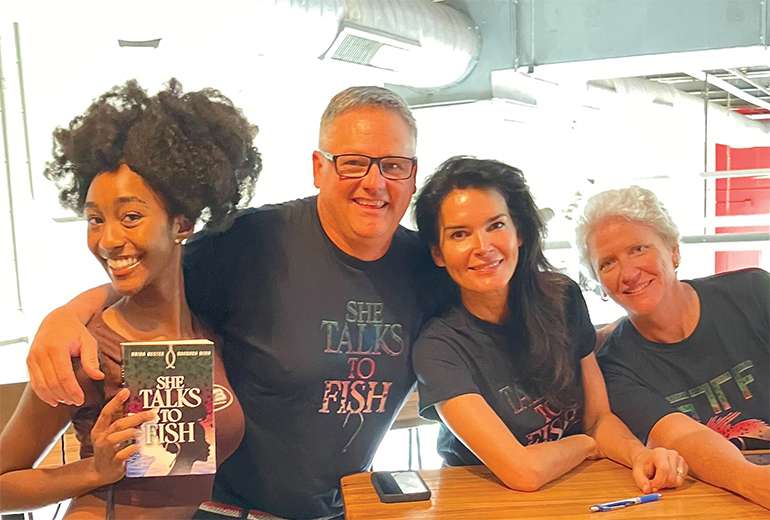
She Talks to Fish, co-written by Barbara Beam, was released through Amazon on Sept. 22. At the time of this writing, the book was number one in new releases in the fishing genre. Hester started the project as a screenplay, but when it didn’t get any takers he decided to adapt it as a novel.
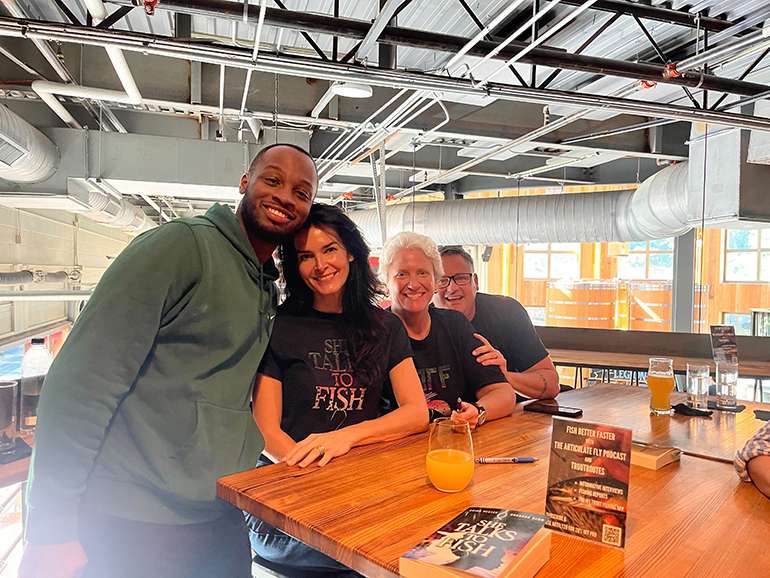
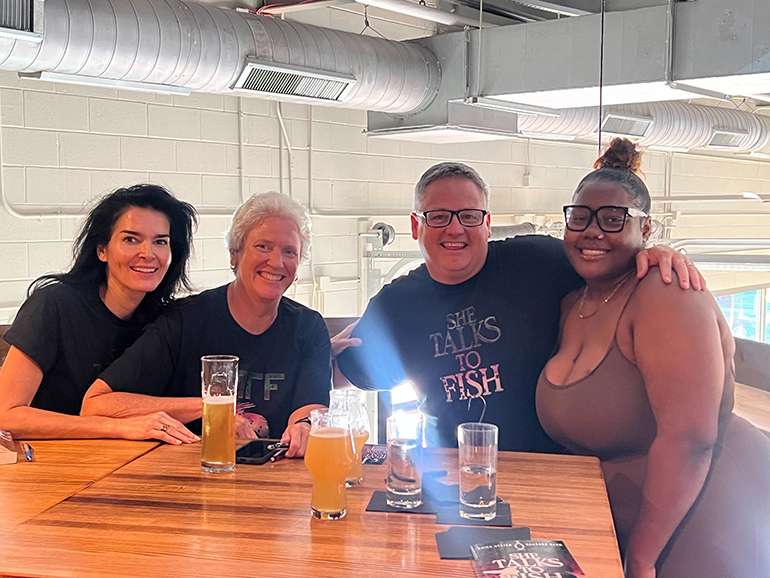
Hester held a book signing at Legion Brewery in SouthPark on Oct. 5. A native of Boone who learned fly-fishing in the nooks and crannies of the Blue Ridge Mountains, he donated the proceeds to a number of Hurricane Helene relief funds.
Following the Oct. 5 signing, we talked to Hester about his first novel and how he hopes to allow any reader to see themself in its pages, and to see themself with a rod in their hands.
Queen City Nerve: What has your journey in fly fishing looked like?
Brian Hester: Growing up in Boone, I always thought that fly fishing, which I was self-taught, was this sport that hardly anybody that I knew did, if anybody did it. It was just one of those things where not a lot of people fly fished, but I did because it was like a sanctuary for me. It was like this happy place. I was thinking to myself, “Why doesn’t everybody do this?”
How and why did you teach yourself?
It was one of those things that intrigued me as a little dude. I was at a picnic with my family at Price Park, just outside of Blowing Rock on the [Blue Ridge] Parkway. I remember sitting on the bank, barefoot, watching an elderly man fly fish. Then he ended up catching a native brook trout.
If you have ever seen a native brook trout, it’s like – I don’t want to get religious, but it seems like the canvas of the skin of this native brook trout looks like it was painted by Michelangelo. You have these beautiful emerald greens and olive greens that tapered into this volcanic yellow-orange on the fins and the belly of this fish, and then it was accented by these bold, beautiful black lines on the fins, and then it was marked on the side of the body with these yellow and blue bull’s eyes. I was taken aback. I was like, “I can go catch that?”
Immediately, I got home, opened my dad’s fighting rod. I had no idea how to tie any knots, and I definitely had no idea how to cast. But I was out there just trying to mimic what the elderly man had done, thinking I’ll figure it out. And then it just became this pursuit over the next four years. It became my coping mechanism. When all else failed and I needed head space, personal time, I just grabbed my fly equipment and I’d go fish because it was readily available.
Once I caught my first brown trout, I lost my mind. There was no one around to hear me yell, scream, jump, but I do remember telling myself at that time when I was 14, I was like, “I can’t believe everyone on the planet doesn’t do this.” But then in the same breath, I was thankful because it was one of those situations where I was able to figure a bunch of this stuff out on my own and do this magnificent thing.
Were you concerned that you wouldn’t be able to tell this story as a white man, seeing as how the main character is a Black woman?
I’ve done my homework and I didn’t want any misrepresentation. I didn’t want somebody to walk away going, “He got it completely wrong. He doesn’t understand anything.” I had a ton of beta readers, and these beta readers crucified me. They would say, “She would never do that” or “It would probably be better if you actually said it this way,” and then I would go back to the drawing board and I would come at it from a completely different, new lens, and a completely different attitude.
How does fly fishing intersect with inclusivity in your experience?
The organization that I created took off because I believe fly fishing is our world’s greatest equalizer, or just fishing alone. I’m saying it this way because I’ve tried to attack my own philosophy about this. And it’s a pretty good philosophy because I can’t find fault with it. My philosophy is this: Fishing doesn’t care about anything. It doesn’t care about your culture. It doesn’t care about your gender and/or gender associations. It doesn’t care about your political views. It doesn’t care about if you’re tall or short, if you’re skinny or heavy. It doesn’t care about your skin color or your religion. But what it demands is your attitude and your effort.
Were there any stories and/or students specifically that inspired your vision of Maya Jones?
Danee Townes just finished at Winston-Salem State University and was one of the wonderful members of my Anglers Club at Myers Park. She was a huge inspiration for me to build and pursue this story because she was eager to see what fly fishing was all about. She jumped in, started tying flies, got the gear and never looked back in terms of investigating. I will say she met a bunch of fellas and other women she would have never hung out with otherwise. All of this forced my charge to explore authorship.
I started asking my own internal questions of the why’s. I started investigating more of the statistics of women and their involvement and moreover women of color that have fly fished. The discrepancies were ridiculous.
How long have you been working on this story?
Ten years ago I started my Anglers Club at Myers Park High School and two years into its existence I started plugging away at building a story. A story with an unknown narrative, but a story of belonging and following a passion, albeit while drowning out the noise and being true to your gut — mostly not giving a damn about the haters or naysayers and you just doin’ you. I started to write my story. I thought what I was doing was decent and then thought, what the hell, I knew [co-author Barbara Beam] could write scripts or at least put what I had done into script form, I would be golden and I would send it out to everyone and everyone would love it and then I would set the world on fire.
I remember she put it into script form in like a week. I was blown away. As fast as she got done, so did our interaction. Four years went by and with some divine intervention, strange coincidences, and a decent amount of drive I started rewriting my story to be a novel.
What happened with the screenplay?
I had a student in class whose mom is [actress] Angie Harmon. I mean, if you’re an educator, you’re going to find a way. I have no shame. I was like, “Here, take this to your mom and give it a read. If she says, ‘Go kick rocks,’ then I’ll just eloquently bow out and I’ll never speak about it again.” I saw a text that Angie Harmon sent and it said, “Tell your teacher I’m going to make this movie.” So that gave me a little bit of hope. I always try to temper that. So that was my plan A. We didn’t get any takers on the screenplay, so we have pulled the script back to ourselves.
Are you still planning to pursue making the screenplay into something on screen?
I really, really, really want to make the movie because it’s a game changer. Then the playing field gets wildly even then. I just want to see more women on the water with a fly rod. If you find just one young Hispanic girl, one young Asian, one young African-American woman that falls in love with this, just think what happens when she shows her children. Then her children take it and they are doing it because they’re supposed to, because nobody said that they shouldn’t, couldn’t, or wouldn’t because of the self-imposed stigma of being a crusty old white dude. Fly fishing has a bad socio-stigma.
What was your working relationship like with Barbara?
Her role was simple: Build the tree with a few branches and I’ll put the leaves and ornaments on those branches. From that point, the back and forth started with each individual chapter and its ebbs and flows. It was like a [Jimmy] Connors vs. [John] McEnroe tennis match. This is where she got the nickname Barb the Butcher and I also refer to her as Tonya at times, the reference coming from Tonya Harding. Club ’em at the knees and they’ll eventually fall and fall hard. Barb’s work was specific and yet very broad; correct my mistakes and also keep our Titanic clear of icebergs. Navigation was her strong suit and she did it flawlessly by connecting all the dots and points of the book.
How did your first foray into fiction writing compare creatively to putting paint on campus or your other visual art work?
What do you hope people take from this book?
I’m not trying to be some martyr. I’m just saying, “Why are you not telling this story?” or, “Why hasn’t somebody already told this story? Why hasn’t somebody already stepped up and done this?” It became a point of passion for me to try to change, or at least for just a moment when somebody reads the book, that they are able to see through a brand new lens, that they’re able to embrace what they are reading and, again, walk away inspired, empowered, and enlightened.
Read more: Mimi Herman Discusses Debut Novel ‘The Kudzu Queen’