
Cheryse Terry Serves as Black History’s Protector in West Charlotte
Preservation work takes priority for Archive CLT entrepreneur

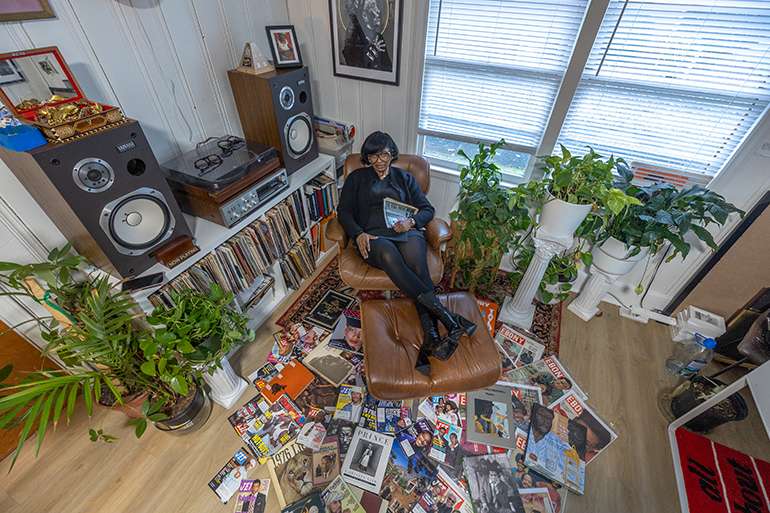
The art on the walls downstairs in Cheryse Terry’s split-level west Charlotte home is enough in itself to make a visit worthwhile. What sits between the four walls is the true treasure, however: an archive of historical Black ephemera that would likely take months just to catalogue and organize.
Over the decade it’s taken for Terry to build this archive of newspapers, publications, physical media, photographs, tchotchkes and trinkets, she has become one with the collection, it seems. Any mention of a given moment in Black history might send her to the shelves to dig out a specific memento that’s connected to it.
For Terry, who in 2022 opened the book-and-coffee shop Archive CLT on Beatties Ford Road to much renown, the annals tucked away among the shelves and drawers that we’re perusing on this Saturday evening to kick off Black History Month in 2025 are the real project.
The coffee was just a way to get folks to sit down and listen.
“Archive, the cafe, the vibe, it’s just a tip of the iceberg to get people to come and then have to deal with and listen to the work that I actually wanted to do, the 501c3 that I’m starting: Archive Historic Preservation Society,” she explains.
Among the art hanging over my head while we talk is a small but eye-catching cross-stitching that depicts the character Hippolyta from HBO’s Lovecraft Country. The text stretching above Hippolyta’s voluminous afro reads “NAME YOURSELF,” referencing a quote from the character in which she searches for “a world where I can name myself anything.”
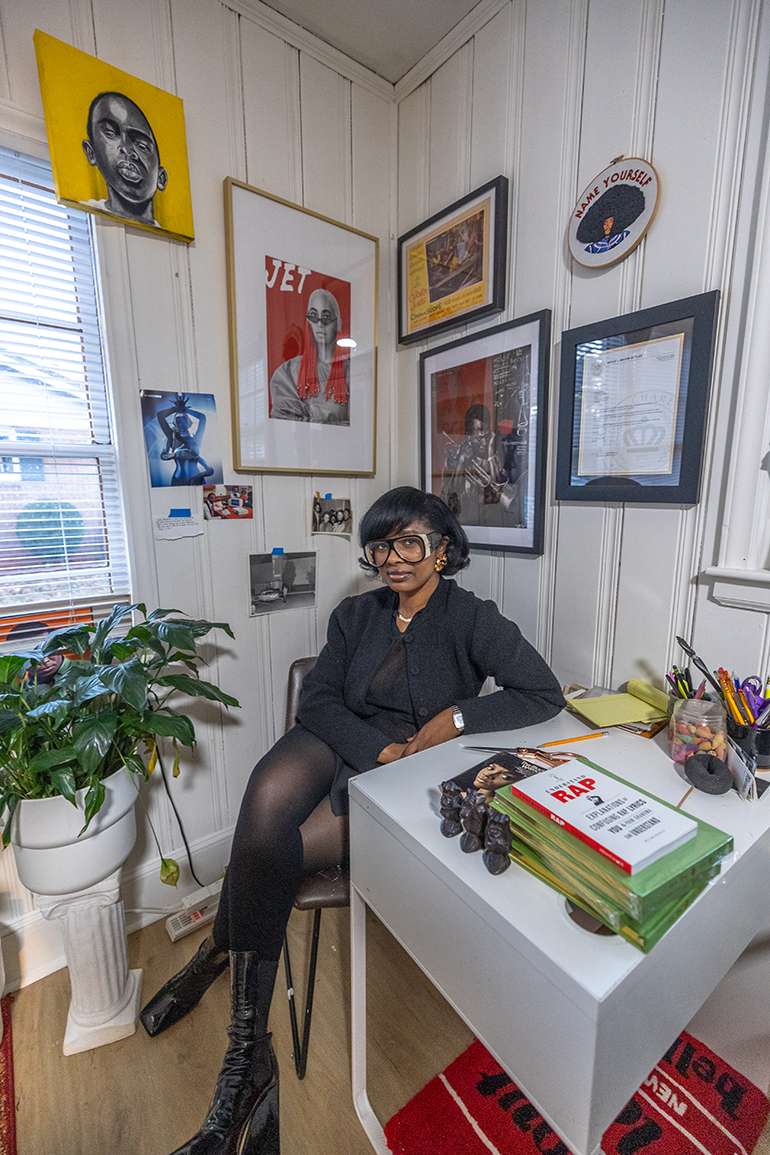
Twenty years ago, living life as a pregnant teen growing up in west Charlotte, Terry may have been written off by many as just another stereotype who wouldn’t go far in life. But drawing on the strength of her own mother she has shattered such labels, naming herself and pursuing a path most impactful for her family and community.
Terry’s work in preserving and digitizing Black history earned her recognition as an Emergent City Champion by the Knight Foundation in 2024 and has led to partnerships with Johnson C. Smith University as well as the Charlotte Mecklenburg Library to help strengthen each institution’s own archive of Black history — local and beyond.
Sitting among the trove of curios in her home, Terry spoke about how the death of her mother affected her, the importance of digitization in an age of AI, and the real archive from which Archive CLT was born.
Queen City Nerve: I noticed in your bio on the Archive CLT website, it doesn’t start with “Cheryse Terry, archivist” or “business owner.” It’s just the first five words, “Cheryse Terry is a mother…” Is that indicative of how you view your duties, with motherhood as the first job, passion and priority?
Cheryse Terry: Yes. That was the first real identity because I became a mother at 15. So I would like to think before I knew myself, which I really don’t think I all the way know myself now, but I would like to think before I even got any grasp on who I was and who I wanted to be, I was a mother first. That has been my longest journey and the most researched and the most loved and the most tumultuous at times and the most rewarding for sure.

Your own mother, Yvonne Burton, passed away in 2014. What were some of the most critical lessons you took from her that you carry on as a mother yourself?
To love unconditionally, because I couldn’t imagine that having a pregnant 14-year-old as your child is the most ideal thing, especially after she adopted me at two days old. I was raised in a church, and so she was really big in the church. She had a leadership role.
To proudly walk around with me at the age of 14 and pregnant and tell me, “Okay, you made a mistake. The result of the mistake is the child, not the child being the mistake. You hold your head up high, you’re going to graduate from high school, you’re going to be okay. You ain’t better than nobody. Nobody’s better than you.” That’s what she raised me to be.
She gave me the confidence I needed to instill that to my girls. Even though she’s been gone a decade, I’m able to carry that and hear that voice constantly.
How did her passing affect the way that you move through life and the work that you do now?
I think people don’t really come into themselves until a loss like that — until the loss of their parents, if their parents meant that much to them. Because my entire life, like I said, 14 and pregnant, she gave me the confidence, “Screw everybody who says something about you. You’re still great.”
Having that over your shoulder, having that cheerleader all the time, having a love so gigantic … And then me being a mother of three at the time when my mom died, and all my children being small. I’m raising girls, and so who mothers the mother? I was 24.
Even now, I was telling my girls in the car the other night, and I’m like, “Girls, I get overwhelmed. You got to understand, I’m still grieving after all these years … I don’t have a mom. When you all stressing me out, there’s nobody for me to call and be like, ‘Mom, did I do this to you?’ I just have to take everything with me.” So it’s unimaginable to know that I’m still even living and breathing without having that type of unconditional love, that cheer, that comfort, that support system after a decade.
I think that’s when a lot of my growth stopped, mentally, because I still have to carry every day the loss. And so part of my collection and part of my homage to her is not letting the things of her generation, the things that informed her, die.
It was just the next year, if I’m not mistaken, that the house that you grew up in burned. Looking back 10 years later, how did that inspire your archival work?
Along with the death of my mother, it totally was the icing on the cake for the work that I know that I was meant to do … If you think it’s just a sensationalized story of, “Oh, her mom died and her house burned down,” then look at California. It’s very close to us now. It’s a part of our current news that we can see the impact of somebody losing their home and losing everything they had.
I think about Asheville [after Hurricane Helene]. So now with me digitizing family archives, which is part of my work that I’m doing next, we have the technology to preserve our things.
Think about when we go home for Christmas or we’re looking at old pictures, are we scanning it? One flood, one fire, your grandma has kept this for 70 years in the family. So it’s up to us now to use our technology to make sure it’s preserved. They did the work by capturing it and documenting it. It’s up to us to preserve it. Now, getting that messaging out because of the house fire is very vital to the work that I’m doing.
I think we all are archivists in our own way. There’s things that we see that mean something to us. But I don’t think that Black people consider enough that our personal history makes up a larger history.
[She points to two black-and-white photos taped to the wall, one of Ken Koontz in the parking lot of WBTV Studios, where he was the station’s first Black reporter, and another of famed poet, writer and activist Nikki Giovanni posing with students at Johnson C. Smith University] Like behind you, those pictures of Ken and Nikki. She just passed away, but that is a picture of her at Johnson C Smith. Collecting those things tells our larger story.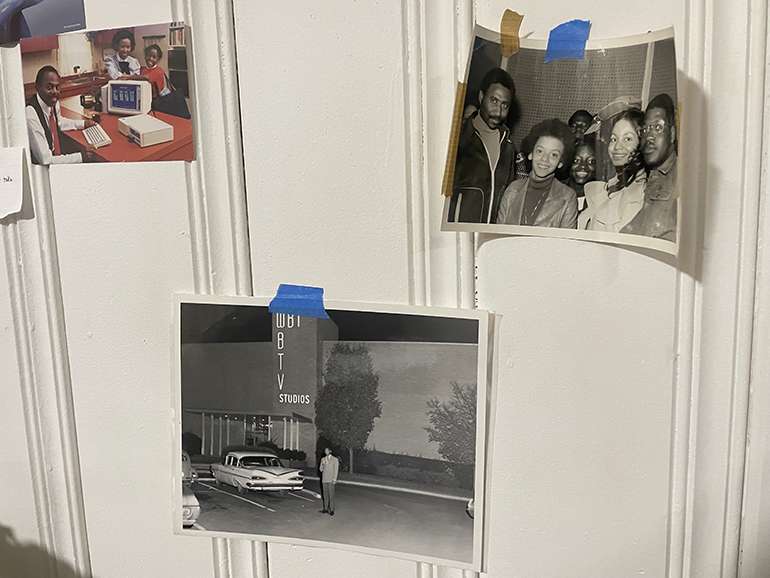
The archivist role is having the discernment and having the foresight to know what needs to be collected from where we’re going, what our children need to inherit and know about our future. With AI entering our lives now, you’ve seen Martin Luther King with a hoodie on and all these things. We’re not going to know what’s real and what’s fake. It’s important for us to hold on to physical things that are dated and have provenance.
Read more: Photo of MLK in Charlotte Highlights Three Generations of Local History (2021)
What’s an experience since opening Archive CLT that has stuck with you in regards to sharing this passion for archival preservation?
I hired a black girl from rural white America that had never heard of Jet magazine, and that informed so much. That’s the reason for the civil rights movement. Jet magazine, September 15, 1955, is when they printed the Emmett Till story and you sent that all over the country and people were outraged. How could this Chicago kid be lynched like this? He just went there for the summer.
For her, as a Black girl, not to know this, it’s like, no, this work needs to continue. My mother is the inspiration behind me making sure that the legacy of our publications and the work that we’ve done thus far don’t die with Gen Z and so on.
How would you define what you look for when you’re collecting? There are print periodicals here, then there are little tchotchkes like figurines and whatnot, and there’s everything in between it seems like. How do you narrow down what you’re looking for, if you do at all?
See, when I began collecting, and you can hear this from any collector, they’ll say once they have an interest, anything that resembles it or had anything to do with it broadly, you just got it. But after doing that for so long and then opening a store named Archive and then being on the Today Show, naturally everybody that sees you do the thing, oh, honey, I had so much mail from all over the country. Like, “Oh, this young girl is interested. Let me send this to her.”
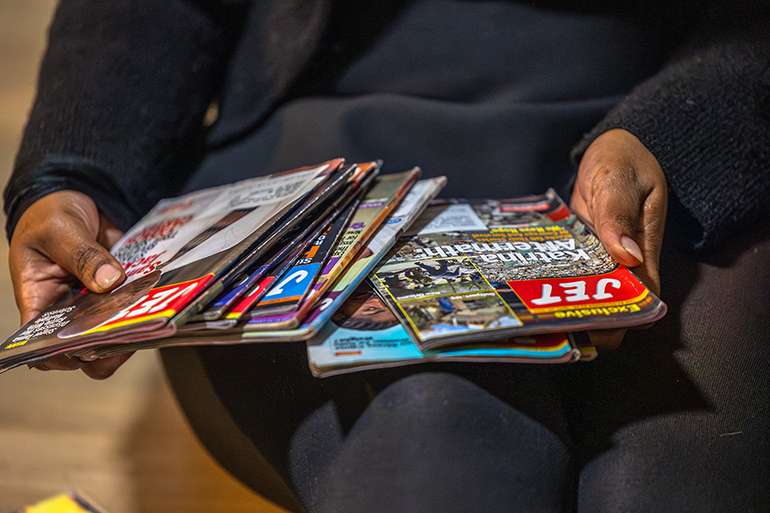
A lady came from New Jersey and gave me 1,300 Jet magazines. I have people in the community now that know I’m doing the work, and their kids are minimalists now so they don’t want to take it. They know that I have appreciation for it.
Now, when I look for stuff, if somebody calls, “I want to make a donation,” I get that call all the time. If they say there’s some Essence magazines from 2013, those are accessible on eBay. I don’t turn away anything, but I’ll sell them super discounted at Archive or reach out to artists who do collage work. I can make sure that, because the person who donated them has really good intentions, I can match them with somebody who can make great use of them. But I always filter through things now.
Do you have any white whales that you’re still searching for?
That Jet magazine I just told you about from Sept. 15, 1955, that’s a Holy Grail for me. I’m on eBay. I got it in my search every night. I’m always on the auction sites. I’m always looking for specific things to add to my collection. I got a list of Holy Grails, and that’s one. I have the second ever Ebony Magazine, December 1945. Obviously, I would love the first cover ever. I’m constantly looking for things that I don’t have. If they’re super rare that speaks to what I want to carry.
I’ve seen you speak about how much of inspiration Gordon Parks has been to your work. What is it about his work and/or his humanity that speaks to you?
Him and Toni Morrison are like my fairies because, for him, the resilience of his past, growing up in poverty, but being an original … being a director, an author, a photographer for Time magazine, and he did Vogue and all the things. There was never a ceiling on his talent and what he thought, what he felt about himself. He was able to show up and express himself creatively in a lot of different forms and a lot of different methods. Having somebody with that type of resilience and he went off to shoot overseas during the war. Just his story of his resilience really speaks to me and really inspired me.
Then Toni Morrison, of course, didn’t write her first book until she was 39, but won the Pulitzer and was the first Black woman to do so and just do it in such a way that was appreciated by everybody but was intended to speak directly to Black people and deal with the complexities of the Black experience. I think those two are the inspirations to who I want to be and what I want my work to mean.
Any goals for the new year? New projects?
Yes, of course. Digitizing the community, continuing my collection, and The Ephemera Club will be launching. The Ephemera Club is a subscription-based service, powered through Archive, where you pay a monthly fee and then I’ll send you a mystery box of ephemera. It’s like, a very niche thing for people who are looking to collect or are collectors. I’ll be dabbling into my personal collection and sending out things, then doing a newsletter that’s specific to collectors. I’m excited to work on it.
When will that launch?
Let’s do the cliché thing: coming soon. Stay tuned for the announcement.
Bonus: Cheryse Terry’s most prized archive possessions
When I arrived at Cheryse Terry’s house for our interview, I told her that I planned to put her in the hot seat after we spoke to have her select her five favorite pieces of ephemera from her vast collection. By the time our interview was over, she was able to single out five pieces that mean something extra special to her.
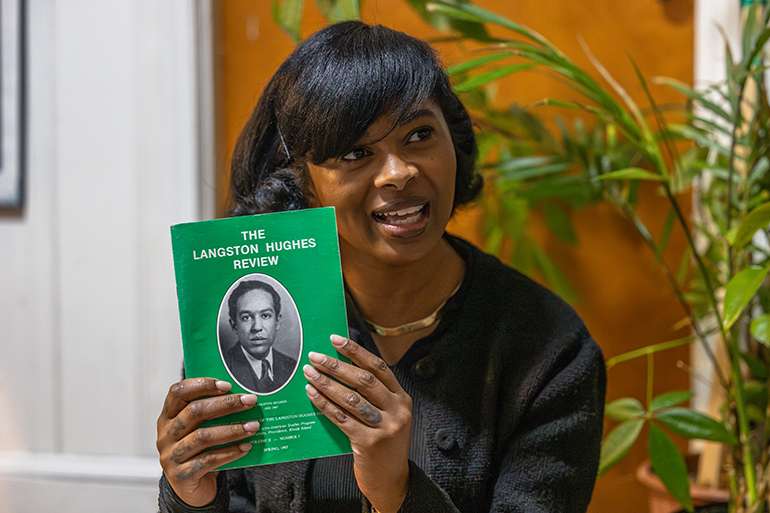
The Langston Hughes Review; Vol. 2, No. 1, Spring 1983
“[Charlotte art collector] Patrick Diamond, I love him to death, when I was a part of The Vault exhibition with the Mint Museum, [motions to her collection] all of this was in the Mint Museum for months. [Patrick Diamond] gifted me this, and I thought it was so cool to have a Langston Hughes Review. But that’s not even the coolest part. It’s from Maya Angelou’s library. When she passed away, [Diamond] was able to go and acquire some statues and he got a few pieces of ephemera, and so he gifted this to me. That’s amazing. It has her actual stamp in it.”
Vibe magazine; September 1993; Snoop Dogg cover
“This is the first ever Vibe. Extremely rare, honey. But also the Jodeci Vibe, August 1995. And these are hometown heroes, so I love that.”
Jet Magazine; December 9, 1965
“This covers the bombing of Kelly Alexander’s Home. That’s local news that made national news.
Read more: Four 1965 Attacks Made Racial Realities in Charlotte Impossible to Ignore
ESSENCE Magazine; September 1971
People don’t know this, one of the founders of ESSENCE Magazine was Gordon Parks. And so these were under his editorial direction. That’s him listed as the editorial director. I got a few of these founding copies.
Honorable mention: The Art of Elizabeth Catlett by Samella Lewis; 1984; signed by Elizabeth Catlett


Great article on Cheryse Terry. Her section of the Mint Museum’s “The Vault” exhibit was memorable: moving, fun (I think of the hair pick collection), surprising, sobering, nostalgic. Cheryse’s passion is evident, but coupled with her energy, discernment, and intelligence…it’s an amazing combination. Kudos to Ryan Pitkin for a great interview. Kudos to Cheryse for her inspiring story and work. Her collection of ephemera really captures moment to moment living that’s almost impossible to recreate through traditional history texts.