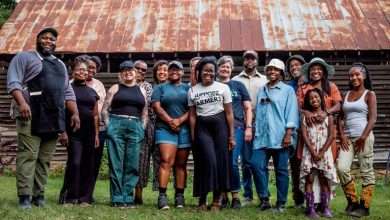
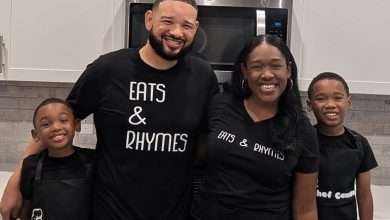
Carolina Farm Trust Marks 10 Years Confronting Food Insecurity
Inaugural dinner promises to be organization's biggest event yet

Looking back now, Zack Wyatt recognizes that he didn’t fully appreciate what it meant to grow up on a 300-acre farm. To him, living on a dairy farm in Northern Virginia was just work: mowing 6 acres every week and taking care of countless animals … all to be sent back to his hometown in Texas every summer to do more work on his great-grandfather’s ranch.
Nowadays, that way of life has been diminished. Around the turn of the millennium, about half of Virginia’s Loudoun County, where Wyatt grew up, comprised agricultural land. Within a decade, it seemed that it had all simply vanished, he recalled.
From 2002 to 2007, Loudoun County saw 13.5% of its farmland erased by development, and the downward trend has continued since.
That was around the time Wyatt moved to Charlotte, which has seen its own farmland dramatically decrease since 2000. He wasn’t here to farm, however, instead trying his hand in the mortgage and IT fields.
After the 2008 financial crisis and an unproductive IT partnership, Wyatt was forced to rethink his future. He had to get on food assistance programs like EBT and SNAP to support his family of seven, an experience that bore a renewed interest in the ways of his upbringing.
“It wasn’t a great time in my life, clearly, but … something kind of triggered … getting back into understanding food systems,” he said. “Once you kind of peel that onion back, it’s pretty horrifying.”
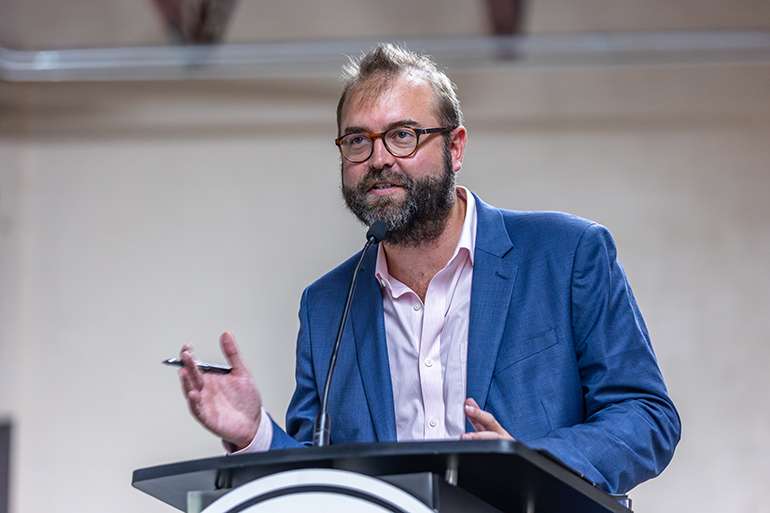
Wyatt started talking with local farmers to understand what the food system had turned into since his childhood and how difficult it was for a farming community to survive today.
“[It] was doubly horrifying,” he said. “It’s not a large leap to basically see the foreshadowing of our future. There’s gotta be a different way.”
Food and agricultural systems run the world, Wyatt said. Our food system is intertwined with climate change, health, social progress and politics. How do you repair 90 years of deteriorating agricultural infrastructure to rebuild a system that benefits farmers and consumers?
In the current food system, there is little an average person can do to make actionable changes, Wyatt admitted. Looking back, he wonders if it was that feeling of powerlessness that set him on the path to found Carolina Farm Trust, an organization dedicated to rebuilding what a regional food system looks like from production to consumption, in 2015.
“[There was] a clear understanding that we really had to go all the way back to really the dirt and start rebuilding a system that actually works for us instead of, more or less, killing us,” he said.
The organization will celebrate its 10th birthday with the inaugural Carolina Farm Feast, a unique farm-to-table fundraiser featuring local produce from the Carolinas, on June 28 at its CFT Market on Hoskins Road in northwest Charlotte.
“This event champions the local economy, providing vital support to chefs, artists, farms and small businesses, fostering economic growth and sustaining the talents that help our community thrive,” reads the event page.
What’s wrong with our food system?
Most people don’t know what a food system is, let alone what’s wrong with it, Wyatt said. He spent his first five years with Carolina Farm Trust educating people on what the current food system looks like and its deficiencies.
“It gets overwhelming really quickly when you start talking [about] it. And it’s also very scary, so there’s a lot of people that just don’t even want to think about it,” Wyatt said.
COVID-19 laid bare the shortcomings of the current food system in America. Grocery stores typically have a two-day turnaround with produce. When the pandemic hit and folks started hoarding food, trucks couldn’t keep up with the demand.
“Seeing the grocery store shelves bare, I think, was very alarming. It gives you a lot of anxiety, because the grocery store offers you a very big illusion of abundance,” Wyatt said. “The current way we do things… there is an expiration date.”
That expiration date is creeping closer. The American Farmland Trust, a nonprofit agricultural conservation organization, released the Farms Under Threat 2040 report in 2022 to project how development and climate change will affect agricultural land if it continues on its current path without smart growth practices.
North Carolina was rated second in projected farm loss nationally behind Texas. According to the report, 11.6% of North Carolina’s agricultural land — nearly 1.2 million acres — will be converted into subdivisions, strip malls and scattered rural housing by 2040.
Listen: Zack Wyatt and Michael Bowling with Carolina Farm Trust (2023)
Land that the American Farmland Trust deems as “Nationally Significant” — or best suited for growing food and crops — is on the decline in North Carolina and elsewhere, but its critical for long-term food security and environmental health. Losing it will affect the country’s ability to maintain a steady food supply in the coming decades.
Food insecurity rates have already been steadily rising across the US, with 100% of counties in the nation home to people facing hunger, according to Feeding America. That organization releases an annual Map the Meal Gap study, launched in 2011 to provide estimates of local food insecurity and food costs in different states and counties.
One in seven North Carolinians face hunger everyday — 438,200 of them being children and teenagers, according to the 2025 study using 2023 data. An estimated 148,940 people in Mecklenburg County alone were reported as food insecure in 2023, a 2.4% increase from 2019.
The conversation around the food system may be overwhelming. It is not, however, hopeless. Over the years, CFT has worked to identify solutions for the issues created by the broken system, beginning with the source: farmers.
How Carolina Farm Trust plans to rebuild the system
Though most people don’t think about the role of farmers in providing every piece of produce they buy at the grocery store, that’s who keeps food on the shelves, Wyatt said.
Loss of farmland could increase drastically in the next 20 years, as 40% of farmland in the US is owned by folks 65 or older, leaving 375 million acres potentially vulnerable to development when it changes hands.
Younger generations don’t show much interest in farming because of its inherent challenges — both physical and financial, said CFT director of development Olivia Horton. Unless you’re inheriting land or resources to get a farm up and running, the startup cost is often insurmountable for new farmers interested in the profession.
Without consistent and reliable revenue streams to keep their farms in business, farmers will continue to age out, which is something that should concern everyone, as they are the ones who feed us, Horton said.
CFT supports small, community farmers directly by helping them purchase equipment, lease or purchase land and reach wholesale and individual customers through marketing campaigns, according to the organization’s website. It also supports the next generation of farmers through farm apprenticeships and volunteer positions on local farms, community gardens and land within the CFT Farm Network.
Within the current food system, there are two ways for farmers to make money: sell their produce and livestock to wholesale food product suppliers or hawk it at a farmers market.
”Those are two enormous extremes,” Wyatt said. “Farmers markets are amazing but they are not a scalable solution … All it would take was 1-2% of the population to go to the farmers market and [they] would be exhausted.”

Local farmers markets are also typically only held once a week. So where can farmers sell their products the other six days? For years, CFT worked to keep a stable revenue for farmers through its two Urban Farm Network properties, pop-up farmers markets, farmer advocacy and by connecting farmers to new customers.
The model allowed CFT to help cultivate and manage urban farms at the Aldersgate Retirement Community in east Charlotte and Free Spirit Farm in Huntersville, preserving around 34 acres of farmland amid urban expansion, helping folks understand where their food comes from and demonstrating the importance of rural farming communities.
Read more: Carolina Farm Trust Receives $400K Grant for Free Spirit Farm Project (2023)
Still, distribution is everything to farmers. Wyatt wanted to expand on his plan to build an earned revenue model that takes some of the burden off the farmers by creating the infrastructure for a permanent, local food distribution center in which farmers can sell their produce year-round.
“[Farmers] need more than that one day to truly sustain a fully functioning small business,” Horton said. “We don’t want to compete with the farmers markets at all. We want them to stay, we want everyone to enjoy them, and then we want to give everyone else options the other six days of the week.”
Without a brick-and-mortar location, however, building a fixed infrastructure would be difficult, and there wasn’t much hope of finding investors. Much of the funding meant for food security programs was redirected to other COVID-19 initiatives during the pandemic. Wyatt was unsure if his organization could last through 2021.
It was during this precarious time that Wyatt heard word of an available warehouse space in the Thomasboro-Hoskins neighborhood in west Charlotte. He recalled that he almost didn’t want to visit the warehouse and get his hopes up because he had no money to offer.
Stepping into the building in April 2021, however, lit a new fire under Wyatt. The space checked all the boxes of his wish list: a location in west Charlotte, close to I-85 and in a community where the market could become an asset.
Wyatt was honest about his situation and the warehouse owners gracefully accommodated him, taking the building off the market until Wyatt secured a grant with a contact he had at Lowe’s. For the remainder of 2021, Wyatt’s team worked diligently with county staff to design, plan and approve the project.
Read more: Carolina Farm Trust Facility Aims to Fill Void in West Charlotte (2022)
At the time, the American Rescue Plan Act (ARPA) was providing millions in funding for agriculture, specifically farmers and ranchers. CFT was the first project that Mecklenburg County commissioners approved for ARPA funding, which turned out to be a god-send as inflation nearly tripled building costs during its development.
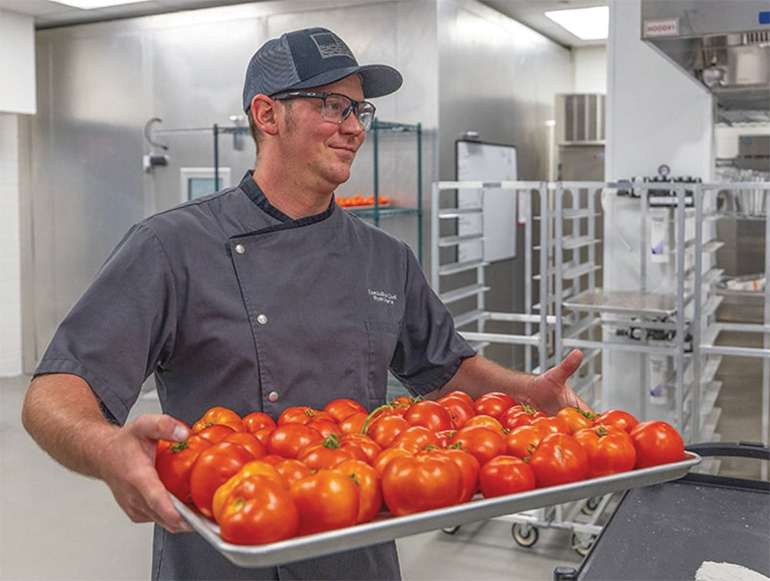
Despite the challenges, phase one of the CFT Market, as the project is called, was completed. Opened in June 2024, CFT Market serves as a local food distribution center with a commercial kitchen to utilize its local produce and proteins.
The market increases accessibility to food grown by local farmers more accessible, keeping it affordable to the surrounding areas with an added benefit of maintaining the nutrient density in products.
An extended supply chain from production to processing to packaging to transportation to distribution severely affects the nutritional value and freshness of the food many people eat from grocery stores, along with the environmental and economic costs associated with foods that travel long distances, Horton said.
CFT Market emphasizes a regional approach to food distribution by buying from farms within the Carolinas. In one year, the market has provided more than $400,000 in revenue to local farmers, Wyatt said. His goal is to double that by the end of this year.
“It’s been really exciting to see just what can be, because when you start talking about [how] we’re going to go try to create a food system that will compete with the industrial food complex, [it’s] pretty scary,” he said.
Answering the call
After Hurricane Helene ripped through western North Carolina in September 2024, the World Central Kitchen reached out to CFT to deliver 1,500 hot meals to the Boone area in a two-day timeframe. Over the month of October, CFT delivered 23,269 meals to hurricane victims.
”That triggered, again, just like how important [and] what that facility really means,” Wyatt said.
CFT has also worked to address food insecurity and launch senior nutrition initiatives through the county’s community resource center. The organization plans to continue upping its impact with CFT Market’s second phase, which will include a retail grocery store, teaching kitchen, event space and separate meat-processing facility.
CFT will also incorporate a generator in its main building and meat-processing building so it can be an emergency resource center in the event of a natural disaster.
Despite CFT’s local impact and work to rebuild the food system, decisions made on a federal level still affect the organization. The Trump organization’s decision to freeze US Department of Agriculture (USDA) funds in January threatened hundreds of thousands of farmer’s livelihoods. Although the freeze was lifted, the proposed federal budget for Fiscal Year 2026 would still slash nearly $7 billion in USDA funds.
“When the [federal government] is making the cuts they’re making now, it really affects every single funding model in the country and on a global level, too,” Wyatt said.
The cut in funding emphasizes the necessity of the earned revenue model that CFT is building, he said. By ensuring that farming stays profitable, less farmers will age out of the profession and more will continue to produce an abundance of produce and livestock.

When there is an abundance of products, CFT can sell them at a lower price per pound while still ensuring the farmer gets paid properly. This model promotes a regional economic system that prioritizes local and affordable fresh, healthy foods while rewarding the people who provide them for us.
Businesses and nonprofits in Mecklenburg, Lincoln and Union counties have already shown interest in the model to distribute locally grown food to their populations, Wyatt said. CFT hopes to build on and deepen the community’s interest in the market and local farms and products through its upcoming birthday celebration, the Carolina Farm Feast.
A feast for a cause
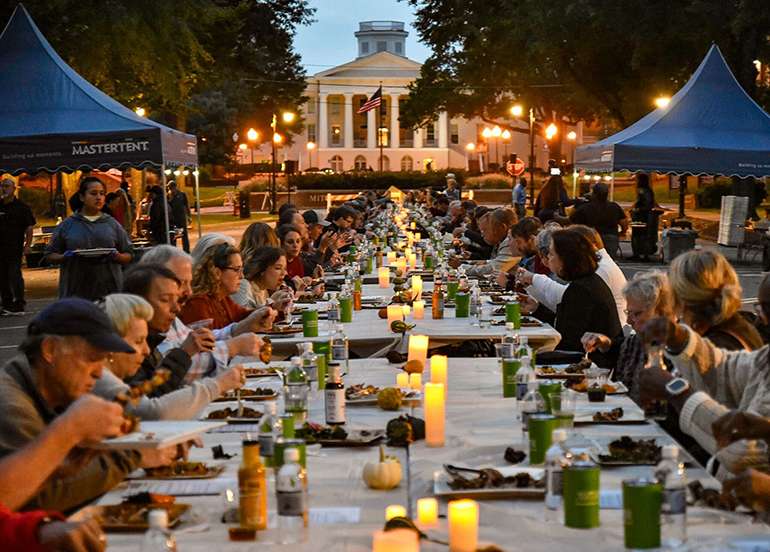
The Carolina Farm Feast, a farm-to-table dinner featuring North Carolina food and art, will be the biggest event hosted at CFT’s new west Charlotte facility since its opening. The organization couldn’t think of a better way to celebrate 10 years of supporting North Carolina agriculture and fresh food accessibility than a big farm-to-table dinner with local art, local music and, of course, local food, Horton said.
”I am absolutely convinced that food has always brought people together,” Wyatt said.
Each of the four courses, made from locally grown products, will tell a story. Attendees will hear about where the ingredients came from, the area that the respective farm is located and its unique connection to CFT.
Horton said organizers are expecting 300 attendees; CFT hopes it will be the biggest farm-to-table dinner they’ve ever seen, and the food won’t be the only highlight.

CFT has partnered with Charlotte arts nonprofit ArtPop Street Gallery on to commission 20 local artists who will create two custom table runners for the banquet tables under the theme, “Why we love North Carolina.”
The runners will be up for bid during a silent auction after the feast.
Guides will also conduct exclusive tours of the facility, giving visitors a look at phase one and a sneak peek at the vision for phase two.
“It’s an awesome reflection point of how long things take to really gain momentum,” he continued. “People were like, ‘You’ve been around for 10 years and this is all where you’re at?’ And I’m like, ‘Hey, I get it. But it took five years just to really get anything going.’”
Wyatt’s team started with one person and a $100,000 budget. They’re now a team of 28 with a multi-million dollar budget. Walmart started with just one store, Wyatt pointed out.
“All these behemoths started somewhere, it’s just a matter of building what we want,” he said. “What I really want people to … walk out of the Carolina Farm Feast is understanding how much power they have. We are the economy … what we spend our money on everyday drives the economy.”
Nearly everyone agrees that a local, healthy food system that is easy to participate in would be invaluable, but folks have to understand that they are the ones who have to invest in it, Wyatt emphasized.
Read more: Deep Roots CPS Farm Builds Network of Urban Farmers (2024)
Horton hopes attendees will be inspired to support their local food economy and understand the importance of agriculture and the effect that it has on our economy, the environment and our health. She wants people to form a connection with the farmers that feed us.
CFT is hoping to duplicate the Carolina Farm Feast year annually, rotating between locations that are significant to the organization and the people involved. Beyond that, Wyatt’s ultimate goal is to implement this new food system locally and use the Charlotte metro area as a proof of concept to later scale into different regions around the country.
“[It’s all about] building trust,” he said, “Not only building trust with our farming communities, building trust with our community as a whole … is going to take a long time and I feel like we’re on a good path.”
And the only way to stay on the path is to make sure we’re all on it together.
The Carolina Farm Feast will take place on June 28 from 6-9 p.m. at CFT Market, 511 S. Hoskins Road. Visit the event page for more info.