
Greensboro’s Triad City Beat Announces Imminent Closure
Biweekly paper served Triad community for over a decade


After 11 years in business, Greensboro-based independent newspaper Triad City Beat is shutting down at the end of the month.
“It is with a heavy but also grateful heart that we are announcing the official closure of Triad City Beat,” wrote managing editor Sayaka Matsuoka on the biweekly newspaper’s website on Jan. 31.
Matsuoka thanked readers for contributions that had helped keep the paper running through the end of February, but added that the financial difficulties facing Triad City Beat were too much to overcome after 11 years of community-centered journalism.
The announcement comes a month after the paper’s executive editor and publisher Brian Clarey resigned in the wake of a devastating car accident that injured him, his wife Jill and their son Ross. Facing massive medical bills and life-changing decisions, Clarey stepped down from the paper he cofounded in 2014 and accepted a position as media relations specialist at UNC-Greensboro.
“Eleven years is an incredible run for a news organization,” says Clarey, who notes that Triad City Beat has never been entirely free of financial concerns throughout its history.
“We almost closed so many different times. We nearly ran out of money so many times,” Clarey says. “But we just kept going.”
This time, however, it’s final.
“[Closing the paper] became inevitable after looking at the finances,” says Matsuoka, who adds that the paper will publish two more issues on Feb. 6 and 20, continuing to update its website throughout the month. After that, the Beat goes dark, though the archives will remain online for posterity.
The staff will host its “Last Anniversary Party” at Scuppernong Books in Greensboro on Friday, Feb. 28 at 6 p.m.

Despite the paper’s looming closure, both Clarey and Matsuoka believe the publication has been a success, covering and telling stories that mattered to readers in the Greensboro, Winston-Salem, and High Point region.
“We are a small independent newspaper; what’s called movement journalism now,” Matsuoka says. “We’ve always had an eye and a sort of fearlessness for telling stories that pushed … the boundaries outside of traditional journalism.”
“We were able to do stories that we thought were important, and there was nobody killing our stories,” Clarey says. “If someone called me and had a problem with something we wrote, I didn’t care, as long as we did our job with diligence and did the right thing.”
Triad City Beat’s uncertain launch, but with clear mission
Triad City Beat’s history is inexorably linked with Queen City Nerve’s, as both publications were launched by staffers who were fired by the same man, Charles Womack, publisher of Triad-area publication Yes! Weekly.
Clarey had spent nine years as managing editor for Yes! Weekly when he came into work on election day 2013 to be unceremoniously fired by Womack.
Five years later, on Halloween 2018, the staff of Womack-published Creative Loafing Charlotte, including Queen City Nerve co-founders Justin LaFrancois and Ryan Pitkin (along with the author of this story), sent their own an election preview issue to the printers only to then be immediately and unceremoniously fired by Womack. We launched our new publication a few weeks later.
After Clarey’s departure from Yes! Weekly, he was joined by two other former staffers, Jordan Green and Eric Ginsburg, who came together to launch Triad City Beat in 2014.
“We raised $49,000 hoping to have twice that much,” Clarey says. “It wasn’t enough [to launch a paper], but we did it anyway.”
Matsuoka joined the paper in 2014 as an editorial intern for five months. She returned in 2018, working her way up to managing editor by 2020. Green and Ginsburg eventually left the paper to pursue new paths.
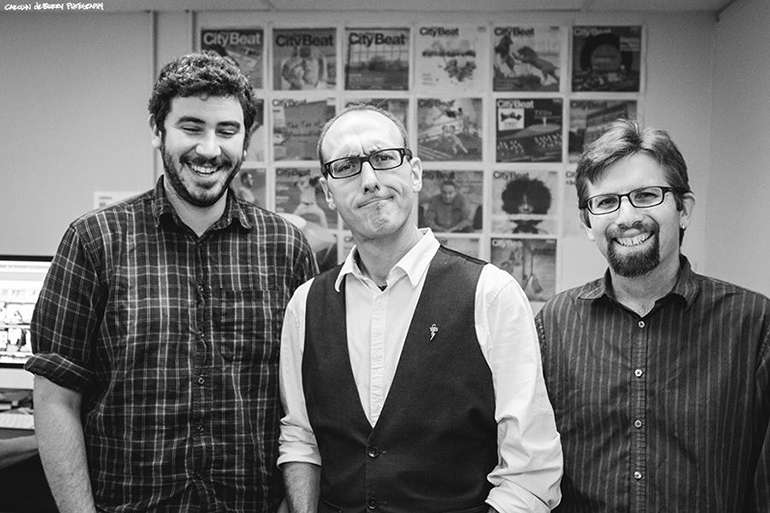
“I’ve written every kind of story you could possibly imagine,” Clarey says, explaining why he stayed with the paper for over a decade. “I’ve been close to so much turmoil; I’ve ridden a knife’s edge on these world events and big decisions. I didn’t get rich or famous, but I got to do some really good work.”
“I stayed because I love the job,” Matsuoka says of her own journey with the Beat. “I loved going out in the community and telling stories.” One of her proudest accomplishments with Triad City Beat came in the 2023 election season, when the paper hosted “reverse town halls.”
“We put voters up on a stage and invited all the candidates to come … and listen to voters, rather than the other way around,” Matsuoka says.
As part of its identity as a “community-first” publication, the paper also presented mobile newsrooms, where community members could meet and question Triad City Beat reporters at local coffee shops.
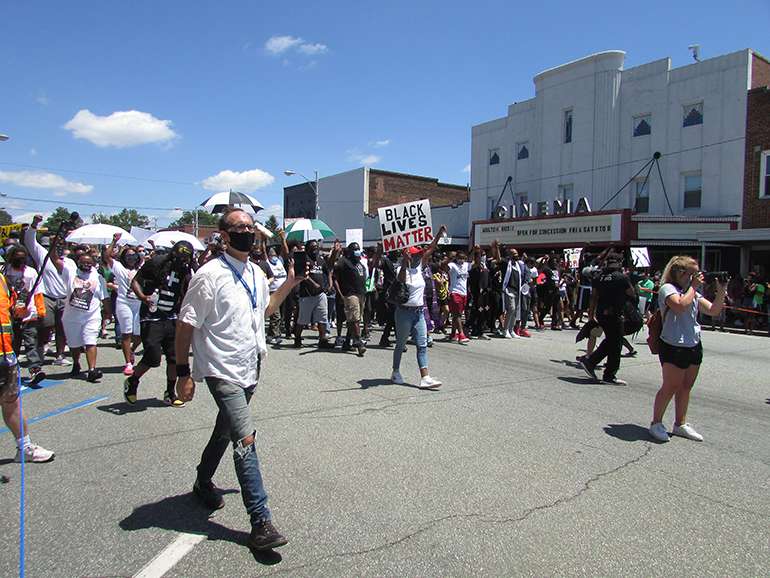
Clarey is proud of the paper’s coverage of what he calls “the racial reckoning” of 2020, when thousands took to the streets to demonstrate for the value of Black lives and against police oppression. Clarey was teargassed covering the story and got local police to admit that they used tear gas on the demonstrators despite their prior denials.
Tough decisions and the end of an era
On Aug. 30, Clarey, his wife Jill and their son Ross were driving to Boston to drop Ross off at college when their car collided with an 18-wheeler in Charlottesville, Virginia. All three family members sustained serious injuries, but Jill Clarey bore the brunt of the crash.
She was hospitalized for months and underwent physical therapy. While still recuperating in the hospital, she asked Clarey for a divorce.
“I’ve been married for 23 years, and for the last 11, I’ve had Triad City Beat,” Clarey says “I was never able to pay myself as much money as I needed to. My wife made more money [and] it was a source of resentment.”
Faced with mounting medical bills and the sudden need to find new housing, Clarey admitted to himself that he had to quit the paper.
“I was T-boned by this truck and it just knocked the fire out of me,” Clarey says. “Even if I didn’t have these financial concerns, I don’t think I have what it takes to do this anymore.”
The accident and Clarey’s departure is not the only reason Triad City Beat is going away, Matsuoka insists.
“The paper has always been a financially unsustainable venture that has only been able to run on the passion, goodwill and generosity of the people who have worked here,” she maintains.
Despite the lights going out at Triad City Beat, Matsuoka insists that independent journalism will continue in local communities.
“A shift started happening during COVID and the racial reckoning of 2020,” Matsuoka says. “People started to realize that local politics has more of a direct and immediate impact on their lives than national politics, and local journalism is going to have more of an impact than national journalism.”
She notes that local journalists are invested in the community in a way that national reporters, who may parachute in to cover a story, are not.
She and Triad City Beat reporter Gale Melcher plan to keep their expertise and skills in the Triad area while continuing reporting in the community.
As someone who has dedicated most of his career to independent journalism, Clarey said he’s frustrated to watch mainstream/legacy/corporate media continue to play the politics of fear, from national outlets contributing to the divisive climate of the day to local networks publishing mug shots.
“Especially now, when corporations have more money than ever, you have to have somebody in the top position who, when an advertiser gets mad about something you wrote, they don’t care, and they’re not going to back down,” he says.
Despite the disappointing ending, Clarey insists that Triad City Beat was worth all the trouble.
“What’s more exciting than when a big story is breaking and you’ve got three reporters following it and running out to get photos?” Clarey says. “There’s nothing else like it. It makes you feel so alive.”



No way I’m too late… I had been trying to figure out why the “Save TCB” links weren’t working. I hope to hear that something new happens for local reporting in Greensboro area. I’ll be here to support.