
OPINION: Transgender Women Need the Support of Fellow Women
A new federal bathroom bill brings back fresh memories in North Carolina

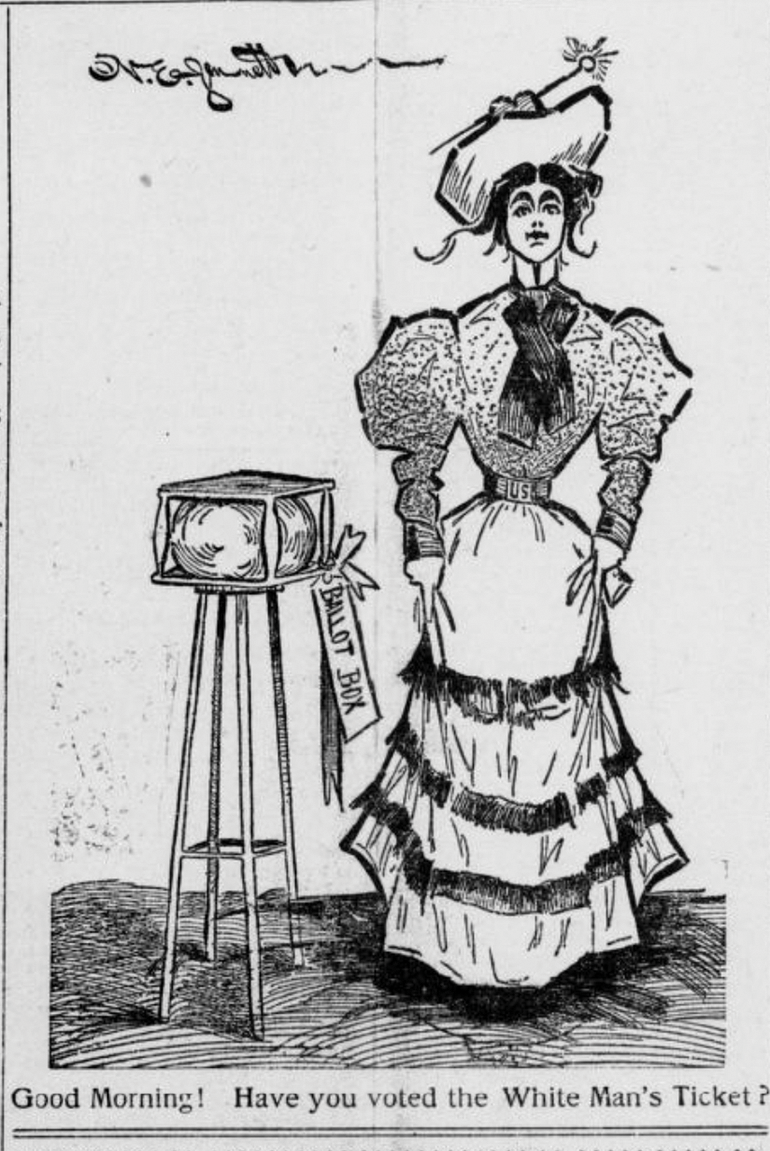
A young woman stands beside a ballot box, sleeves puffed, neck hidden by a high white collar, hat tilted atop her head. She holds up her skirts as though she is about to curtsey and looks straight at the viewer, chin lifted, expectant. Beneath the drawing a caption reads: “Good Morning! Have you voted the white man’s ticket?”
It was Nov. 8, 1898. Election Day. The young woman’s presence on the front page of North Carolina’s most prominent newspaper marked the culmination of a months-long campaign waged by a group of men determined to seize control of state government. They made white supremacy their central theme and argued that their victory was needed to protect white women from Black men.
The “Red Shirts,” as many called themselves, seized on a small number of cases in which white women were in fact assaulted by Black men and publicized them repeatedly in speeches, newspaper articles, rallies and parades. The strategy tapped into deep-seated racial prejudice and sparked fears of a rising tide of violence that campaigners claimed only white men could stop.
Then as now, white women were more likely to be assaulted by white men than those of any other race. The Red Shirts conveniently ignored those statistics. Just before election day, they staged a grand parade in Charlotte. “Proud Caucasians,” one song ran, must defend their women’s “spotless virtue” with “strong and manly arms.”
When they won, they solidified their grip on state power through a bloody coup in Wilmington, through disfranchisement, through half a century of Jim Crow segregation and through ongoing tolerance for lynching and other forms of violent intimidation.
More than a century later, the campaign of presidential candidate Donald Trump struck a similar note, this time casting undocumented men and transgender women as the threats to women.
In mailers, podcasts, television ads and campaign speeches, Trump and his supporters took a handful of assaults and injuries and recounted them over and over, asserting that only a Trump victory could shield the nation’s women — defined primarily as middle-class suburbanites — from an increasingly menacing world.
“I want to protect the women of our country,” Trump told a cheering Wisconsin crowd. “I’m going to do it whether the women like it or not.”
As his words show, this strategy targets women as well as men.
The end of the 19th century and the beginning of the 21st were marked by economic shifts and cultural transformations that included not only racial reconfiguration but also shifting gender roles. A focus on “protecting” women allowed those men who saw themselves as society’s rightful leaders to conduct a double-edged campaign.
Most brazenly, the rhetoric of protection demonized its targets as violent and uncontrollable. Less obviously, it locked women into roles defined by dependence and fragility.
The 21st century has brought a new spin to this old story: targeting transgender women.
Early skirmishes in this campaign involved bathrooms. North Carolina led the way. In 2016, the state legislature passed House Bill 2, known widely as HB2, which required anyone in need of a public bathroom to use one that matched the sex listed on their birth certificate.
The focus was transgender women; allowing transgender women into women’s bathrooms, HB2’s supporters argued, would open the door to sexual assault. “Keep NC Safe,” read signs at pro-HB2 rallies. “No Men in Women’s Bathrooms.”
The recent furor over transgender women on sports teams has added another twist. Opponents of allowing transgender women to compete in women’s sports have argued that these women have an unfair competitive advantage. They have also claimed that transgender players pose a singular physical threat to their female opponents.
As with the white supremacists’ charges of assault, the latter part of this campaign has magnified a small number of athletic injuries, repeating the stories so often that they come to seem inevitable.
One of the most prominent involves a North Carolina high school volleyball player, Payton McNabb, who suffered a concussion when she was hit by a ball spiked by a transgender player. Although hundreds of high school volleyball players suffer concussions every year, McGee’s injury was held up as a reason that transgender athletes should be banned from women’s teams altogether.
“We’ve had one injury,” stated NC Sen. Vickie Sawyer of Mecklenburg County, who sponsored the Fairness in Women’s Sports Act passed by the state’s Republican majority in 2023. “The odds are pretty high.”
Once again, the strategy traps women. It bolsters assumptions of female vulnerability and effectively erases the many tall, strong women playing on teams across the county. As long as women have played sports, especially capable female athletes have had their womanhood called into question — and have even at times been asked to prove it.
The rhetoric of fragility only strengthens far-too-pervasive beliefs about what women cannot and should not do.
Both then and now, some women have actively promoted this rhetoric. Many others have accepted or tolerated it, especially when it meshes with their regional or political affiliation. In 2016, for example, NC Rep. Tricia Cotham, also of Mecklenburg, spoke forcefully against HB2. By 2023, she had switched from the Democratic to the Republican party and said little about the women’s sports act.
A few women, however, have mustered the courage to challenge the status quo within their region or their political party.
In the 1930s, as anti-Black violence raged, a group of white Southern women announced that they were not afraid, and that they had had enough. In what historian Jacquelyn Hall termed a “revolt against chivalry,” more than 10,000 Southern women joined the Association of Southern Women for the Prevention of Lynching (ASWPL).
Members of the ASWPL pointed out that most lynchings did not involve claims of sexual assault and declared that they would not allow men bent on violence “to hide behind their skirts.”
By 1935, nearly 4,000 North Carolina women had joined the association. That spring, leaders of the Charlotte YWCA invited ASWPL president Jessie Daniel Ames to speak in Charlotte.
These women’s stance broke the enabling silence of the South’s white women and underscored the cynical hypocrisy behind the rhetoric of protection. Their courage and conviction made them part of the decades-long struggle for civil rights, in which many different people played many different roles.
Present-day women can follow this example. They might start small — with bathrooms.
In recent weeks, Congressional Republicans led by US Rep. Nancy Mace of South Carolina have pushed for legislation that would ban transgender women from using women’s bathrooms in the Capitol and other federal facilities around the country.
Proponents have claimed the action is needed to “protect” non-transgender users from discomfort or assault. Nearly a dozen states have enacted similar laws. Mace, similar to Cotham, appears to have only recently decided that trans people pose this apparent threat.
Like Southern women critiquing Southern actions, Republican women across the country — including those here in Mecklenburg County — could come together to refute these actions, blunting their party’s advancing anti-trans campaign.
Like the members of the ASWPL, they could announce that they are too strong and too confident to feel threatened by the prospect of transgender women in their bathrooms. Such action, while just one step, would uplift both transgender women and women as a whole.
Pamela Grundy is a North Carolina historian. She authored Queen City Nerve’s publication of Legacy: Three Centuries of Black History in Charlotte, North Carolina, and co-authored the forthcoming second edition of Shattering the Glass: The Remarkable Story of Women’s Basketball.




Ty
I agree completely!! Transgender people make up an incredibly small portion of society, they already suffer why put more on them. They feel they ARE WOMEN so why would they do harm?
If you want to be a woman, with all the disadvantages this world dishes out to us, welcome to the fight.
Great they “feel” like real women. But they aren’t real women and should not be allowed in “women” only spaces such as the locker room or women’s bathrooms. This is only common sense. I am amazed that in today’s culture that is so “pro-woman”
that women can give up their privacy and achievements to men who “feel” like they are women.