New SNAP Eligibility Rules Will Limit Access to Workforce Training Programs
Changes to federal SNAP rules and funding could prevent thousands from accessing job training programs that help people move out of poverty


In fall 2025, after Congress failed to agree on federal funding allocations for the new fiscal year, resulting in the longest government shutdown in U.S. history, the US Department of Agriculture told state Supplemental Nutrition Assistance Program (SNAP) agencies that the government would discontinue allocation of benefits for the program beginning Nov. 1.
Hunger relief organizations and grassroots organizers mobilized, holding food drives and fundraisers to meet the urgent need amidst the crisis. As time passed and the government opened back up, the news cycle moved on, but SNAP remains at risk.
Eligibility changes and funding cuts included in President Donald Trump’s so-called Big Beautiful Bill Act could impact more than 1.4 million North Carolinians who rely on SNAP. While food remains the main benefit to Food and Nutrition Services (FNS), these changes could affect more than meals. Many folks rely on their SNAP eligibility to qualify for other programming funded by North Carolina’s Department of Health and Human Services (DHHS).
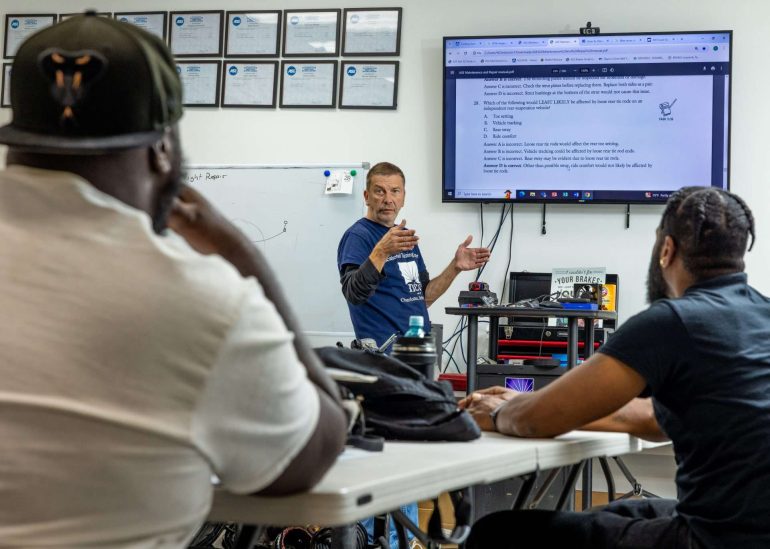
One such program in Charlotte is NCIA’s Vocational Training Center (VTC), which offers career paths into trade industries like automotive maintenance, HVAC/R and commercial transportation.
VTC students must be receiving SNAP benefits, also known as food stamps, in order to qualify for the program, leaving a number of folks ineligible for VTC classes and certifications who would have previously qualified.
VTC HVAC student Casper Pollins pointed out that programming like he’s participated in at the Vocational Training Center is what helps people climb out of a situation where they’re struggling financially.
“NCIA offered me an opportunity to rectify that financial situation by giving me training that I’m taking now so that I can find [better] employment opportunities to put myself in a beneficial position … to further my life financially as well,” he said.
The latest cohort of VTC students, including Pollins, will graduate on March 6. Now, SNAP federal eligibility changes are putting future students at risk of losing their benefits and access to a career path.
The new SNAP eligibility rules, paired with a funding deficit at the NC DHHS, expose two major barriers that will impact countless individuals.
How new SNAP eligibility rules are affecting job-training programs
“Some of those new guidelines, rules and regulations that [the Food and Nutrition Service] has implemented, it is disqualifying … We’re denying people’s food stamp applications and furthermore denying them of being in the program,” said Danielle Ellis, a social worker with the state’s More Than A Job program who works with NCIA.
“[Newly disqualified people] are not able to take the opportunity of a paid training to better themselves and be able to go into the workforce,” she continued.
DHHS is also NCIA’s number one grant funder, Poltawsky said. The money from the state was the reason NCIA was able to establish a VTC in Charlotte.
DHHS only funds certain programs in NCIA according to the SNAP eligibility of the people the organization serves. When the government endured the longest shutdown in US history in October 2025, NCIA footed the bill to continue training DHHS-funded students.
The next cohort of students includes a waitlist of 85 people who want to train for a commercial driver’s license but do not qualify for SNAP, Poltawsky said.
While NCIA is looking to diversify funding so it can accept folks outside of the FNS restraints, DHHS funding remains the only option right now — an unfortunate reality given the new SNAP qualifications.
One of the major changes falls on able-bodied adults without dependents (ABAWDs), which refers to folks aged 18-64 with no children.
With the new regulations, which took effect on Jan. 1, a person is now considered an ABAWD once their youngest child turns 14, the legal working age in North Carolina. This means that even if a family has five children, once the youngest turns 14, the parents or guardians are considered childless under new federal law, Poltawsky said.
The requirements under an ABAWD status are different from somebody without children or children under 14 years old. If a person fills out a SNAP application under ABAWD status, they are required to complete 80 hours of work or training every month and provide evidence of those hours to maintain benefits.
If a person is unemployed or doesn’t provide evidence of those 80 hours for three months, their benefits will be taken away and they will not be able to reapply for another three years.
“I think there’s an element of it that’s trying to discourage people from wanting to apply, period,” Poltawsky said. “And then it’s just cutting the amount of people who are eligible, which then in turn is going to affect our ability to enroll people, because not as many people will qualify.”
Another major barrier is a change in the definition of “homeless.”
“It used to be [that] if you’re in a shelter or you’re on the streets, that’s considered homeless,” Ellis said.
“Homeless is homeless, right? You don’t have your own roof over your head. But now they have set a criteria to what ‘homeless’ looks like.”
Under new regulations, one must be “critically homeless,” meaning physically on the street and not living in a shelter or in their car, to qualify for benefits.
Ellis is already seeing the impact of federal eligibility changes in her everyday work with her clients.
She said that if someone is trying to recertify their SNAP benefits in March and their youngest has turned 14, it completely changes the structure of their whole home. Though FNS sends a pages-long explainer of their new status, many people don’t understand why their benefits are changing or getting revoked.

Some folks find themselves either not compliant with the 80-hour work or training requirements or they haven’t been reporting what they’re doing correctly to the agency. The system then automatically marks them as noncompliant and they either lose their benefits or become ineligible for VTC classes.
That is why Ellis’ work is so important. DSS caseworkers and ABAWD liaisons can walk people through eligibility changes and manually correct automatically closed cases.
Pollins told Queen City Nerve his benefits were paused for a reason outside his knowledge and, had his case manager not been there, he still wouldn’t have any answers as to why.
“I got my case manager and [she’s] a great help,” Pollins said. “They help me out a lot … because most of us was in the dark, just like I am, like ‘Why hasn’t my benefits been restored?’ Most of the stuff I could never do on my own, as far as what they’re doing for me.
“More than just taking a class, it’s really a personal friendship or personal thing between you and … the facilitators there because they really care,” he added.
Why SNAP benefits are linked to workforce development
Formerly known as the National Center for Institutional Alternatives, has connected underserved individuals in the Baltimore area to employment, educational and housing opportunities for 47 years. It began offering services in Charlotte in 2020.
While NCIA started as a criminal justice reform organization, it redirected its programming as time progressed to respond to the needs of the community, launching residential and career programs for people with intellectual disabilities and schooling opportunities for at-risk youth.
As a response to the death of 25-year-old Freddie Gray, who died due to a severe spinal cord injury he suffered while in the custody of Baltimore police after being arrested in a high-poverty area of the city in 2015, NCIA created a VTC in Baltimore to provide workforce resources that could help get folks out of poverty.
VTC students participate in 17-week training modules that are offered three times a year to earn industry-recognized certifications. The center offers half-day schedules so those with current jobs can work while attending class.
“From there, they kind of got into the trades, because there’s also the element that we like to serve people who may have been justice involved,” VTC’s program director Christine Poltawsky said. “We were trying to find things that people could be trained in fairly quickly and turn their life around in a decent amount of time.”
The VTC serves people that not every nonprofit will serve, Poltawsky said. According to the NCIA website, the organization focuses on vocational training, career preparation and employment support to citizens returning from incarceration, veterans, SNAP recipients and recent high school graduates.
The centers also have an employment specialist and case manager on staff to overcome barriers to growth including lack of housing or introductory qualifications to the program such as acquiring a license. The case worker also educates students on financial literacy and creates a budget for newly earned income.
After NCIA co-founder Herbert J. Hoelter visited his daughters in Charlotte, passing through the Charlotte Transit Center across from the Spectrum Center in Uptown during his trip, he recognized a similar need in our city that existed in Baltimore, according to Poltawsky.
The Charlotte VTC opened in 2020 at 517 Blairhill Road. Since its opening, the center has partnered with local organization Roof Above to assist students with housing, graduating and employing 400 individuals with an 80% graduation rate.

The economic impact of SNAP job-training programs
Since NCIA moved to Charlotte in 2020, VTC’s 400 graduates have an employment rate of 70% while the remaining withdrew before NCIA could connect them with an employer, Poltawsky said.
Hiring 400 employees at an average annual salary of $40,000 results in $16 million in total annual earnings flowing directly into the hands of workers in the Charlotte area, she noted.
The earned income then becomes purchasing power spent on essentials like housing, groceries, transportation and entertainment. Because many of these expenses are local, this income stays within the region and supports local shops, services and landlords, Poltawsky said.
That circulation of earnings is what economists call a “multiplier effect,” in which initial government spending leads to a larger national income.
VTC-offered training in trades like HVAC technicians, automotive maintenance and commercial driving are high-demand skills in North Carolina. Restricting access to FNS benefits in turn affects access to employment rates.
“Food stamps [are] essentially good for a lot of people because it brings them into programs like mine that can pay for them to go to training for free, or help them get a job,” Ellis said. “But then they have these new guidelines and rules that’s coming and working against them, that’s hindering them.”

Despite this, Poltawsky believes her position as program director on orientation day is to let the new students know that the VTC is a positive environment.
“There’s a lot of negativity out there,” she said. “I want this to be a place where, when you come in, you shut all that out, you can focus on you, which may have never been the case, and take the time that you need to invest in you,” she said.
”There’s plenty of evidence out there that having work and having purpose really works hand in hand with people’s quality of life,” she added. “I think that we’re definitely contributing to that and I think that if we weren’t here we wouldn’t be able to do that.”
Poltawsky and NCIA are asking the community to make state representatives aware of the importance of funding for workforce training and programming.
NCIA is accepting donations to maintain enrollment for those cut out of FNS eligibility on its website.
For now, however, Pollins is focused on the footwork.
“Now it’s time to go to work, put all the information to work,” he said. “These guys, what they’re doing for me now will rectify the situation and I’ll be okay … [I’m] cleaning up as a result of the records of my past. The main thing [is] that things will … turn around soon if I stay the course.”
Read More: Farmers, Hunger Relief Orgs Call for Budget Passage at Critical Time for NC Families (2025)
Frequently Asked Questions about SNAP eligibility changes
What are the new SNAP work requirements?
The updated rules require able-bodied adults without dependents to complete at least 80 hours of work or training each month to maintain benefits.
How could SNAP changes affect job training programs?
Many workforce training programs require participants to receive SNAP benefits to qualify for funding, meaning eligibility changes could reduce enrollment.
What is an ABAWD under the new SNAP rules?
Under the new rules, adults with children aged 14 or older may now be classified as able-bodied adults without dependents, making it more difficult for them to qualify for SNAP.