Skylar Schock Uses Comedy to Open a Door to Mental Health
Laugh Until You Cry shows provide path to healing


There are any number of groups one might expect to find meeting in a church on a Saturday night — 12-step meetings, Bible study, book clubs, etc. A comedy show is likely to be low on that list.
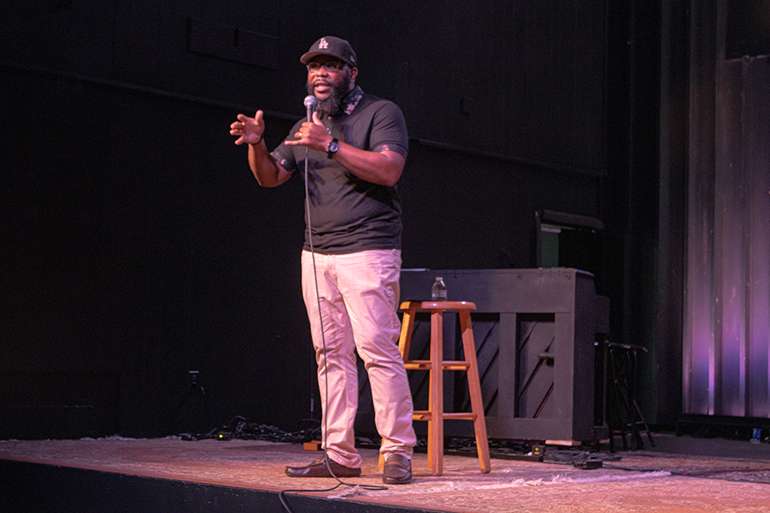
However, down the otherwise empty halls of Watershed Church in southeast Charlotte’s Chantilly neighborhood on May 17, five comics and a psychotherapist came together not as the start of a joke but to connect through comedy more broadly.
Created by Davidon-based comic Skylar Schock, Laugh Until You Cry is a comedy event series that encourages others to delve deeper into discussions about mental health using comedy as the kick-starter to that conversation.
On top of her work in stand-up comedy, Schock is an actress, writer, producer and award-winning filmmaker. Back when she was earning her MFA in performance at University of Nevada, Las Vegas, she never really considered herself a comedian. That’s until she happened to land in a stand-up class.
The final for that class would require her to perform stand-up comedy somewhere on the Las Vegas strip. She started learning about joke structure and writing while performing at open mics to prepare for the looming final exam, and something in her shifted.
“I fell in love with it,” she recalled. “The first time I ever did it, it was the most nervous I’d ever been. Since then I’ve just continued to explore the craft of it.”

After passing her UNLV class, Schock challenged herself to explore a variety of topics within comedy. As she created material for her shows, one idea that intrigued her was a comedic exploration of mental health.
That’s how she launched Laugh Until You Cry, a comedy show that not only sheds light on topics involving mental health from the stage but encourages the audience to create meaningful and open discussions surrounding their own shared personal experiences.
As she crafted the show, Schock found that it is one thing to privately laugh at something alone, but another entirely to laugh with an audience, creating meaningful connections and reminding others that they are not alone in their experiences or struggles.
“Comedy does have a way of connecting people socially,” says Schock. “I think laughing together in person is the best medicine.
“Laughing at home on your phone, at school, or on social media, it’s awesome and great, but sometimes when you laugh by yourself, it can further the feeling of not being understood or you’re just furthering that feeling of isolation or loneliness,” she continued. “When you laugh at a room of people and everyone’s together, that shared experience is created and so it equally just creates a moment of connection.”
Shortly after the show’s debut, Schock received heartbreaking news through a devastating phone call, one that would shift her world. She learned that her sister had been hospitalized after suffering from her own mental health struggles.
Tearfully, Schock began to reflect on the material of her show, recalling one specific joke from three weeks prior that she instantly regretted.
“I had made a joke onstage about my sister’s mental health. I had said something along the lines of … ‘My sister and I see the world completely differently. She thinks I spend too much money, I think she’s mentally unstable.’”
What seemed at the time a harmless joke now felt all too personal, and it ended up creating a divide between Schock and her sister.
“We never had a way to talk about it,” Schock tearfully explained. “She didn’t have a way to bring up this experience that didn’t make her feel ashamed. It breaks my heart. There’s a lot of people who have an experience with mental illness or mental health and they can’t even talk about it because they feel like somehow it’s some mark on them,” she said.
The two didn’t speak for over a year. During that time apart, a remorseful Schock reflected on her own work and the difficulty of discussing mental health topics in a comedic way.
After eventually reconciling with her sister, Schock decided she had to make a change to Laugh Until You Cry. She approached her work on Laugh Until You Cry in an academic way, receiving Special Congressional Recognition for the show in the process.
Through that work, the show turned into something more than a stand-up comedy show; it became a space that created vulnerable yet laughable experiences that opened doors to honest conversations regarding mental health topics.
A Watershed moment for Laugh Until You Cry
Having since moved to the Charlotte suburb of Davidson, Schock’s show at Watershed Church followed the normal agenda of a Laugh Until You Cry show: rotating sets from a diverse range of comedians followed by a moderated talk in which the performers open up about their own experiences with mental health.
Performing alongside Schock were four other local comedians: Craig Collin, Roxanne McDonald, EJ Masicampo and Chris Monds.
The use of stand-up to approach these topics created a vulnerability that allowed others in the room to relate and connect, giving way to honest conversations. It also gives comics an outlet to lightly share personal problems of their own.

“I want to talk about something on stage when it’s bothering me,” says Masicampo, who shared his experiences of being the child of Asian immigrants and a single father.
Working during the day as an associate professor of psychology at Wake Forest University, Masicampo also shared how speaking up about one’s private experiences not only can set someone on the path to healing but empower others in knowing they are not alone.
“We are so used to only talking about the good stuff, being online and only sharing the good stuff,” Masicampo said. “Sadly, it is rare for people to talk about things that aren’t going well and how hard everything is. It’s nice to recognize that you’re not alone in that … We’re in this together and it’s going to be better for each other.”
Kim Honeycutt, a Charlotte-based psychotherapist who moderated the post-show discussion with the performers, has worked in the field for about 30 years. She kicked off the discussion about how stand-up comedy can help open the door to discussing mental health.
“Comedy is such a great way for people to make things proportional and [comedians] take what they’ve been through and make it relatable,” Honeycutt said. “It’s the right size, and it is done in such a beautiful way that it’s about them, and when it’s about you, it automatically can help other people.”
Honeycutt explained that comics are inherently good at tackling touchy topics, as they’ve often worked to develop their own way of doing so — especially if they themselves are currently still working toward their own healing.

“It is not about feeling better or feeling less than. It’s the quality that we find in knowing that all of us struggle,” said Honeycutt. “Everyone has a day that they don’t know if they’re going to get through it. Just do we have permission to show that, to be that vulnerable. This is people being really vulnerable, but doing it in a measured way that’s safe.”
Roxanne McDonald, one of the performers at the Watershed Laugh Until You Cry event, is an addiction specialist who has her own history with alcoholism. Having embraced the darker parts of her past, McDonald now dedicates her craft and her professional work to helping others heal.
“There is a life after dark,” she says. “After experiencing whatever that is, whether it’s a rough patch or mental illness, there is always a bright side. I went from a really dark place to a light that is filled with light and love and passion, and none of those things would have been possible without the types of resources and events like this to be framed.”
Read more: The Comedy Club at Duckworth’s Fills a Gap in the Local Scene
Throughout the night, the show served as a chance for both performers and the audience to bond and create new interpersonal relationships, inviting others to start their own unique journey in healing or simply open up their minds to support those they know who may need help.
As Craig Collin, six-time cancer survivor and keynote speaker at the event, put it, “Focus on the scar, not on the wound.”