SEIU Stands Firm in Calling for City to Improve Pay, Safety at CLT
Officials claim state law ties local lawmakers' hands in passing proposed ordinance

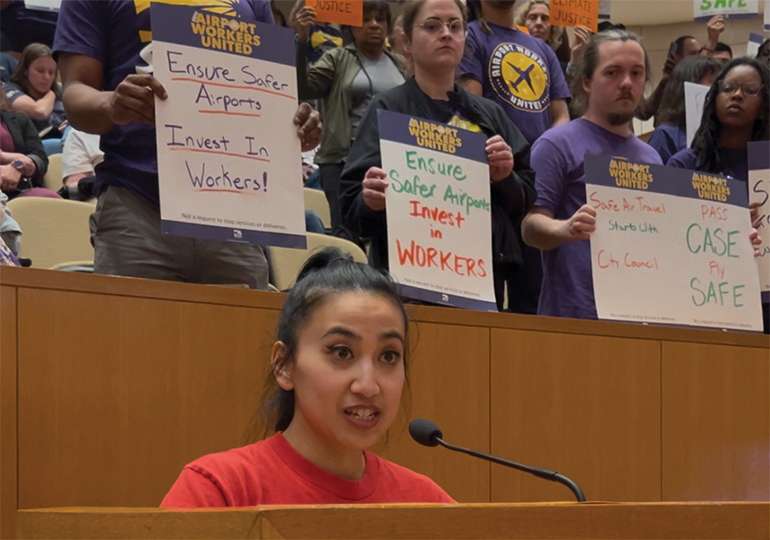
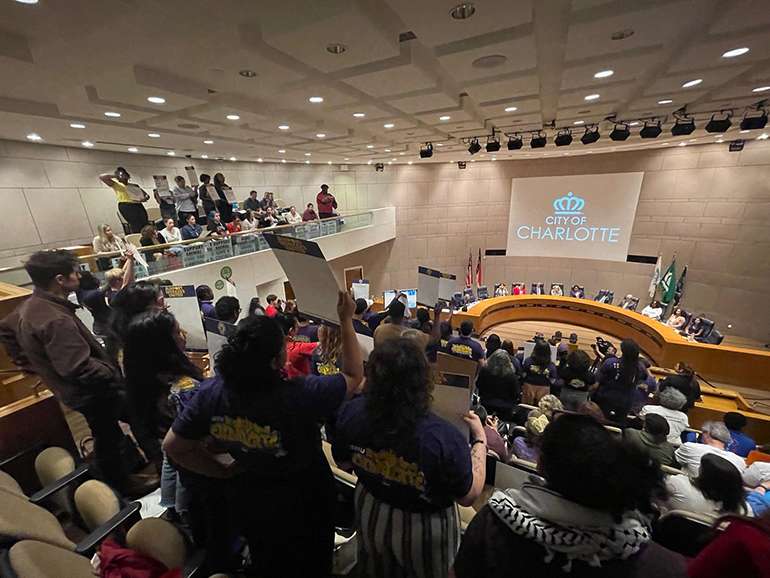
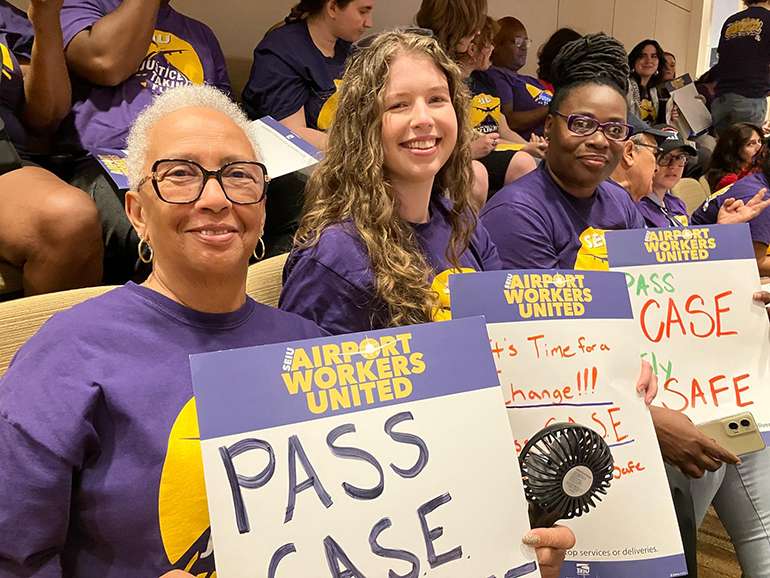
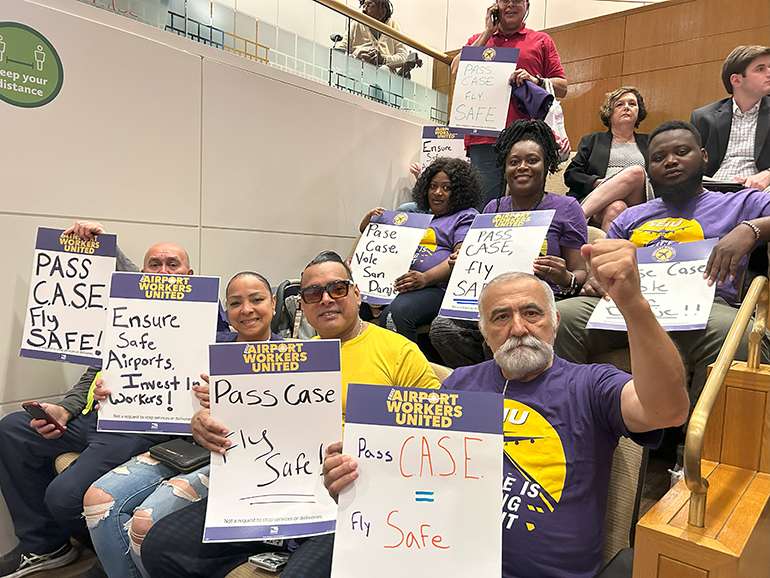
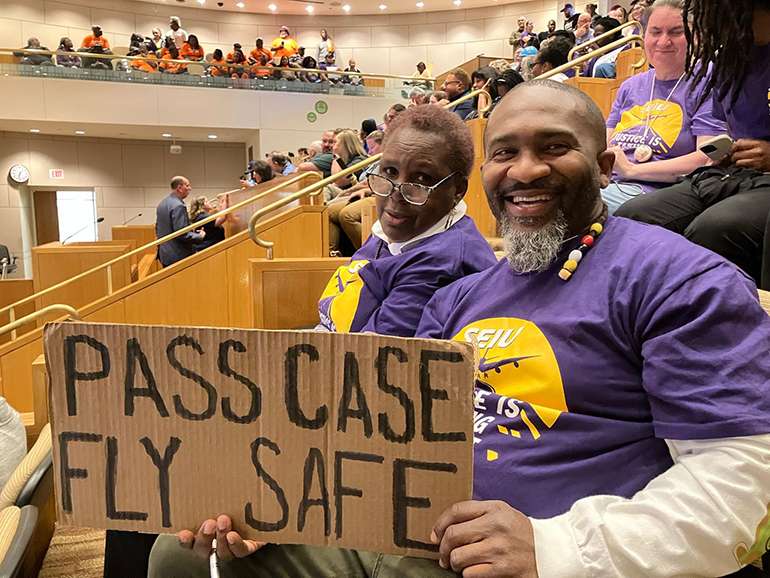
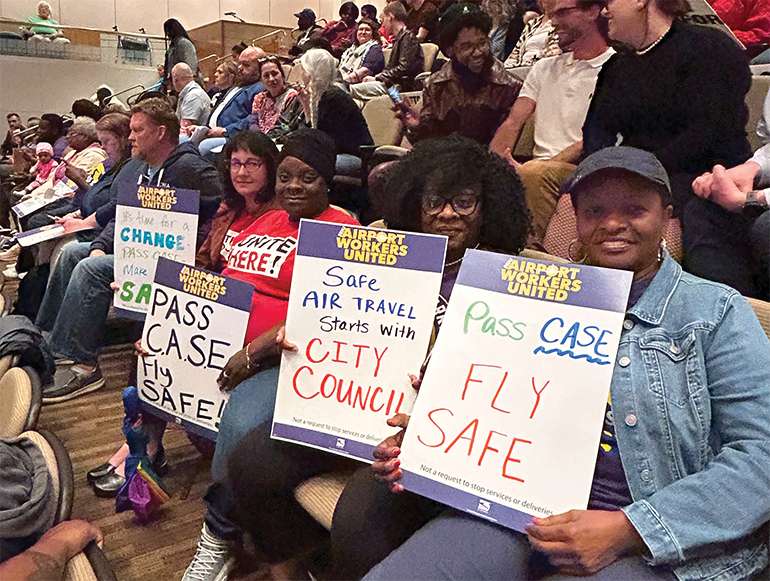
On the evening of May 27, the Charlotte City Council chambers were lined with purple. People wearing SEIU shirts reading “Justice Is Taking Flight” filled the rows of seats, showing their support for an ongoing campaign to increase wages, provide benefits and ensure safety for workers at the Charlotte Douglas International Airport (CLT).
SEIU Local 32BJ represents employees of Prospect and ABM, third-party companies that provide workers to serve as wheelchair attendants, cabin cleaners and provide other services for airlines.
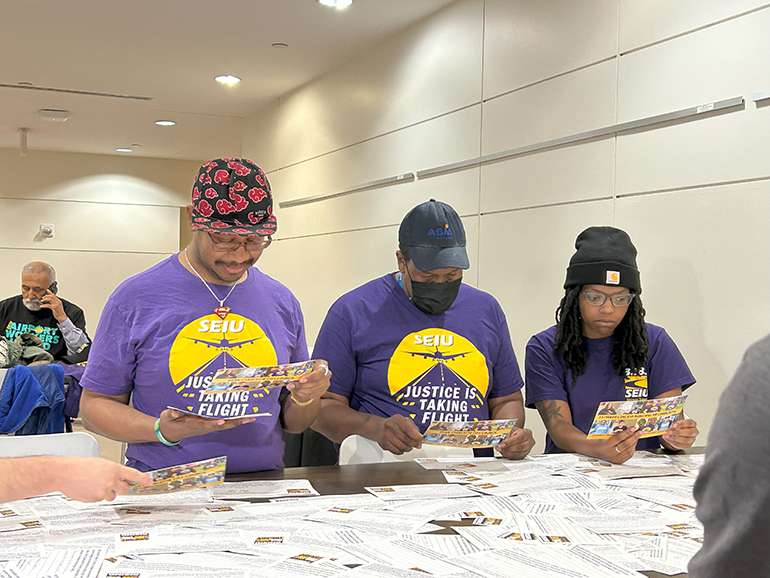
Over the last three months, people from all over the Charlotte region, from organized labor to community advocates, have shown up to support SEIU’s campaign, including machinists from IAM, flight attendants from APFA and CWA, members of the Metrolina Labor Council and the Housing Justice Coalition, and students and faculty from UNC Charlotte and Davidson College.
The crowd at city council’s last meeting in May showed up to support SEIU 32BJ’s proposed ordinance, called the Charlotte Acting for Safety and Efficiency (CASE) ordinance. CASE seeks to address CLT’s high turnover rate and understaffing, which workers say endanger them and passengers.
Over 80% of airport workers surveyed by SEIU reported being hired after 2022. More than half of the workers surveyed reported lacking health insurance, while 44% have run out of money for food. Others have shared experiences of housing precarity and homelessness due to low wages.
The ordinance would set minimum standards for wages, benefits and training for workers employed by companies that the city permits to operate at CLT. Policies similar to CASE have been successful in reducing turnover elsewhere in the country.

San Francisco International Airport adopted the Quality Standards Program in 1999, which similarly required minimum compensation, benefits, and training standards for employees. After wages increased, the turnover rate at the San Francisco Airport decreased by 34%.
However, city officials such as interim city attorney Anthony Fox insist that state law limits them from providing much recourse to airport workers because, though the city does own the airport, the workers in question are not considered city employees.
City claims preemption
At an April city council meeting, Fox stated the city’s position that CASE violates preemption, i.e., the restrictions that North Carolina state law places on municipal law. Fox pointed to two policies: the North Carolina Hour and Wage Act and the North Carolina General Assembly Statute 160A-21, which prohibit any city or town from passing regulations that mandate certain wage levels.
According to Fox, the city simply does not have the authority to pass CASE. “They are wanting you to insert yourself in the employee-employer relationship as it relates to compensation,” he told council, “simply because that relationship exists on property that you own.”
SEIU has requested that Charlotte City Council send its proposal for a new CASE ordinance to the Budget, Governance, and Intergovernmental Relations Committee for an in-depth review.
It was during the final moments of the May 27 business meeting, long after the advocates for airport workers had addressed council during a public forum, that council members Tiawana Brown, Victoria Watlington and Reneé Johnson raised the subject.
Acknowledging Fox’s claims, they asked that the committee review what can be done to ensure the city isn’t allowing companies that mistreat or endanger their employees to operate at the airport. Lyles refused the request.
SEIU’s case for CASE
The SEIU says CASE’s legality rests on the city’s ownership of the airport and thus its responsibility to only allow access to companies who will operate safely.
While state law restricts the ability to mandate a city-wide minimum wage or require wage standards as a condition of contracts, SEIU says the city is not purchasing vendors at the airport.
“The city isn’t buying anything here,” says Ana Tinsley, SEIU’s southern regional communications manager. “It’s acting as a private entity that is selling access to businesses seeking to operate at CLT.”
SEIU organizers say they’re accustomed to hearing the argument of preemption used to justify bad employer practices.
“Preemption is used as a political tool by powerful corporations, like airlines, like American [Airlines] and the politicians they influence,” says Chris Baumann, director for SEIU Workers United Southern Region.
Ismaail Qaiyim, an attorney and leading member of the Housing Justice Coalition, a community-led group advocating for rights protecting people from displacement, has “constantly, constantly come up against the preemption argument,” he says.
Most notably, Charlotte’s primary real estate and developer lobbies claimed preemption in 2021 when the Charlotte Community Benefits Coalition, a coalition of 30 neighborhoods and groups in Charlotte’s crescent, requested that community benefits agreements (CBAs) be considered in the Charlotte 2040 Comprehensive Plan.
CBAs are contracts between developers and neighborhoods that give concessions to communities, such as affordable housing or green space, in exchange for their support on a development.
According to Qaiyim, Charlotte’s real estate lobbies claimed CBAs violated state law.
“The city took more of a back seat and really let the developer lobby be the aggressor in this argument,” he says.
The Community Benefits Coalition did its own research, however, and introduced a legal memo arguing the legitimacy of CBAs. As a result of its efforts, the city incorporated CBAs as a policy goal in the 2040 Comprehensive Plan.
As Qaiyim sees it, preemption is the city’s “go-to line,” and a “frankly lazy, lowest common denominator sort of response.”
The shadow of American Airlines
Rather than an issue of legal technicality, SEIU and its community partners frame the city council’s refusal to put CASE into committee as a matter of political will — a will influenced by corporate interests.
Operating 89% of flights out of Charlotte, American Airlines dominates traffic at CLT. The threat of the airline moving its services is “the ultimate cudgel,” Qaiyim says.
American Airlines lobbyists sit in on city council meetings when they know CASE will be discussed in a public forum, says Baumann.
“We’ve seen the American Airlines lobbyists there. We know that they’re talking on an active basis to the city council members,” he adds.
American Airlines has numerous ties to the government. Since 2007, it has received over $81 million in North Carolina state and local subsidies through tax credits, rebates and grants.
The country’s second-largest airline also relies on the city as a landlord and land use regulator. Despite vocal community opposition, the city has threatened eminent domain and purchased hundreds of parcels to expand the airport’s footprint, and therefore, the number of flights American Airlines flies out of CLT.
American Airlines has “an extremely sweet view,” says Qaiyim, “and they don’t want to give any ground to the community or folks working at the airport.”
When Queen City Nerve reached out to American Airlines for a comment following an April rally by SEIU organizers outside the Charlotte-Mecklenburg Government Center, a spokesperson stated that the airline did not have “authority to comment” on the rally or the proposed ordinance because the workers in question are not team members with or employed by the airline itself.
North Carolina’s reliance on the exploitation of labor
In arguing that CASE violates preemption, Fox reasoned that the purpose of state laws prohibiting minimum wage standards is “to maintain a competitive position in North Carolina for business and industry.”
Dr. Takiyah Harper-Shipman, associate professor and chair of Africana Studies at Davidson College and a scholar of political economy and economic development, reframes the cost of maintaining competitiveness.
North Carolina has historically attracted businesses through the promise of a large, exploitable workforce, Harper-Shipman explains. “Historically, North Carolina has always had this abundance of labor, which it calls its comparative advantage or ‘competitiveness.’”
Harper-Shipman details this history in her book, Unruly Fertility: Race, Development, and Decolonial Reproductive Politics, to be published in 2026 by Stanford University Press.
“Any company, any business, can come to North Carolina, and they can set wages and determine benefits based on competition in the labor market from other firms. If there is little or no competition, those wages are going to be especially low if the primary goal is to extract surplus value, or to generate a profit by putting as little as possible back into maintaining a viable and healthy workforce,” she says. “And North Carolina doesn’t mandate that with laws to protect workers.”
This exploitation is stratified along racial and gender lines. Cleaning cabins and assisting passengers in wheelchairs is “a devalued form of labor, specifically because of who historically has been tasked with doing that: primarily women, and especially Black women, in the US,” says Harper-Shipman.
She adds that, to maintain competitiveness, state and local governments must enshrine anti-worker laws to preserve the exploitability of its large labor force, which it promotes as essential to the state’s economic growth.
In a 2024 report, Oxfam ranked North Carolina the worst state to work in out of 52 states, including DC and Puerto Rico. The state’s $7.25-an-hour minimum wage contributed to the low ranking. Beyond wages, there is no mandated leave or breaks.
“The state doesn’t mandate any type of leave — paternity leave, medical leave, or bereavement — none of that is mandated,” says Harper-Shipman, adding that the state also doesn’t mandate breaks for workers over the age of 16.
When it comes to organizing, rights are close to none, says Harper-Shipman. The government suppresses unions through the so-called “right-to-work” law and public sector collective bargaining is prohibited. Workers who report wage theft are not protected against retaliation and an employer can terminate an employee at any time for any reason barring federally protected discrimination.
In this light, the high turnover rate for CLT’s most straining jobs is not a coincidence but part of North Carolina’s broader economic strategy, says Harper-Shipman. What attracts corporations is “North Carolina auctioning off its population to capital to businesses.”
Read more: Workers Decry Trump Cuts at West Charlotte Town Hall
SEIU organizers say they are regrouping after Lyles’ public refusal to send CASE to committee.
“We feel that the mayor’s action was dictatorial,” says Baumann. “I think we’re seeing a lot of that in this country right now with executive overreach.”
Although the next step for the pro-CASE coalition is unclear, the threat of voting out anti-labor local leaders is on the table.
At May’s City Council meeting, Donielle Prophete, President of CWA 3645, warned, “This is an election year, and we are fully prepared to mobilize our members and the broader Charlotte community to support those who stand with us and vote out those who don’t.”