‘Scrooge in Rouge’ Nicely Rewards the Naughty
Newly renovated Warehouse Performing Arts hosts holiday run

Up in Cornelius, Bob Cratchit still can’t afford new clothes for Tiny Tim and his kiddies as the holiday season approaches. But Ebenezer Scrooge’s downtrodden clerk can take comfort in knowing that the local butcher has been suffering even more.
As he reports to his goodwife Martha, the butcher accidentally backed into a meat grinder and has gotten a little behind in his work. Nor is that the wurst of it. The poor man also fell into an upholstery machine. He’s completely recovered.
Such wince-worthy wordplay rules defiantly throughout Scrooge in Rouge: An English Music Hall Christmas Carol, now playing at the newly renovated Warehouse Performing Arts through Dec. 20. If you’ve seen productions at the nifty Westmoreland Road black box during its infancy, you’ll find the upgraded digs larger and posher upon the venue’s recent reopening.
The lobby is far more capacious, the lavatories far more discreet, and that door along the corridor connecting them very likely opens on a real dressing room. Real estate for the performing space has also doubled, though the black box ambiance remains.
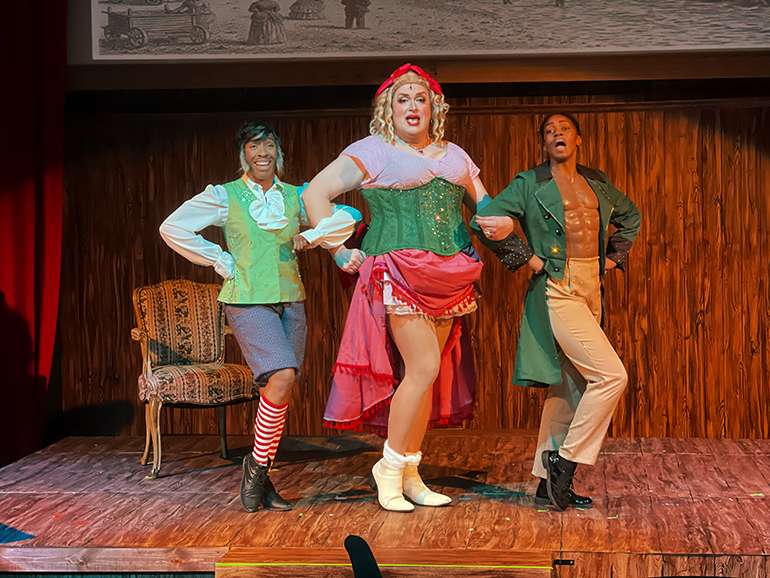
That’s a perfect fit for Scrooge in Rouge, as the 20 roles in this retelling of Charles Dickens’ A Christmas Carol will be played by just three actors, all of whom are obliged to switch costumes and genders on the fly.
Do not think that this creation by Ricky Graham, Jeffrey Roberson and Yvette Hargis, with music by Jefferson Turner, is some kind of fresh British import. Truth is, the wicked bonbon premiered at a New Orleans cabaret back in 2007.
Aside from liberal substitutions of “me” for “my” and maybe a dozen dropped aitches, Anglo idioms and accents are hardly an obstacle.
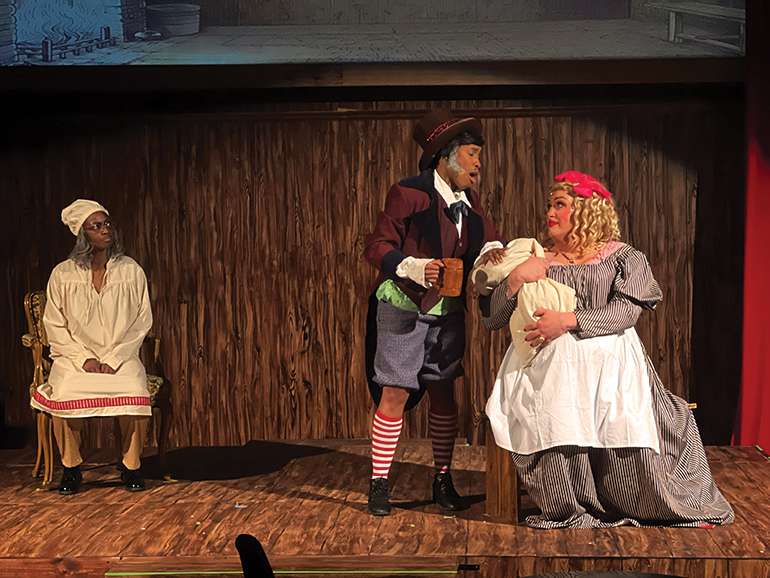
Meredith Magoun’s costume designs hearken back to the same Victorian Era usually depicted wherever Dickens is staged, but we must report that some of the women’s wear is irreverently tinged with burlesque or vaudeville — and that Scrooge’s pathologically cheerful nephew Fred has a decidedly green and Celtic strain.
Lucky Charms? Irish Spring? Keebler Cookies? The man’s feet only intermittently touch the ground.
With this disfigured costuming, accompanist Alfred da Cappo’s anachronistic electric piano, a desk and a chair for Scrooge, and maybe a dinner table for the lowly Cratchits, there’s plenty of room for scenic designer Chris Tyer’s imagination to roam.
His animated lithographs, projected across the upper upstage wall, remind us of the serenity of old-timey frontispieces that graced the opening pages of leatherbound books back in the days of Dickens, Mark Twain and Louisa May Alcott.
Only the smoke belching out of the London chimneys and the multitude of Thames barges hints at the edginess to come. That begins when an animated Queen Victoria abruptly usurps the cityscape and addresses us, her subjects. We are permitted to applaud.
Supporting players Charlie Schmaltz and Lottie Obbligato, who will do most of the backstage costume changing and nearly all the overacting, introduce our star, world-renowned male impersonator Miss Vesta Verile, who will be our Scrooge.
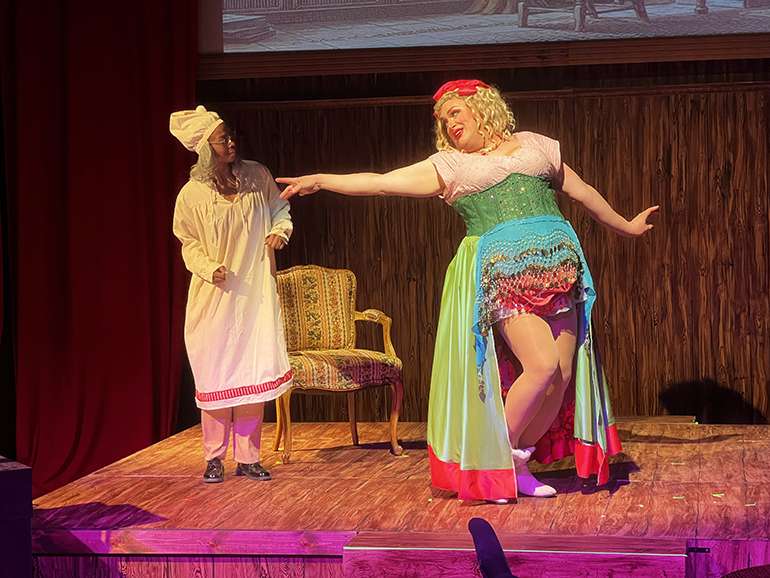
Anchoring this rogue Rouge in its Dickensian soil, Reneé Welsh-Noel gives a surprisingly textured and nuanced account of Ebenezer’s spiritual journey.
Engulfed by the energy and enthusiasm of Nonye Obichere as Mr. Schmaltz and the drag-queen extravagances of Matt Kenyon as Lottie, remaining the steady center of these whirlwinds is quite a feat for Welsh-Noel. Yes, she is greatly helped by some of the most familiar quotes from the sacred text, but Scrooge’s odyssey is rather heartlessly condensed.
Before the full dignity and fearsomeness of Ebenezer’s tight-fistedness can be fully established, Welsh-Noel must navigate Graham’s most willfully tone-deaf lyric for “Bah Humbug,” surely one of the merriest godawful songs ever to earn a reprise in a musical.
The whole ensemble is complicit here, turning Scrooge’s signature putdown into something of an anthem. Compounding his crime, Graham manages to rhyme humbug no less than four times.
Pushing back further against Scrooge’s meanness and reformation, Welsh-Noel serves as director Jessica Zingher’s choreographer. Yes, this is a genuine triple-threat Scrooge, with the acting chops to bring the authentic character back to life amid all the bad puns and freewheeling parody.
You may marvel at how frequently the Ebenezer you know so well is actually standing or pouting or rejoicing before your eyes. Meanwhile, the mirthful bombardment continues almost nonstop thanks to Kenyon’s bustling brass and the extra blandishments Zingher adds to the script’s excesses.
The most memorable of these occurs when we return from intermission and are greeted by an already nonsensical and off-topic excursion to the “Shiny, Briny Sea.” If there’s any excuse for this seaside silliness, it’s the prompt for Kenyon, returning to the plot as the Ghost of Christmas Present — and profoundly ignorant of literary works not written by Oscar Wilde — to mistakenly call Scrooge’s underpaid, overworked clerk Mr. Bob Crabcake.
By this time, as he sashays offstage to transform into the Mrs. Crabcake that the jolly Ghost has just introduced, Kenyon’s irredeemable bawdiness is to be expected. From the opening scene, when Lottie, as a prim Dowager, bursts into Scrooge’s office and calls upon his Yuletide charity, Kenyon’s solicitation becomes a full-scale vamp.
“If you put a little something in my stocking,” the Dowager croons, “I will hold you deeply in a special place!” That’s about mid-level in the mounting eroticism of “You’re Endowed, Mr. Scrooge.”
Read more of Perry Tannenbaum’s theatre reviews here
Saddled with the cheerfulness of Scrooge’s nephew Fred and the usual wimpy forbearance of Mr. Bob, Obichere shines most in her infrequently creepy cameo as Jacob Marley’s Ghost. Of course, Marley draws some of the most memorable lines in A Christmas Carol for Vesta to thunder, most notably, “Mankind should have been my business!”
But a nice quip at the top of her Marley stint and a nifty riff on the prophetic pronouncement that sets up the schedule of Scrooge’s visitations give Obichere opportunities to shine outside her boozy beer-hall song, which is only marginally more solemn than anything Popeye the Sailor ever sang.
The underlying premise of all this madcap scurrying is the sad news we hear in the opening set-up: 17 of the Royal Music Hall Twenty-Member Variety Players slated to perform for us came down with food poisoning at the cast party last night. Charlie was spared because he was out of town, Lottie because she wasn’t invited, and Vesta because she had the good sense not to eat her own cooking.
Midway through Act 2, the absences take their toll at the Cratchits’ — or the Crabcakes’ — hovel when it’s absolutely necessary to have four actors onstage at the same time. Ensconced at the keyboard, Lois Buesser as Alfred flatly turns down the players’ entreaties. After all, she belongs to a union.
What to do, ladies and gentlemen? It’s quite refreshing, when you think about it, to experience real suspense at any version of A Christmas Carol. This Warehouse trifle has it in lighthearted abundance.