Rashaun Rucker Brings the Black Church to UNC Charlotte in Latest Exhibit
Covered in Black | Patron Saints of a Black Boy wraps up Yvonne Bynoe's Southern Black Portraiture series

When Yvonne Bynoe was first commissioned to curate a trio of art exhibits for UNC Charlotte, she thought as much about the end as the beginning.
Having completed two exhibits in her Southern Black Portraiture series, Bynoe is now on the home stretch, wrapping her run of the final exhibit, Covered in Black | Patron Saints of a Black Boy, on June 27. For the renowned Charlotte-based curator, there was no way to tell the story she wanted to tell without including the Black church, and Rashaun Rucker was the perfect artist to help her get that message across.
A North Carolina native now based in Detroit, Rucker’s work connects Christian iconography, Black spirituality and notions of ancestry through a wide range of mediums including photographs, prints, objects and drawings.
“I didn’t find [Rucker’s work] to be the traditional Christian story,” Bynoe said. “I like the whole concept that this was an individual looking at people in their lives — community members, family, friends — as the people who are the prayer circle, the people who are keeping them on the straight and narrow, the people who are helping them to move forward.
“I thought it was both unique and traditional,” she continued, “and I just thought it fit very well with the rest of the story that I was hoping to tell through the various exhibitions.”
Rucker got his start as an artist at North Carolina Central University before relocating to Michigan to earn his Master of Fine Arts in Print Media from the Cranbrook Academy of Art.
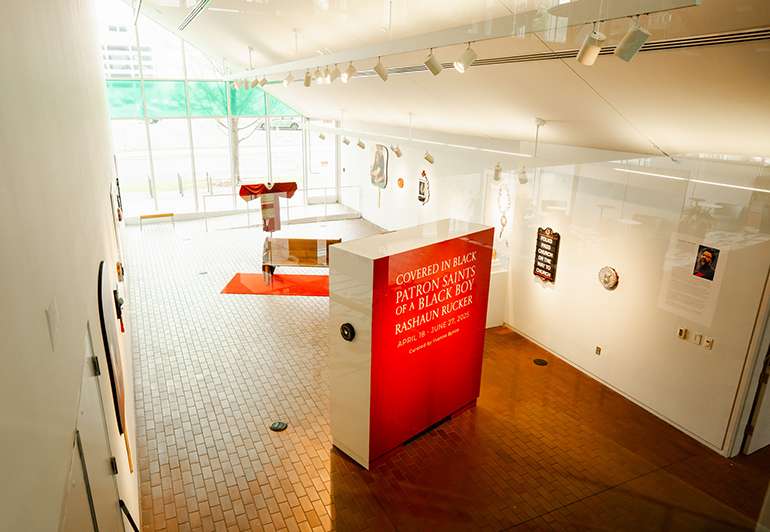
Rucker said many of the pieces included in the exhibit were inspired by the COVID-19 pandemic. He knew of at least a dozen people who died from the virus, which forced him to reflect on who is important within our respective lives.
“The more I started thinking about it, the more I started researching it and reading books and different things about the Black church, about family, about our histories,” he said. “I started thinking more about not just God, but who I see God in.”
Rucker said he doesn’t often get to showcase his work in North Carolina, so finally having the opportunity felt like a homecoming.
“North Carolina made me the artist that I am,” he said. “I owe a great deal to the state and to the people there. I was truly honored to be able to do it with Yvonne.”
We talked to Bynoe and Rucker together for their insight as Covered in Black and the Southern Black portraiture series come to an end.
Queen City Nerve: Yvonne said you can’t really tell the story of the Black Southerner without talking about the church. How did that play into your upbringing?
Rashaun Rucker: I feel like most people in the South, even if you chose a different path, your path started off going to church, especially if you’re a certain age. I’m about to be 48. I feel like if you’re in a certain demographic, you spent quite a large amount of your childhood within the walls of a church.
How heavily would you say that experience influences your exhibit and your pieces?
Rashaun Rucker: Anywhere it’s ever shown in any museum or institution this body of work has been to, I’ve never walked away from it without somebody who was visiting telling me, “I feel like I went to church,” or somebody said, “Hey, I could tell you went to church all your life.”
The iconography is a big part of it, but some of that stuff is pulled from Baptist hymnals and from Bible verses.
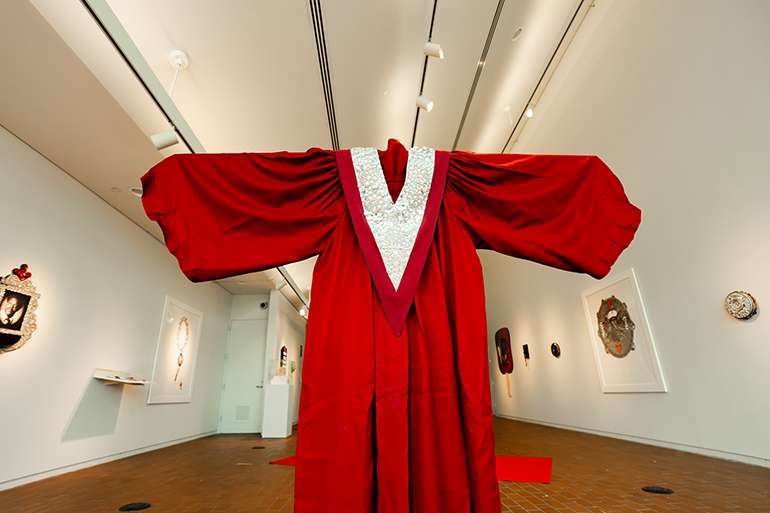
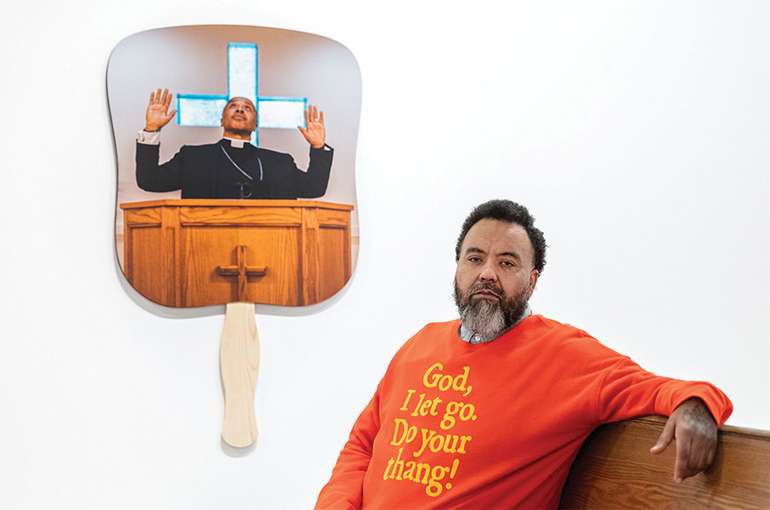
Yvonne Bynoe: In terms of just looking at the whole idea of holy items, relics, it brings it forward with the Black Southern contribution in terms of looking at the oversize church fans. Immediately, when you see that, if you’ve gone anywhere in any vicinity of Black churches or churches congregated by Black people, you’ve seen those church fans.
The fact that he made them so oversized, for me, gave them even more life and even more significance as part of this whole exhibition. For me, I looked at it as we’re expanding the globe and we’re also spanning time when we look at these works.
I thought it was very important, too, what we’re seeing in terms of saints — very often when you talk about saints, it’s usually white people. We’re seeing not only Black people but these are community people. They are the people that you walk and see every day. These are your family members.
The people who have seen the exhibition have talked to me about how it definitely resonates because, even for the people who are not necessarily church or have stopped going to church, they saw the people and how they were presented in these pieces really resonated with attendees.
Why is it important to showcase these depictions?
Rashaun Rucker: One part of it was talking about going through this period of grief during the pandemic. But I also wanted people to see how much I honor the people in my family and how they should be hailed to these types of standards.
I think everybody has a saint in their life and it doesn’t necessarily have anything to do with God — it’s just somebody who’s been there to that level. When I was working in the corporate world, they would say, “Everybody needs a rabbi.” There’s somebody in everybody’s life, that’s why they hold that type of position.
I wanted to show people who these people were in my life and make them bigger than life. That’s why the fans are oversize, the drawings are oversized. Then the things that aren’t oversize, they’re very delicate and well-crafted and put together.
You have to stay there and look at the tambourine because there’s so much going on because you might be looking at one with clip-on earrings from my grandmother and a brooch from my great-grandmother, all these different facets that are in one piece.
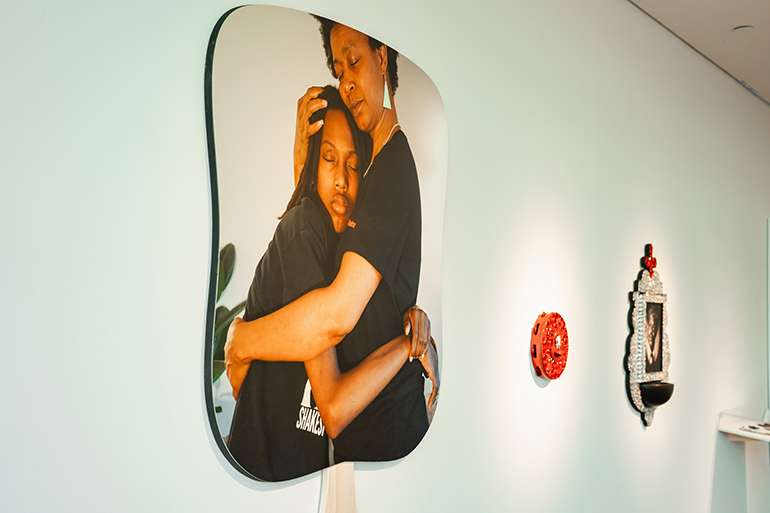
Rashaun Rucker: The work reflects who he is as an artist and as a person. This is family and community. For many Southern Black people and Black people in general, the church is still the central gathering place, even outside of religion. This is where social life happens. This is where you do your choir practice. Yeah, you get your spiritual food, but it’s about family, community first and foremost. I just felt like that’s what most people are getting out of it.
The church part of it is important, but for the people who that’s not their biggest takeaway, they do see the family and they do see the friendships. These are bonds that have been forged through good times and bad times and over years.
This is not like somebody I met yesterday. These are people who have been there and they’ve been through the trenches and they’ve been there through the good times as well.
Yvonne mentioned relics and holy items; how do those factor into your thought process when creating these pieces?
Rashaun Rucker: When I started doing this, I thought about, what would a relic look like for me? What would a contemporary relic be like of a Black person? What is putting you at peace? And that’s what relics would do. Relics back then, they held power and they usually had some piece of that person in it. It might have been a small piece of cloth. Some of those items, like some of the tambourines in my exhibit, have my grandmother’s clip-on earrings in them that she used to wear.
Yvonne Bynoe: Another element of the relic that translates into this exhibition is that they had a healing element. Certainly, if you’re looking at a talisman or something, people had it for protection, but also, a lot of times back in the olden days, you had maybe a piece of bone, you had a piece of cloth of somebody’s or lock of their hair or something. A lot of times people held on to it because they use them for healing. So, the prayer, the healing, the protection, all those things you feel when you’re looking at these various pieces of work.
What do you hope people take from this exhibit?
Rashaun Rucker: When I first started making this, I remember saying that I want people to walk in there and feel like they’ve been hugged. I want it to be warm. There were people walking out of there with tears in their eyes. They said, “This reminds me so much of my big mama. This reminds me so much of my grandad.”
I think I want people to walk away from it and think about who’s worthy in their life to be celebrated, because I don’t think we do that much of that.
You always want to talk about people when they’re gone. Let’s celebrate the people that are still here in a magnificent way. Let’s do that. Let’s think about who holds these spaces for you. I want people to walk out of there and say, “You know what? I need to call my grandma.”
Because there’s all these people that we have that have a major impact on our lives that sometimes when you get older or you get going on your own way, you forget about. My grandmother told me, “You don’t ever have to tell me you love me because you put me in your work.” I can’t ask for much more than that.
And now as you’ve reached the end of this Southern Black portraiture series, Yvonne, what do you hope people took from the work as a whole?
Yvonne Bynoe: I think for me as curating this series, I really feel happy. I felt like I really achieved what I wanted to do and that was to bring some of the best contemporary artists throughout the South here to Charlotte.
Charlotte is positioning itself as a growing art center. To do that, that means you must see what’s beyond Charlotte. In each of the three exhibitions, we saw something different; we saw a different aspect of Black Southerners. These are people telling their own stories, how they felt it should be told.
Read more: Yvonne Bynoe Depicts Black Joy, Everyday Life in How I Got Over (2024)
This is the end of the series but also at the beginning, in my mind, of what can come next for other artists to come here, other curators, other institutions, because we need to see more of it. It’s not so much that everything needs to be light and positive per se, but we need to see a full spectrum of what it looks like to be a Black Southerner. I’m not sure that we always get that.
That’s been my mandate throughout these three exhibitions: to show the full story.