Council Quickies: Mission City Housing Proposal Faces Opposition
Zoning hearings and decisions

Charlotte City Council held its first monthly zoning meeting since returning from the summer recess on Monday night.
Zoning meetings are split into two parts: zoning decisions, in which they vote on whether to approve or deny petitions; and hearings, during which developers are able to present their plans, residents are able to speak in support or opposition, and council members are able to discuss before the decision is scheduled for a later date.
Council on Monday kicked things off with a number of quick decisions before hearing a slate of new petitions. Below, we’ve included some notable examples of both from Monday night’s meeting.
On the Agenda:
- Zoning Decisions
- Mission City Church Towns Hearing
- Other Hearings
What’s next: Charlotte City Council will meet again on Monday, Aug. 25, for a public forum and business meeting.
Zoning Decisions
Council started off Monday night’s meeting by approving a slate of seven zoning decisions with minimal to no discussion on each. Below we’ve included details about each petition taken from the meeting agenda.
Council unanimously approved a petition from DreamKey Partners to build 40 townhomes on 4.4 acres across from the McCrorey YMCA on the east side of Beatties Ford Road.
The development will be part of a workforce housing program, ensuring that at least 30% of the units remain at 80% or less of the area median income for 30 years.
Listen: Nooze Hounds: DreamKey Partners President Julie Porter and Roof Above CEO Liz Clasen-Kelly (2023)
Council unanimously approved the construction of 30 single-family detached, duplex and triplex buildings off of Cleve Brown Road near the Davis Lake neighborhood in north Charlotte.
Council greenlit the development of up to 64 townhomes on Mintworth Avenue off Margaret Wallace Road in southeast Charlotte, with LaWana Mayfield casting the only No vote.
Council approved the construction of up to 90 townhomes on the south side of Mount Holly Road just below the Catawba River crossing, with Mayfield again casting the only No vote.
District rep Malcolm Graham said he was happy with the compromise he was able to come to between residents and developers, though he would’ve liked to have seen more guaranteed homeownership opportunities within the development rather than rentals.
Graham also decried the need for better infrastructure on the state-run roads in the area, pointing out that the same problem exists in other areas of the city such as Steele Creek.
“There is a plan [from the NC Department of Transportation]; it’s about 20 years out and that serves no one any good,” Graham said. “We can’t wait 20 years or 15 years for the state to come and help us out nor should we supplant our local dollars to invest in the maintenance of state-run roads. This will continue to be a point of concern for me.”
Mayfield was also the only council member to vote No on the next two petitions: one that will allow for the renovation of the former Southern Comfort Inn hotel on Tuckaseegee Road into a 125-unit apartment complex and another that will allow for the construction of up to 65 townhomes on Mt Holly-Huntersville Road.
The current restaurant on the former Southern Comfort site, called Love in Action Cafe, will continue to operate as is.
Mission City Church Towns Hearing
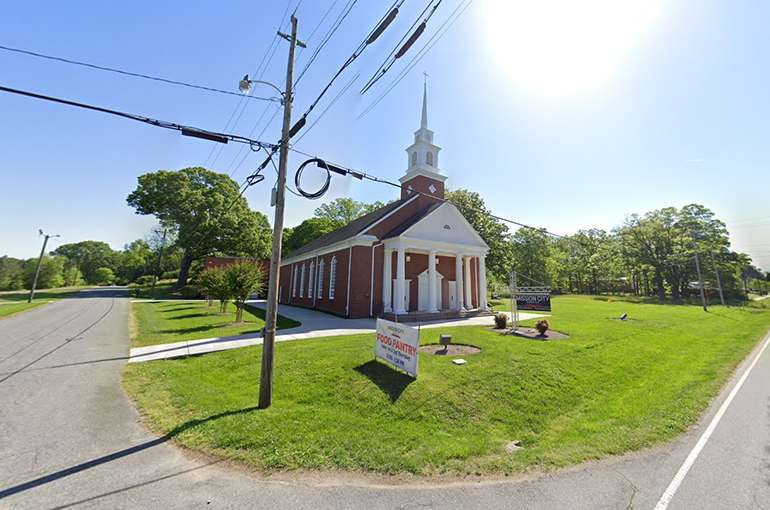
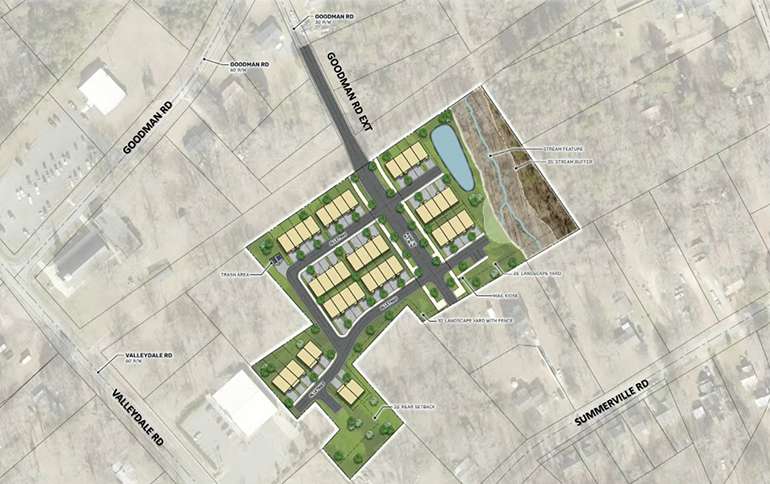
The first zoning hearing of the night was the most discussed, as it brought out the most opposition. Mission City Church is partnering with Freedom Communities in hopes of building 43 townhomes behind the church’s existing property on Valleydale Road at Goodman Road.
The development will feature workforce housing, all of which is guaranteed to remain at 80% or less AMI, with financial literacy classes and other programming offered onsite for residents.
Pastor Kyle Dillard said he and his congregation have been “praying over the land” for years in hopes of building something productive there, adding that there are currently a number of homeless people who live there and his church has been broken eight times over the last decade.
Two neighbors from Goodman Road spoke against the petition. One neighbor whose property adjoins the site claimed she will need to move her driveway if it’s built and pointed out that her home itself is just about a dozen feet from the site.
Bridget Harvey of nearby Oak Street estimated that around 1,500 homes had been added in the area in recent years with no changes to infrastructure.
“If you introduce this to our community, it changes everything,” she said, then went on to claim that people who live in townhomes don’t take as much pride in their property as someone who owns a single-family home.
Dwayne Jordan said his family founded the neighborhood off Valleydale Road and he still owns 12 homes that he rents out on more than 15 acres there, making him the largest property owner on the street. He called on council to deny the petition on the grounds that, “Everything has been single-family dwellings forever,” in the area.
After the opposing neighbors spoke, a representative with Freedom Communities addressed their concerns, stating, “Change is tough, it always is hard. I really respect these folks and the change that comes to their community. People all recognize that the change in our city is happening fast and one of those changes is the affordability of housing and how expensive it is.
“For the greater good of being able to keep residents and make homes available to purchase and give them an opportunity to build their wealth, I hope you consider this.”
Malcolm Graham said he toured the site and called it “problematic.”
“It’s literally a stone’s throw away from the existing homes,” he said. “It’s really about is this the appropriate site and is there an appropriate entry site? I’m a little bit undecided at this point.”
Renee Johnson expressed her own difficulty with the decision, which will come at a later date.
“We need that level of housing in our city, so this would be something that I as a council member would really advocate for and want to see,” she said. “However, as a former realtor and someone who was opposed to the [Unified Development Ordinance] for specific reasons, location does matter … This is important housing, but our current residents are important as well.”
To wrap up the discussion, council member Ed Driggs reminded all those in attendance of the council’s role in these tough decisions.
“We have to look at this through the lens of the pressure that we’re under because of the housing shortage and the desire to create housing, the growth of the city,” he said. “We are often in a difficult situation here because people like you come in and they’re unhappy about the impact of this growth. We cannot entirely prevent that; our job is to minimize that and keep it to a minimum.”
Other Hearings
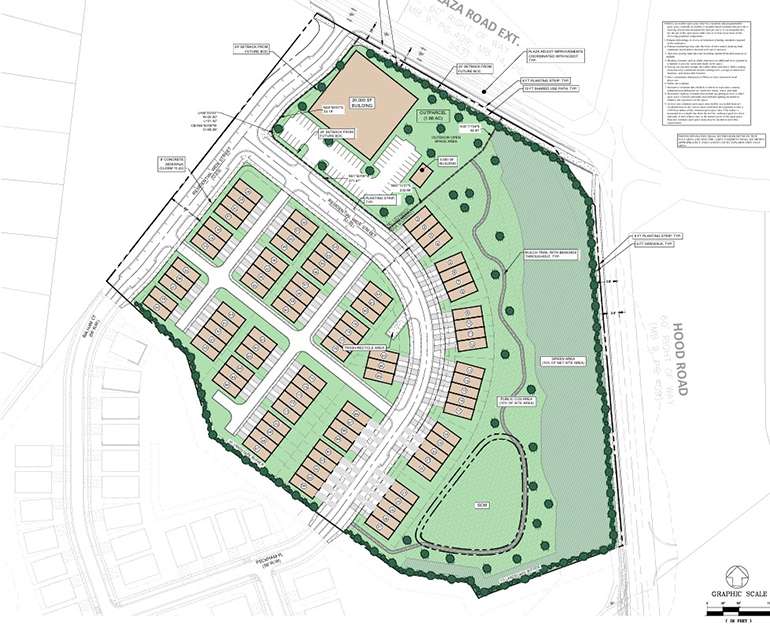
Council on Monday got its first look at a mixed-use petition that would include a 94-unit townhome community at the corner of Plaza Road Extension and Hood Road, plus a 20,000-square-foot health/wellness/athletic facility and an additional 4,500 square feet of retail uses.
One neighbor spoke in opposition, though she brought a petition with 17 signatures. She cited a negative impact for herself and her neighbors if the large-scale development were built due to construction, traffic and other issues.

Representing the developers with Queen City Land, attorney Collin Brown said the idea for the mixed-use portion of the site came as the result of community engagement in which nearby residents asked that some amenities be added to the site in far-east Charlotte where not many exist.
At-large rep Dimple Ajmera, who lives near the site, said she wouldn’t support the petition as it currently is due to a lack of infrastructure that can support so many new families in the area.
District rep Marjorie Molina acknowledged the lack of existing amenities for families already living in the area but also the lack of infrastructure to support more at this moment.
“Council is spending $20 million to put lighting and sidewalks along 5 miles of Harrisburg Road, $73 million to widen and add infrastructure to Robinson Church Road,” she said. “We’re coming as fast as we can afford but there’s still so much to do in that area.”
Developer Bryan Elsey of Manhattan, Kansas, flew in to pitch council on his petition to build a 168-unit apartment building off Tom Hunter Road in the Hidden Valley area of north Charlotte.
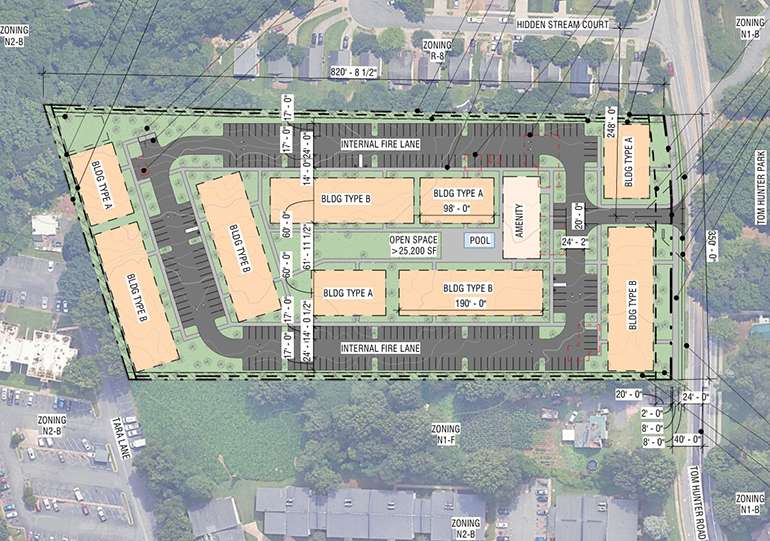
Marjorie Parker, president of Hidden Valley Community Association, showed up to let council know she “strongly opposed” the project.
“Residents know firsthand that adding more apartments without meaningful infrastructure investment will exacerbate traffic dangers, reduce mobility and further limit our quality of life,” Parker said.
She added that the association had asked Elsey to fund a lighted pedestrian crosswalk from the site to Tom Hunter Park across the street with push buttons as part of the project. They also want to see a full traffic analysis, not mandated by the city for a project this size, and the addition of another entrance and exit to the development to help quell traffic congestion.
“Hidden Valley has long borne the brunt of systemic neglect,” she said. “We’re getting some attention now and I’m happy for that … [but] the lack of infrastructure investment has left our neighborhood vulnerable to traffic hazards and safety risks.”
For his part, Elsey cited the critical need for more affordable housing. He said he visited two adjacent affordable housing developments within a two-minute drive of the site and found that both had waiting lists.
He agreed to contribute funding for a lighted, push-button pedestrian signal but would not take on the cost himself.
“With the additional children and the children already there, it’s prime for a potential accident to happen,” said district rep Dante Anderson. “This is potentially a lot of families being added to a neighborhood, so if we’re going to do it we need to make sure that it’s done right and built into the fabric and context of what the neighbors would like.”