Gantt Center Hosts Mario Moore Exhibit on the Elusiveness of Homeownership
In Pursuit of Home opens Jan. 16 and runs through April 26

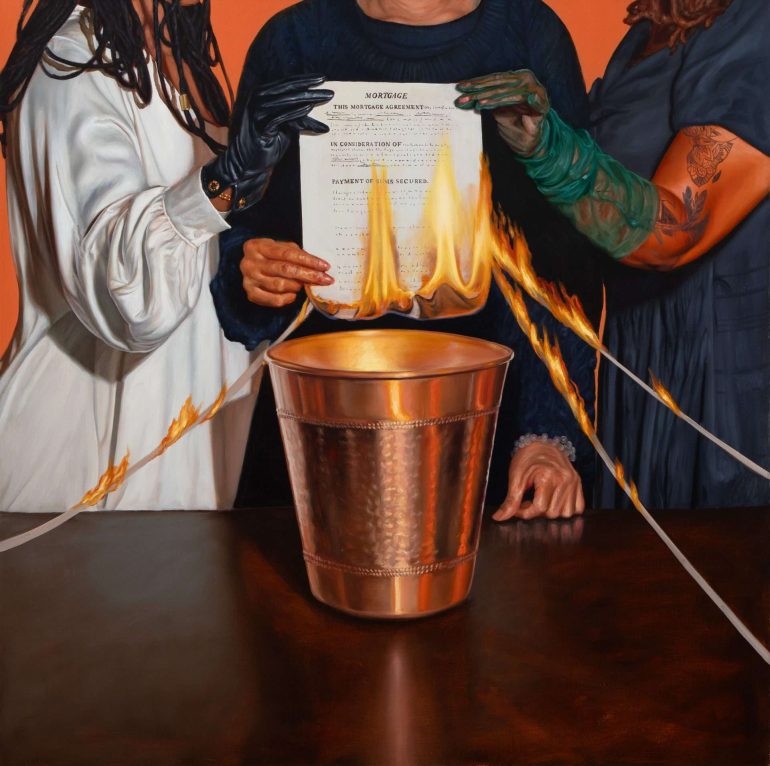
In his painting “Mortgage Burning,” Mario Moore captures an unusual and increasingly rare ceremony. Three Black women firmly hold a document that’s been set ablaze. The flames, licking the curling black edges of the paper, draw our eyes upward to reveal that it’s a mortgage being incinerated above a brass bucket.
The painting seems to depict a magical spell, but it’s really a ceremony once customary in Black American communities.
“A large section of the Black community used to have mortgage burnings after they made that last payment,” Moore says. “It’s something that seems so foreign to me because I never heard of it. It feels like a fantasy when it shouldn’t be.”
The painting is mysterious because of its unorthodox framing. The women’s heads are out of frame because Moore wants the viewer to decide who they are. Are they strangers? Your parents? Yourself?
“Mortgage Burning” is one of 15 artworks including sculptures, drawings and Moore’s signature storytelling oil paintings that comprise the Detroit-based artist’s latest show, In Pursuit of Home, which debuts at the Harvey B. Gantt Center for African-American Arts + Culture this month.
The museum’s opening day celebration of In Pursuit of Home features a discussion with Moore and the exhibit’s curator Dexter Wimberly at the Gantt at 6 p.m. on Jan. 16.
Learn More: ‘In Pursuit of Home’ Opening Celebration & Artist Talk at the Harvey B. Gantt Canter
The show examines Americans’ desire to own their own homes and the security, generational wealth and sense of identity that ownership is presumed to bring.
“This idea of an American dream is centered on land, on creating your own space,” Moore says.
The exhibit’s artworks juxtapose those urges for a home with the increasing unattainability of homeownership. When Moore approached Wimberly with his idea for In Pursuit of Home, the curator, a Black American who has lived in Japan since 2020, was immediately intrigued.
“The spark for this exhibition came from recognizing that the American dream of homeownership, already mythological for many, has become particularly unattainable for younger generations facing unprecedented economic barriers,” Wimberly wrote in an email.
Acquisitions of single-family houses in bulk by corporations, which then convert them into rentals, have helped fuel a rise in housing prices that has turned the American dream into a myth. Faced with additional barriers like stagnating wages, onerous student loans, rising rent and grocery prices and skyrocketing health insurance costs, people in their twenties and thirties have come to realize that attaining a home is indistinguishable from fantasy.
This situation is untenable for everyone. Historically, however, it has been far worse for Black Americans — and for much longer.
“For Black Americans, this isn’t a new crisis; it’s the latest chapter in a deliberate, centuries-long exclusion from the primary mechanism of wealth-building in this country,” Wimberly said.
Citing redlining, predatory lending, so-called urban renewal policies and the 2008 foreclosure crisis that disproportionately devastated Black families, he noted that Black people have been structurally, systematically and intentionally denied access to homeownership.
Moore says there is yet another layer interwoven into the fabric of the exhibit, one that may be imprinted in humanity’s psyche.
“A lot of [the exhibit] deals with not just homeownership or land ownership but also this idea of searching for your place,” Moore offers. “It’s something we’re all looking for, whether it’s an apartment, a country, a state, a city or a job. The idea of looking for a place to exist is really what this show is about.”
Looking for a place to belong is as much an experience as it is a physical thing, he says.
Moore tells complex stories through Black history
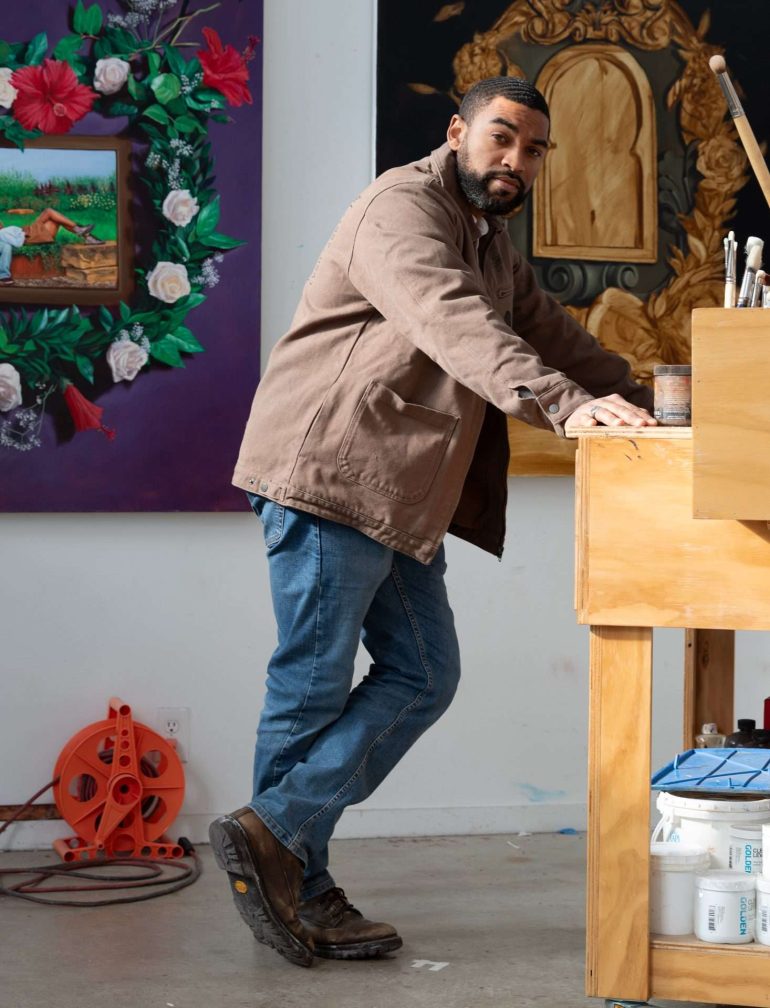
Given the complex entwining of land, labor, economics, myth and history in In Pursuit of Home, there may be no better artist to tackle its themes than Moore. His immersive compositions couple figurative realism with folklore, history with the here and now, and sweeping movements and themes with the personal and specific.
He cites the social realism of Diego Rivera murals he saw on childhood trips to the Detroit Institute of Arts as an inspiration, along with the narrative paintings on Renaissance masters he encountered on a trip to the Louvre in Paris.
Moore’s focus on history is often informed by what he calls “previously unacknowledged Black history.” For instance, the story of his great-great-great-great-uncle Thomas Moore, an enslaved man who subsequently joined the Union Army in the Civil War, prompts troubling questions.
“How do you situate yourself in a country that, historically speaking, doesn’t want you there?” Moore says.
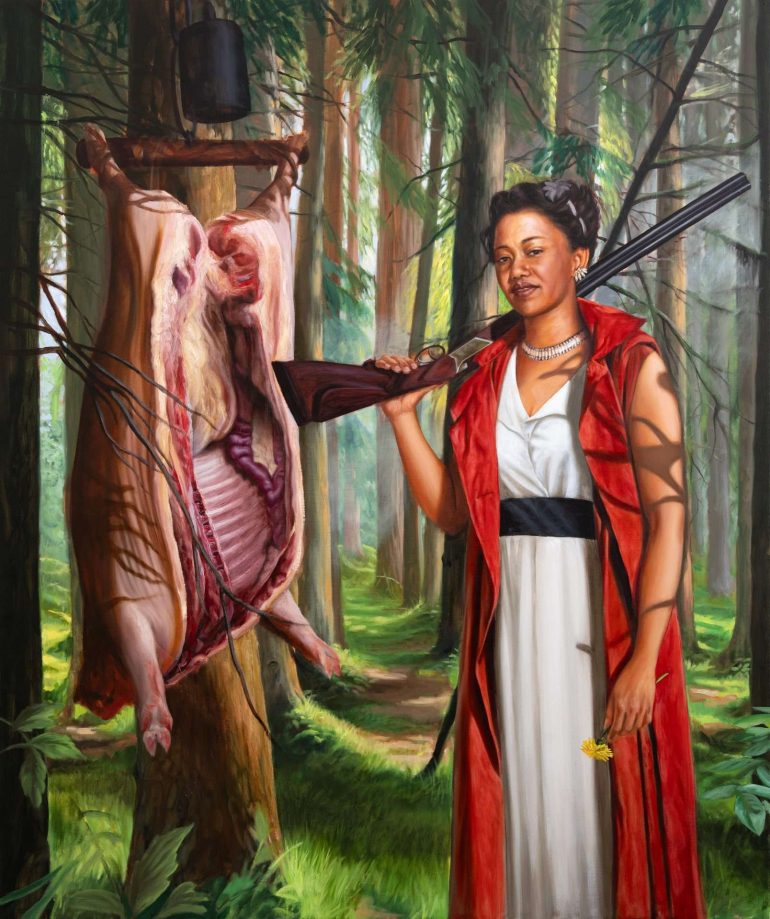
Two paintings in the exhibition draw specifically on Moore’s family history. His great-grandmother on his maternal side is depicted in “Doll in the Wilderness” while “The Patron Saint of Urban Farming” pays tribute to his wife Danielle’s grandfather.
But history is rarely straightforward in Moore’s art. It often intrudes unbidden into the present.
“There’s moments of the past in my work that seem to come out of nowhere. There are elements of imagination within the work, something that is fantastical or out of place,” he says.
Wimberly lauds Moore’s facility for depicting everyday aspects of Black life with dignity and detail.
“He paints leisure, rest, domesticity and contemplation as worthy subjects, which is itself a radical act in a culture that has historically either ignored Black interiority or reduced it to trauma,” Wimberly said.
“I mainly paint people and places in a way that the majority of the public can understand,” Moore offers. “It’s like going to a movie theater or going to see a play. I want you to feel as if the figures within the work can step out and talk to you, or that you can step into the painting.”
Art runs in Moore’s family
“I grew up in a household filled with art,” Moore says.
His mother, Sabrina Nelson, is an accomplished painter and educator while his father, Kris Moore, supported Mario’s interest in the arts. Urged by his father to learn to paint with oils, a teenaged Mario approached his mother’s friend Richard Lewis for lessons.
Lewis, a renowned figurative painter whose work explores the complexity of Black interior life, must have liked the bold high school sophomore, because he agreed. At the same time, Mario started attending protests and marches with his grandmother Helen Moore, an education activist. He credits those activities with spurring his interest in history.
“It felt like I was living in historical moments,” he says.
Mario’s mother is also an admissions counselor for Detroit’s College for Creative Studies (CCS), but that’s not the reason he attended the prestigious private art school. Instead, he was seeking a challenge, and thought he could find it majoring in illustration at CCS.
There he studied anatomy, sculpture and drawing, graduating with a Bachelor of Fine Arts in 2009. Though he chose not to pursue a career in illustration, Moore says the program gave him the tools he needed to create the art he wanted to make.
From 2011-13, Moore attended Yale University, where he earned a Master of Fine Arts in painting. While attending Yale, he met Wimberly, who had transitioned to the art world after co-founding and running the marketing agency August Bishop from 1995-2008.
After graduating from Yale, Moore moved to New York City and entered the city’s bustling art world. In July 2017, he suffered a seizure and underwent brain surgery the following month. As he recovered, Moore was unsure if he had retained his artistic ability.
When a good friend gifted him a sketch book, he at first declined to draw anything, fearful for what it would mean to confirm he had lost his talent. A few days later, Moore started sketching Danielle, then his girlfriend, and realized he still had the capability to produce art.
“It made me appreciate life — family, love and human experiences,” Moore says.

While recuperating, he completed his first work post-surgery piece, “Can’t the New Negro Relax” The self-portrait, which appears in In Pursuit of Home, depicts the artist resting on a couch in front of a picture of boxer Jack Johnson.
In 1910, at the height of the Jim Crow era, Johnson became the first Black world heavyweight boxing champion. He was seen at the time as the exemplar of the New Negro, a tough Black man who would not bow down to white racists.
“Can’t the New Negro Relax” is a silver point drawing, a technique developed in Italy during the Renaissance in which the artist draws on a specially prepared sheet of paper with a piece of silver. Moore liked the softness of the line produced by the technique, which complemented the theme of the piece.
“A lot of times when we talk about Black men in this country, there’s a certain hardness and perception of anger, but I wanted to approach [Black masculinity] with a certain softness,” Moore says.
Bringing ‘In Pursuit of Home’ to Charlotte’s Gantt Center
In 2020, Moore moved back to Detroit, where he and Danielle married in 2021. Moore subsequently bought a home in his hometown, an action that sparked In Pursuit of Home. He started discussing the exhibition with Wimberly, who has organized similar shows in galleries and museums in Charlotte, New York City, Dallas, Berlin, San Francisco, Tokyo and Dubai.
The two men decided that the Gantt Center would be the perfect place to debut the exhibition.
Moore and his work were the focus of a virtual event that Wimberly hosted for the Center in 2020, which included a tour of Moore’s personal studio in Detroit. The museum bought Moore’s painting “Gifts Themselves” in 2022, adding the work to its permanent collection.
Read More: Gantt Center Goes Behind the Scenes with Mario Moore in Latest Virtual Event (2020)
Moore is also acutely aware that the Gantt Center is a stone’s throw from the site of the city’s historic Black neighborhood of Brooklyn, largely demolished in the 1960s and early 1970s by whites who banished Black families from the homes and land that could have granted their descendants generational wealth.
Wimberly has been working with the Gantt Center as a consulting curator for nearly a decade. In recent years, he’s curated three shows at the Gantt: Seeing Stars: Works from the Fischer/Shull Collection of Contemporary Art (2023), Patrick Alston, Post-Traumatism: In Search of Freedom (2023-24), and A Superlative Palette: Contemporary Black Women Artists (2024).
“The Harvey B. Gantt Center represents something essential in the American cultural landscape, an institution committed to preserving, presenting, and interpreting African American art and culture,” Wimberly wrote to Queen City Nerve. “Its position in the American South, a region with its own complex relationship to questions of land, ownership and belonging, made it an ideal location for this project.
“[In Pursuit of Home] ultimately asks visitors to consider home not as a simple consumer good or investment vehicle, but as a fundamental right to self-determination,” he added.
The exhibit will be divided into four sections, or “movements” entitled Interior, Land, Labor, and Longing. Beginning in intimate domestic quarters, visitors will pass into more exposed public areas meant to recontextualize the concept of space. Throughout, Moore’s detailed, lush yet unsettling paintings are designed to raise questions about the vulnerability and instability of home.
Bucolic backyards barely veil the fact that land ownership is never forever. Tactile sculptures inhabit physical spaces while serving reminders that acquiring any object does not mean you’ll possess it for long.
Along the way, visitors will encounter paintings like “The Arrival,” Moore’s self portrait that renders the slightly disgruntled, skeptical artist in a foyer, clutching an unidentified piece of paper.
“It’s what the viewer takes from and adds to a work of art that completes it,” Moore says. “That piece of paper is whatever you want it to be. Everybody has opened up their door and had an envelope handed to them that they’re not too happy about, right?”
“Doll in the Wilderness” depicts Moore’s great-grandmother as a proud, well-dressed woman in a verdant forest. Standing beside a strung-up and gutted animal carcass that Moore says nods to Rembrant’s disturbing 1655 painting, “The Slaughtered Ox,” Doll holds a daisy in one hand and a rifle slung over her shoulder in the other.
“I heard stories that she would hunt and was this really fierce woman,” Moore says. “The idea that this Black woman would be hunting was something that was so foreign in my mind that I needed to see it.”
Historically speaking, Moore is also reminding us that we seldom see paintings depicting Black people in the woods — and certainly not armed with rifles.
“The Patron Saint of Urban Farming” captures a grandfatherly city dweller holding a garden hoe and standing astride a row of collard greens, a traditional staple of Black Southern cuisine. Moore says he wants this figure to be a new kind of archetype, a Black farmer that represents something positive, instead of supporting negative stereotypes of downtrodden, struggling Black sharecroppers.
That said, the exhibit is also set in the context of hopes receding for some in his generation or younger to ever find a home of their own. The painter is 38.
“Everybody is feeling the weight on their wallet in some way,” Moore says. “There’s a level of uncertainty that I think everyone feels across the US. It doesn’t matter what race.”
He believes that people are growing increasingly aware that systems and institutions are only benefiting a few people at the very top, and that the systems in place are not set up to benefit the majority. Whether it’s a perception of revelation, it’s a concept that fuels widespread public demand for affordability.
Moore hopes In Pursuit of Home will prompt people to ask questions about why food, health care and particularly a place to call our own, the basic building blocks for a life of dignity and cornerstones of American mythology, are beyond so many people.
If we’re unable to ask these questions, or to confront the answers they engender, it may mean that for many there really is no place like home.