LaMelo Ball Trade Shocks Fanbase Just as Things Were Looking Up
Team sends star to Minnesota for not much of a return


“Mrs. Lincoln, how was the play?” That was the feeling that permeated throughout the Spectrum Center Thursday as the Charlotte Hornets introduced their two new players from the first round of Tuesday’s NBA Draft.
Nobody cared.
Right after Executive Vice President of Basketball Operations Jeff Peterson introduced the two players and before the questions began, this was the statement given.
“Important to note that at this point, no member of the Hornets organization can comment on any reported transactions or free agency developments until they become official.”
Under the circumstances, trading LaMelo Ball to the Minnesota Timberwolves on the morning of the introductory press conference was questionable timing, and unfortunate for the team’s new rookies, but the trade itself was another thing completely.
I’m not going to compare this trade to the Dallas Mavericks trading Luka Doncic last year, but it brought that same “WTF” feeling when I heard it. Is this real?
Plenty of Hornets fans were up in arms on Thursday on social media and throughout the city, but it’s not something that will lead to the firing of Peterson or anyone else, for that matter. It’s just one of those things I do not understand. So let’s dig in.
Trading Ball at his best
News broke Thursday morning that the Hornets had traded Ball and Josh Green to the Minnesota Timberwolves for forward/center Naz Reid, an unprotected first-round draft pick in 2033; first-round pick swaps in 2028, 2029, and 2030; and second-round picks in 2029, 2032, and 2033.
If you’re wondering, “Is that all?” you’re reading my mind. I’ve heard a lot of NBA prognosticators argue that it was a good deal for Charlotte. Let me tell you why they’re wrong.
No matter what you may think of Ball, and I’ve been critical of him here in my coverage for Queen City Nerve for years, he’s inarguably one of the most exciting players in the league. He is coming off a season where he played in the second-most games of his career (72) and helped Charlotte become a team everyone was talking about as a nascent squad with a bright future.
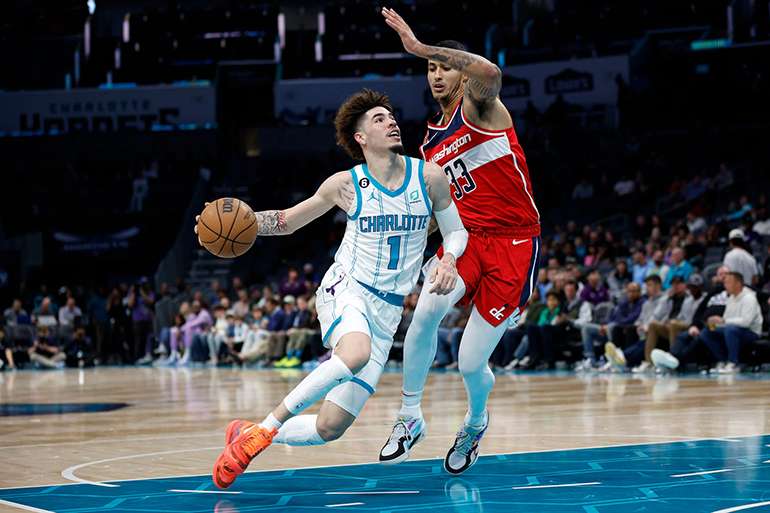
With Ball on the court more in 2025-26, the Hornets offensive rating jumped from 115.0 to 126.1 while the team field goal percentage jumped from 44.1% to 47.2% and 3-point shooting rose from 36.0% to 39.2%.
ESPN’s Shams Charania reported that three teams were interested in Ball — mentioning Toronto and Portland aside from Minnesota. That interest should have resulted in a bidding war for Ball’s services, with the return resulting in a jackpot of assets coming to Charlotte, not a fire sale that overshadowed the introduction of the team’s newest draft picks.
What the Hornets actually got from Minnesota
A lunch-bucket type of player, Naz Reid was generally used as a sixth man by Minnesota. Minnesota originally signed him as a free agent because he wasn’t drafted coming out of college. He plays both ends of the floor and is a player who can contribute to winning, but he’s not a star and doesn’t stand out as the centerpiece of a return for Ball.
But wait, there’s more! The Hornets got an unprotected first round pick in 2033, meaning if the team gets lucky, it could be the first pick in the draft … seven years from now. If you’re a gambler, I wouldn’t bet on that.
They also received three pick swaps with Minnesota, meaning if the Hornets record is better, they can swap spots in the draft. That also means if Minnesota has a better record in a given season, which seems a likely scenario at this time, the Hornets get nothing.
The Hornets also got three second-round picks in the deal. Who knows? Maybe the Hornets get lucky and find a diamond in the rough — a Nikola Jokic or Jalen Brunson — in the second round of one of those future drafts, but that’s a rarity. Of the 750 players drafted in the second round between 2000 and 2025, 16 have played in at least one All-Star Game and 10 made an All-NBA team, according to ESPN Research.
To recap, the Hornets got Reid, one far-out first, three seconds and a lot of wishin-and-hopin’ for the swaps.
That doesn’t sound like a justifiable return to me. Mikel Bridges brought five first-round picks including four unprotected, one unprotected pick swap and some miscellaneous players and a second rounder back from the Knicks two years ago.
About a year ago, Desmond Bane was traded to Orlando for four unprotected draft picks, a pick swap and a couple of serviceable NBA players. There are more examples, but you get the point. In my view, the Hornets got taken!
The discussions we’re not seeing in the front office
Here’s my simple theory on why the Hornets traded Ball for such little return: They don’t trust him. Whether it’s his health, his lack of seriousness or his style of play, something had to be bothering them about him to make this trade at this time.
Trading Ball when they did meant they wanted to get out of a contract that had three years and about $130 million left on it, with Ball being eligible to sign a two-year, $119-million extension in less than two weeks (July 6).
That’s a lot of money for a player who is all too often sitting on the bench in street clothes. Every time he’s on the floor, there’s an injury risk. Charlotte didn’t want to take the chance he would go down again for an extended period, just to watch his value drop while the paychecks kept going out the door.
From a coach’s level, they likely didn’t love his shot selection, because who does? Ball has never seen a shot he doesn’t like. He can be a selfish player and often rests on the defensive side of the ball, though he did put in much more effort the second half of last season.
For one reason or another, they thought the timing was right to move on from him.
There is one other unknown from this deal. The Hornets got a $41-million trade exception as a result of this trade — the largest in NBA history — that they can use for up to one year. A trade exception is generated when a team trades away a player and does not take back an equal amount of salary in return. The value of the exception equals the departing player’s salary.
The exception allows flexibility the Hornets wouldn’t have without it, as they could potentially use the funds to snatch up a disgruntled star who’s demanding a trade elsewhere. If that happens, it could certainly change my perspective on the trade as a whole, but the caveat is that trade exceptions rarely get used.
Where does this leave Charlotte now?
The Hornets entered this offseason on the upswing as one of the most talked about teams in the NBA. The prevailing thought was that they could be one of the best teams in the Eastern Conference in the near future. Now that timeline has changed; they will likely take a step back next year.
Thursday morning also brought news of Coby White’s extension, which, like the trade, is not yet official and wasn’t discussed at the press conference. White reportedly signed a three-year, $74-million contract and will take over as the Hornets new point guard.
White was great in the sixth man role last season, providing a spark off the bench. Making him the starter hurts the team’s depth in the backcourt, and it remains to be seen whether he’s really a point guard. I see him as more of a combo guard who can play the point, and it’s unclear how placing him there full-time is going to affect Brandon Miller, Kon Knueppel, and the center grouping.

Reid will likely take over at power forward or perhaps center, where the Hornets now appear to have a logjam. He’s a good 3-point shooter at 37% from distance over his career, and if he plays more center he could open up the court as the other three centers on the roster don’t have that in their repertoire.
Reid also adds physicality and toughness to this roster; something that has been missing. While I couldn’t ask Peterson about Reid, I did ask how the new draft pick, Hannes Steinbach, would help the Hornets physicality.
Peterson initially addressed their other pick, 6’1” Christian Anderson Jr., stating, “I know he looks kind of slight. I don’t know how much he weighs right now, but he’s physical. He’s not afraid to get in there and he’s scrappy and he’s not afraid to roll up his sleeves and do the work. Hannes, it goes without saying, just his physical presence [makes a difference] as well.”
Read more: Hornets Enter Offseason on Good Footing Despite Play-in Whiplash
I asked head coach Charles Lee if he was considering playing Moussa Diabate at power forward more and how he was going to handle his center rotation.
“I think we have a deep big man rotation. We have great versatility. Those decisions will be made down the road,” he responded.
Regarding Steinbach, Lee said he’s “just looking forward to getting him in the building and getting to work and coming up with a player development plan and trying to figure out what’s the best way to get him acclimated.”
Like Lee, I’m trying to figure out what’s going on. It will be interesting to see if anything else is in the works. Either way, Thursday’s move was a shocker and the reverberations will be felt for seasons to come.