The Religious Aviation Org Nonprofit That Launched a Community in Charlotte’s Backyard
JAARS landed in Union County in 1961 and never left


When Charlotte musician-producer Te’Jani was a kid growing up in Union County he would walk to a nearby airstrip in the morning and watch planes take off bearing translators bound for South America, Africa and the South Pacific.
There were no security gates or fences around the tarmac runway, allowing Te’Jani to sometimes skate the length of the airstrip on his longboard when air traffic was low.
One time, Te’Jani joined a pack of nearly 30 kids on a summer day to play a game of capture the flag along the 3,309-foot-long runway.
“We were all running around in face paint with glow sticks,” he says. “It’s a fun memory.”
Te’jani was playing on property owned by the Christian mission aviation organization JAARS (Jungle Aviation and Relay Service), as he lived nearby in a census-designated place (CDP) in Union County also called JAARS.
Both places still exist, in fact they thrive, but many people in the Charlotte area have never heard of either. The story of JAARS ranges from pilots braving tropical storms and overgrown airstrips in Peruvian mountains to kids playing in wild wooded areas amid a close-knit community 6 miles south of Waxhaw.
Launched in 1948, JAARS — the nonprofit organization — relocated from Yarina Cocha, Peru to its present site in 1961.
Its Union County compound began with a 200-acre donation by the Belk family, founders and heirs to the Charlotte-based department store chain that bears its name, and has since grown to 630 acres.
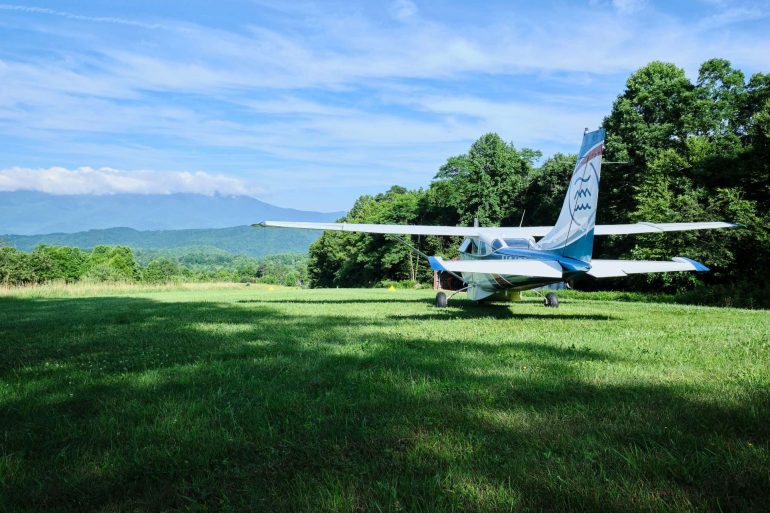
That property is the home of JAARS-Townsend Airport (N52). The public use airport, operated by JAARS, has three grass runways in addition to the tarmac airstrip, hangers and facilities to train mechanics, technicians and pilots.
JAARS’ mission can be summarized with two words: translation and transportation.
“[JAARS] primarily supports the development, in collaboration with local language speakers, of an accurately translated Bible in the languages [that the local people] value the most,” says Steve Biggerstaff, vice president of advancement with JAARS.
The organization partners with translators from its sister organization Summer Institute of Linguistics (SIL Global), which engages linguists who translate the Bible into over 900 languages for 1.5 million people who do not have copies of Christian scripture in their language.
Read More: Multifaceted Musician Te’Jani Becomes the ‘Life of the Party’
When the Bible translations are completed, JAARS ships them to communities in countries including Brazil, Colombia, Ecuador, Peru, Cameroon, Gabon, Kenya, Liberia, Uganda, Bolivia, Indonesia, the Philippines and more.
Linguists are sometimes flown in when certain population groups have no written language, Biggerstaff notes.
He says JAARS pilots fly the “last mile of missions,” the gap separating the furthest reach of roads, trains and boats from remote communities. The pilots, who must fly over terrain that causes dangerous airflows and land on steep airstrips carved out of mountainsides, transport more than linguists and Bibles.
“We transport nationals and/or their goods [like] pigs, coffee, cacao and crafts … to and from markets to help villagers afford tools and clothing and other basics,” Biggerstaff says. “We medevac villagers to urgent health care and we occasionally help government officials visit the most isolated and marginalized people in their countries.”

Such experience proved fortuitous in 2024 when Hurricane Helene tore through communities in western North Carolina. JAARS, which had previously flown relief missions in the aftermath of the 2004 Indonesian tsunami, engaged in both search-and-rescue and emergency-response provisioning missions in western NC in the days after Helene struck.
JAARS members continued to do so until the National Guard and other primary responders ramped up, says Biggerstaff.
Nonprofit watchdog organization Ministry Watch gives JAARS a 77 Donor Confidence Score, meaning donors can “give with confidence,” noting that the aviation ministry posted a total revenue of $9,830,256, offset by $7,703,667 in expenses for a net revenue of $2,126,589 in 2023, the most recent available data.
Living in JAARS
The surrounding JAARS sprang up rather quickly following the establishment of the JAARS headquarters.
Covering 0.9 square miles, the community has a population of 959 in 2025, according to independent data gathering website World Population Review (WPR), which reports the median household income at $64,107 with a poverty rate of 25.4%.
Who runs the community is an open question. It’s located in unincorporated Union County and is close to Waxhaw, but calls to spokespeople with Union County and Waxhaw reveal that neither government entity administers or provides police, fire or water services to the homes in JAARS.
Biggerstaff also wonders who runs the JAARS CDP.
“We think it may have something to do with the fact that JAARS [the nonprofit] owns three wells and acts as a North Carolina utility in providing water both to our campus and to a small number of adjacent homes and neighborhoods,” he says. “Other than that, we don’t know anything about a CDP.”
Te’Jani lived in JAARS from ages 12 to 18. When his family moved to the community from the Chicago area in 2009, he experienced culture shock.
He was used to riding his bike to any number of nearby stores and remaining on guard while doing so. JAARS was more spread out and everyone seemed open and friendly.
“As much as I missed the city and the convenience of being a city kid, JAARS felt safe,” he says. Everyone was Christian in the community, but so was Te’Jani. His father had recently become a minister after attending Southern Evangelical Seminary in Matthews.
Te’Jani remembers JAARS as a place where you could meet other kids, become friends and wind up having dinner at their house all in the course of a day.
“We all knew each other,” Te’Jani recalls. “It got to the point where I’d go to a friend’s house and walk his dog when he wasn’t even home.”
Local filmmaker and musician Nick Will grew up within walking distance of JAARS and visited the CDP often.
“When I was a kid, I’d walk around the neighborhood and knock on everyone’s doors,” Will says. “I’d ask if they had any kids that I could be friends with.”
Read more: Low Groves Doc Kicks Off ‘Wish You Were Here’ Event Series
That’s how Will met his friends Levi and Nate Diggins. He remembers the brothers’ father B.J. Diggins, who was a pilot for the JAARS ministry, taking the kids for an airplane ride.
“We all went up in the air and got to see the area around there,” Will says.
He also recalls hanging out with other kids at a pool on the ministry property and participating in summer camps where adults taught the kids about wildlife.
Although Te’Jani rarely went to the pool or attended summer camps, preferring to play with his friends in the neighborhood or in the woods, he remembers an event called JAARS Day, where staff opened the hangers to the public and conducted tours of the compound.
The ministry still celebrates JAARS Day. The upcoming iteration on Oct. 25 will feature helicopter and airplane rides, hands-on children’s activities and interactive exhibits from JAARS’ two on-campus museums: the Cardenas Building, which shares the history of JAARS, and the Pittman Building, devoted to the world’s alphabets.
WPR reports the demographics of JAARS as 69.8% Black or African American and 30.2% white.
Te’Jani, who is Black, remembers that the population of JAARS was diverse, incorporating people from Kenya, Cameroon, the Philippines, Indonesia and Japan, as well as the US.
Despite the community’s diversity, he realizes in retrospect that there was a cultural homogeneity in this safe, bucolic and rural-suburban enclave.
“We watched the same TV shows, we read the same books, we shared the same activities and it felt like we all knew each other,” he notes.
For some, including Te’Jani, it became necessary to break free.
“JAARS was a good place for where I was at that time,” he says. “But some of my friends that grew up there felt like it was cultish. Because it’s so close-knit, because everyone believes the same thing, because everyone is so attached to that identity of being Christian, if you express a different idea, you are met with opposition, worry and shame. I didn’t understand that until I was older.”
Te’jani is no longer Christian and Will says he holds personalized spiritual beliefs that he puts into practice daily, though both maintain friendships forged at JAARS.
It may be that they’re living the blessing/curse of the modern world, balancing a community that nurtured them with individualism.
While JAARS brings people closer through language and shared faith and values, modern civilization explodes with endlessly evolving viewpoints and possibilities.
To paraphrase F. Scott Fitzgerald, the true test for our future may be the ability to hold two opposing ideas in the mind at the same time, while retaining the ability to function. Like a JAARS pilot navigating a mountain updraft, it can be a bumpy ride, but both courses should be valid.