
ESSAY: Processing the Life, Loss and Legacy of HNin Nie
A legacy that will live forever

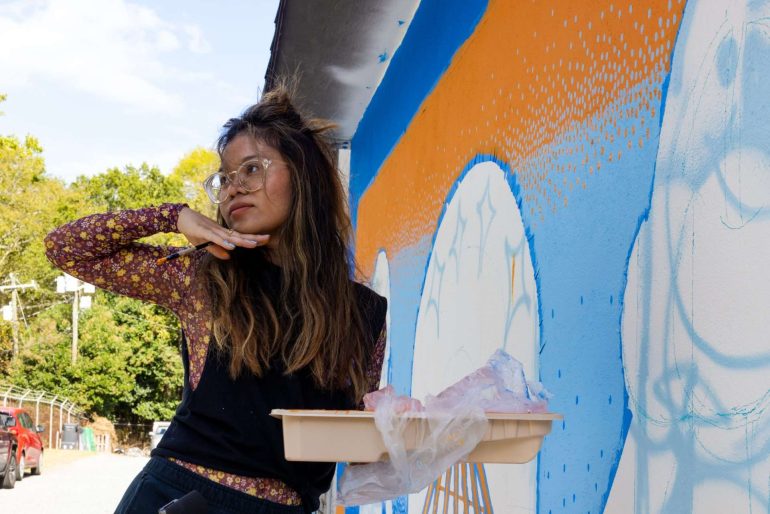
HNin Nie has died.
What an awful sentence that was to write. And worse still to read.
But it’s true. It is real. I’ve been around the block a few times now with regards to loss, and in my experience it is the horrible reality of the situation that is most difficult to metabolize. It doesn’t feel real. It shouldn’t be real. It can’t be real.
The dreamlike unreal quality of those early days in grief is profound. Yet with every breath we draw, the fact is harder and harder to ignore. Life continues … with a ragged hole in the center of it all, and we can only hope as the days pass that this hole will transform itself into a seam of sorts, which is just a nicer word for a scar.
Grief is a scar where the sacred and the mundane have stitched themselves into us. Bearing witness to a life and to that life’s passing is one of the greatest things a human can do. It is awful.
A beloved and irreplaceable fixture of Charlotte’s artistic community, HNin Nie left us on Aug. 26, 2025, a little less than a month shy of her 33rd birthday. Her work and her very presence are vital to any conversation about what is, was and will be good about this maddening and tragic and miraculous world.
I am rocked by her departure and can only imagine the furious vacancy that this has left in the lives and hearts of those she loves best.
Please understand that I am reluctant to use the past tense for an artist of her caliber, a human of her quality. HNin Nie is funny and fierce and smart and kind and always will be. She is Legend. It is proclaimed.
Born in Vietnam but living on Charlotte’s west side since infancy, HNin can be counted proudly among our homegrown geniuses. She exploded onto the arts scene here with work that defied categorization, existing at a shifting crossroads of street art, internet culture and sophisticated, psychologically rich aesthetics.
Her work is equally at home on the side of a building as it is hanging in the stark white box of a contemporary art gallery. The work is visionary; in what can only be described as a sort of folk magic, HNin blends text, painting, sculpture, installation and video to remarkable effect.
In 2018, HNin did a residency at Goodyear Arts, and while her contribution to her cohort’s showcase exhibition was uniformly delightful, evidence of an artist working beyond her years and experience, one piece in particular served as an ambitious statement of purpose.
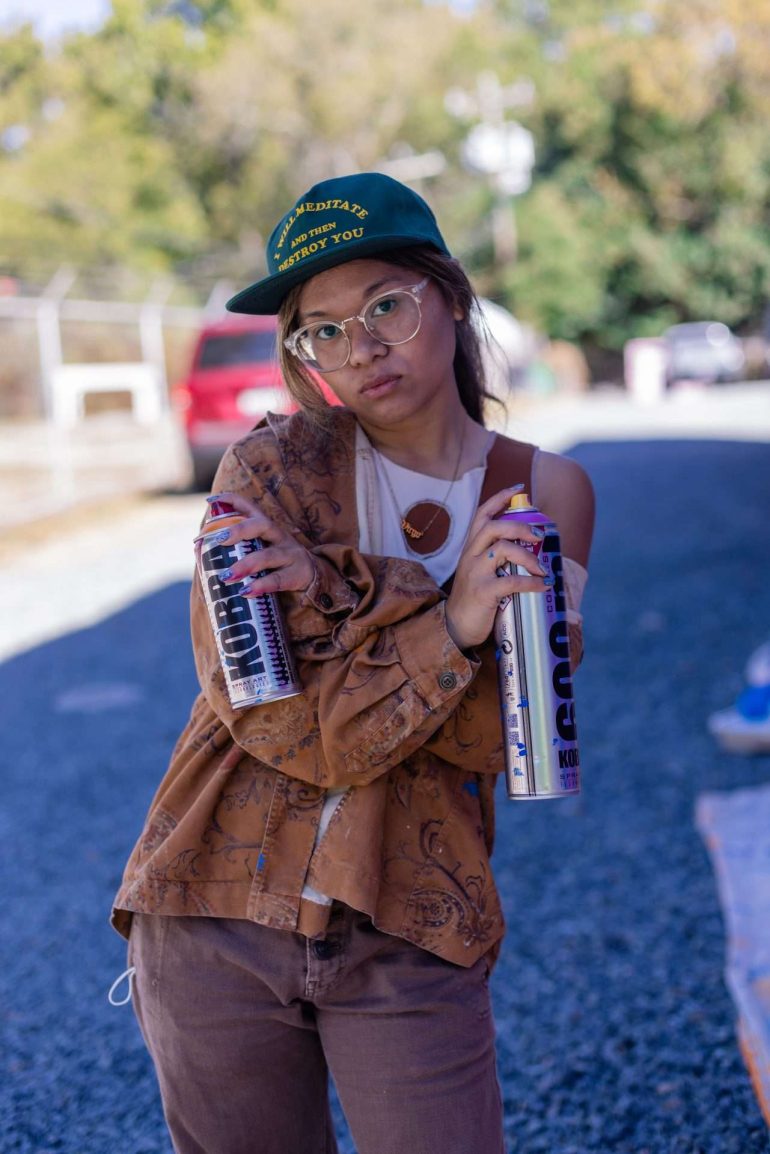
For “The Voices In Your Head,” Hnin designed and fabricated a wooden head roughly the size of an old school Fotomat, portraying an alter ego that HNin was playing with at the time named Negative Nancy. Unlike the Olmec monoliths that the piece reminded me of, “The Voices in Your Head” was hollow, allowing guests to walk inside. In a grandly literal gesture toward what she is doing with her entire oeuvre, HNin used this piece to invite us explicitly inside her head.
The vulnerability at play here does a sort of alchemy that saves the work from solipsism and moves it toward that hallmark of real artistic expression: generosity of spirit and the impulse towards connection, collaboration and play.
Poet, professor and multi-disciplinary artist Amy Bagwell puts it this way: “Everyone who met her must know HNin as a supremely generous, brilliant, funny, loving, courageous, and vulnerable person and artist. She took risks in her art (like her legendary Negative Nancy room-sized, immersive head she built for her residency at GYA – though she had never made sculpture), always pushed and supported other people’s work, and also taught me and my son, Charlie, how to moisturize our hair as we walked out of a performance at the Mint Museum, insisting we stop right on the steps to talk about it because we were doing it totally wrong. She busted up hierarchies and showed me and others that art is not separate from life — or that it shouldn’t be.”
A video of her at work in the studio records her in blissful concentration painting smiley faces on a store-bought floral sun dress. HNin teaches us by example that the triangle delimited by the categories of Art, Artist and Life is a fuzzy, rumbling thing, phasing in and out of our grasp.
The inner life evidenced by HNin’s work is as complicated as it is playful. Much of the pleasure of engaging with her creations is in the buzzing tension generated by a bright color palette and naive imagery that acts as a sort of screen over a conceptual field rich with earthy sensuality and black humor. She pushes at the edges of legibility and reason.
This brinkmanship is one of the most seductive aspects of Nie’s art. There is something conspiratorial about the way she trusts us to manage maneuvering through the semiotic hinterlands she conjures. The more time I spend in her imagination the more destabilizing the experience becomes and I am knocked back on my heels at how imagery so personal can feel so universal.
Her works are sophisticated dialogues with a rich inner world, and their expression is appropriately complex, swarming with visual puns and a language of symbol that is deeply personal and instantly iconic. There is something like an emotional heat mirage at play here, saturated not only with color but with feelings so strong they insist on the distortion that she employs.
HNin’s work has a literal wobble to it that could be a nod to old-school Zap Comix or a simple necessity of finding physical expression for inner experience: the dialectic of heart and mind straining at the limitations of the actual.
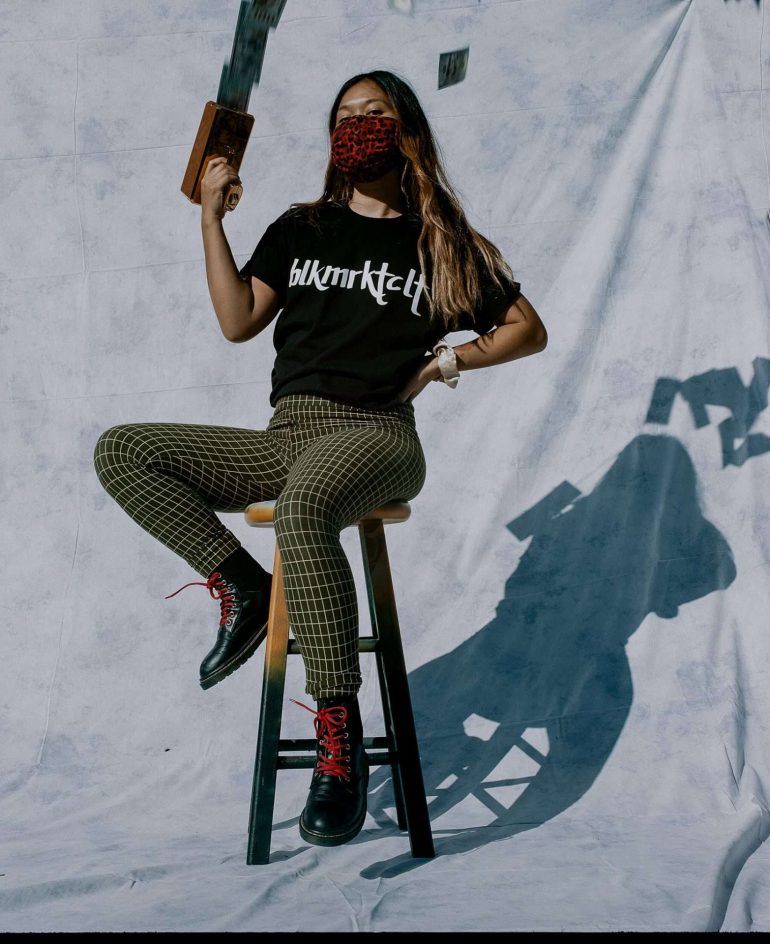
In a conversation we had years ago, HNin summed herself and her work up quite aptly, saying “You can be happy and fierce too. You know: frolicking fiercely in the flowers!” Of course this was pronounced with the beaming smile that is so familiar to those who have spent time with her.
Did I mention that HNin is funny? HNin has jokes, but that’s not the secret to her funny. The funniest people make us laugh because they show up to the world with a point of view and no illusions about how weird this place is. That is HNin: honest and afraid and brave and sly. Her work is a mirror of the mind and heart that made it.
Her sculptural installation “Dream Machine,” which could easily be read as more of an elaborate prank than anything else, is actually one of the purest and most shattering shocks l’ve ever received from any single piece of work. It was a cosmic joke, the cosmic joke, distilled into a simple machine that seduced viewers into interacting with it and then gave us a thrilling and jouissance marbled jolt of existential philosophy.
What a good friend an artist is, when they agree eagerly to be your mirror and your guide through the muck as well as the sunshine.
Mixed media artist Seirin Nagano, a professor at UNC Charlotte and co-director of Goodyear Arts, articulates Hnin’s special way of sharing space with the people around her.
“I was wondering how she could touch so many people’s lives, and how, regardless of the amount of time spent with her, the time would be so thick, and she made you feel like you knew her for a long time, probably because she was always fully present in place and time,” Nagano says. “If you were with her, she was fully there with you. When I was with her, time seemed concentrated and illuminated.
“Her keen sense of the world and fundamental understanding of being and human nature are very present in her works. Her work doesn’t just stay on the surface. Their bright, fun and funny (sometimes dark) quality, like herself, finds a place in the viewers’ hearts and stays; her characters, words, letters, and colors build a house in us and move in.”
Nagano recalls one time in September 2022, her birthday night, when HNin was among a group of friends enjoying a drink on the porch at Goodyear Arts after studio time. Birthdays came up in conversation and HNin learned that it was Nagano’s birthday night.

“She gave me a neon green pin that says “Hot Shit!!!” and drove me around the city, hopping bars and celebrating. That night, we talked a lot, sharing silly to serious stories, and we learned so much about each other. Since that day, she had been my confidante and confederate,” recalls Nagano.
“HNin is so singular and magical. I feel we’re extremely lucky that she left her works all over the city, and so continues to be present in our lives.”
Confronted with the list of people with thoughts and memories and tributes and eulogies to share with HNin, I am overwhelmed. I can’t put all of you in this brief text. There are too many of you.
You knew her better than me and I don’t want to fail you and so I am trying to communicate something true about this remarkable artist — something beyond the joy I gained in the little bit of time I spent with her.
Moments here and there, conversations and laughs and high fives passing each other in the hall.
I cannot do any kind of justice to the HNin that is treasured by her friends and family. I can only aim for something else. Hopefully something beyond the simple, and remarkable, fact that the work she made impacted me. Always. And still does. What do we say when someone like this leaves us? We know that words fail when it comes to the big stuff and yet still insist on trying.
If there is any use for someone like me in this moment, when the brilliant and kind and absolutely incandescent artist HNin Nie has transitioned into whatever comes after this life, it is my task, in the midst of shock and grief at the departure of one so young, to declare her entry into the Hall of Legends. I am not the arbiter by any means, merely the person who will set it down so that it’s in the public record.
HNin Nie is part of what makes Charlotte great. Her work makes this place more bearable on the bad days and more beautiful on the good days.
It isn’t only in the context of the arts in Charlotte that HNin is remarkable. Her work has been shown in Charleston and Chicago and Tokyo. This is a major artist we are talking about, whose vision and body of work stand out for their expansive curiosity, impish humor and clear-eyed vision of the delight to be found in this vale of tears. The fact of her mortality is insignificant in the final analysis and lasting impact of her work.
Curator Jen Edwards of The Mint Museum said to me, “Grief from HNin’s passing still hits me in waves, but then I see her work on my walls, or a sign she made for my office, or her mural in Plaza and I feel her humor, her generosity, her absorbing eyes, and I feel her still here.”
Read more: New McColl Residency Centers on all Things Local (2019)
This experience has been echoed in most every conversation I’ve had about HNin since she passed. It seems like we see her work wherever we go, and so she is with us. Even when it’s awkward.
I was at a birthday party earlier today and in the bathroom there was one of her paintings, bright and singular and strange. HNin, whose “I Pooped Today” stickers can be found all over Charlotte, would find my awkward experience of peeing next to her painting hilarious, I imagine.
This is the strange blessing of the artist, especially one as prolific as HNin. She lives in the structure of our city, her work is on our walls, on our school buses (technically the school bus is in Fort Mill but let’s not split hairs), on the buildings that we pass by and cross through. HNin is here.
HNin is here for us to study and enjoy and engage with and write about and respond to. And that is strictly the legacy and continued vitality of her work.
When we factor in the soul impressions left on family and friends and younger artists who looked up to, were mentored by and carry forth some whiff of HNin into the future there is no reasonable way to say that she is gone.
HNin is Legend.
HNin FOREVER.


Thank you Matt for that loving tribute to HNin Nie.