Local Glassworker Puts Passion Into His Pipes
How one local artisan mixes glassblowing and flame work for function

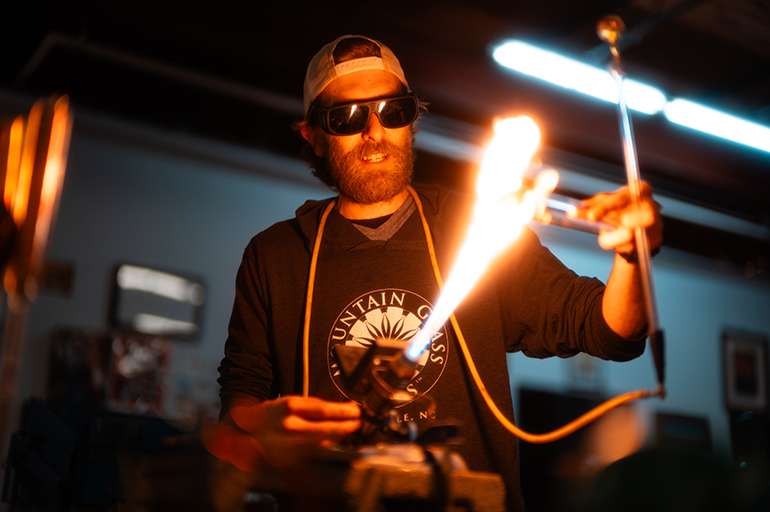
Local glassworker Chris Cooley* apologized for the state of his work bench in Hot Glass Alley as I arrived for a visit on a recent Saturday morning. His studio space was littered with a chaotic amalgamation of spare glass rods, finished and unfinished projects, and tools that are unfamiliar to most but an extension of self in the right hands.
Cooley’s hands sported a number of burns — some fresh and others healed. When you’re working with temperatures that reach upwards of 2,000 degrees, burns just come with the territory.
Though Cooley admits his propane torch setup is dated, adding that he could drop a few grand to upgrade to a torch that heats the glass he works with much faster, his current setup holds sentimental and practical value.
Cooley’s torch, secured by a clamp onto a cinder block in the center of his work bench, is a hand-me-down from the friend that inspired him to start working with glass in the first place.
“He gave me all of my starting equipment because he was upgrading all this stuff and I was pretty much the only one that was showing interest,” Cooley said. “I would just go and hang out in his garage [or] at the basement of the house he was renting, and just talk to him and hang out and ask too many questions.”
Cooley has come a long way from asking questions in a basement in 2014, slowly crafting his expertise in a field that exists at the intersection of art and science, utility and wonder. We sat with him in his north Charlotte studio to go past the burns and chaotic work bench and retrace his journey in glasswork.
Trusting the process
Though Cooley’s friend taught him a few glass-blowing basics and pointed him in the right direction, Cooley had to work through years of trial and error to nail down a process to create what he truly wanted to make: dry smoking pipes.
“I prefer to smoke out of a dry pipe, so, of course, I’m going to do that,” he said. “That’s sort of why … I got into glassblowing.”
A dry pipe is essentially a tubular design with a bowl on one end and an opening for smoke inhalation on the other. Cooley’s pipes fall within the same criteria but his bias toward a heavy, thick glass pipe guides his particular creations.
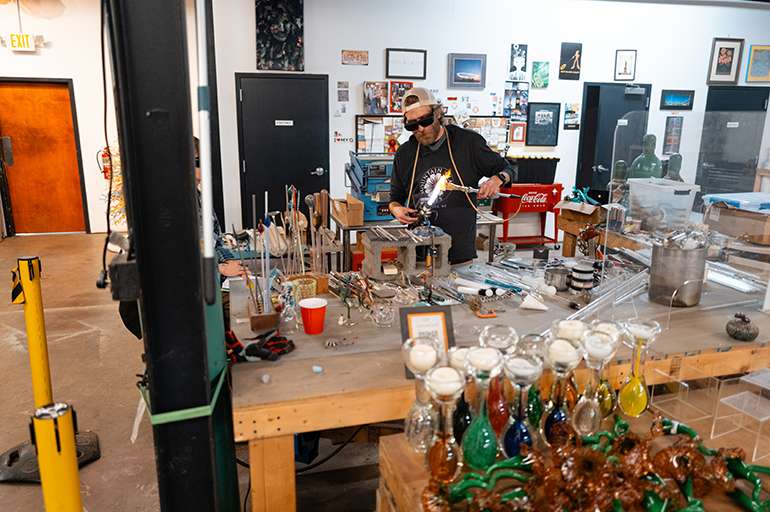
Before setting up shop in Hot Glass Alley’s studio in 2021, Cooley spent three years teaching himself the minute skills of glass pipe-making in his backyard shed. When the government issued stimulus checks during the pandemic, Cooley saw an uptick in sales.
“I sold more pipes than I could make,” he said. “I was doing it every day, and that’s when I feel like I really started to put a process together and everything that’s kind of gotten me to this point.”
Cooley starts with a “blank” — a clean slate of glass piping called borosilicate glass, or boro, which is different from the “soft glass” typically used for making cups, bowls and plates. Soft glass has a higher coefficient of expansion than boro, which makes it easier to expand with the traditional four-and-a-half-foot steel blowpipe the folks in the “hot shop” use.
On Cooley’s side of the studio, he swaps out the large furnace for a more controlled torch. Working with the torch allows Cooley to make finer adjustments on his pipes and add smaller details.
Cooley welds the blank together with a smaller, hollow tube, allowing him to hold onto and rotate the blank. To get the desired color of his pipe, Cooley pours finely crushed color called frit into the inside of the tube and melts it evenly throughout, sealing the opening to secure the frit inside the tube.
The pattern of the bowl at one end of the pipe that we watched him make during our visit was pre-made by Cooley to achieve a “wig-wag” design, created by using glass tubing to twist and manipulate the lines on the bowl to create zig-zags.
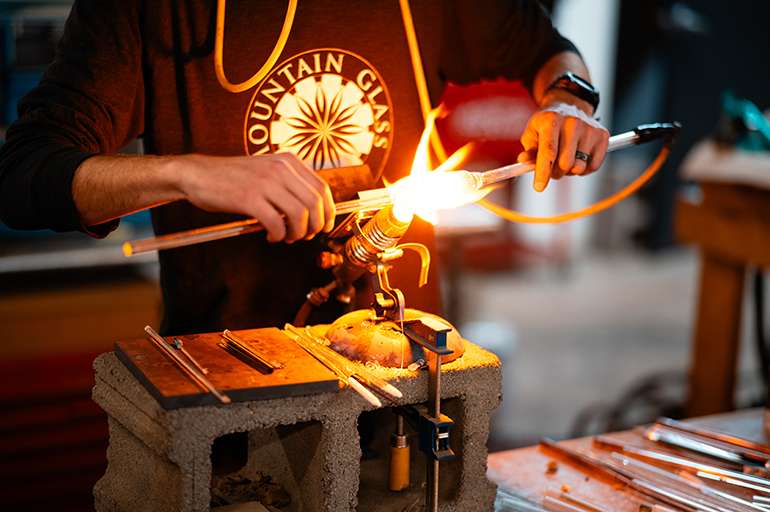
Cooley will use one of the many smaller glass rods on his work bench to add details and pull excess glass off of the pipe.
“Glass is my tool as well as my canvas,” he said.
Cooley’s other instruments consist of graphite tools that have a high heat resistance, but he also uses his hands to manipulate the glass and gravity to his advantage. He utilizes all of these tools as he attaches another glass rod to the other end, using both hands to rotate and center the tube.
“I’m always turning … That’s what you’ll notice here and in the hot shop as well,” he said. “Glass wants to be round; it’s like when you gather honey out of a honey jar and spin it, it’ll stay round … That’s when it’s the happiest.”
Instead of a steel blowpipe, Cooley uses a blowhose to blow air into the pipe as he turns it. Concentrating the flame onto a specific spot while using the blowhose allows the molten glass to expand like a bubble, eventually popping a hole in the pipe.
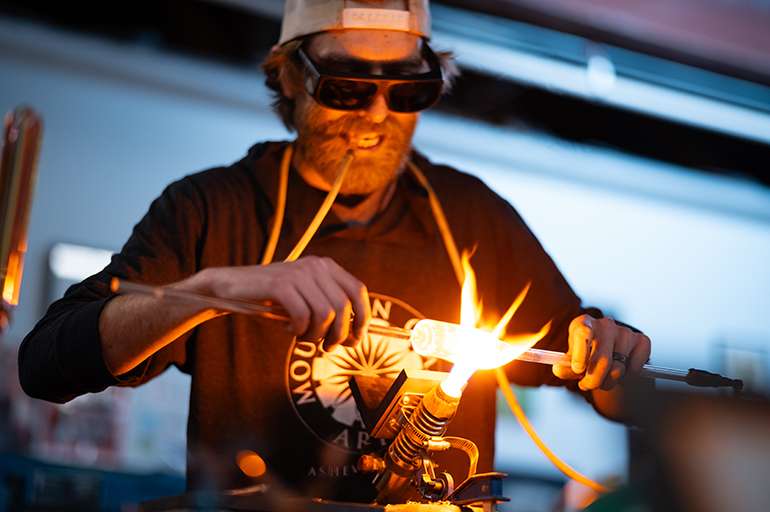
As Cooley rotates the pipe onto an L-shaped graphite mount secured in front of his torch to maintain the outer wall, he is simultaneously blowing into the pipe to manipulate the inner wall.
“[This is when] you get into the trouble of having to turn both of your hands at the exact same speed, at the same time,” Cooley said while rotating the pipe. “I really want this to be as centered as I can get it or else my whole bowl is going to be wonky at the end of this. So every little move I make, even this early in the process, can have dire consequences later on.”
“A force and a flaw, that’s how you break glass,” Cooley added.
One flaw that could be detrimental to the pipe would be an uneven thickness in the pipe wall. When the wall is a consistent thickness throughout the entire pipe, the glass could survive a fall onto concrete, something Cooley guarantees with his products.
Cooley recalled a client that had to surrender her pipe to a police officer. When the cop attempted to shatter the pipe on the concrete ground, it bounced like a ball and stayed intact. He even proved it to us by throwing one of his creations onto the rough gravel parking lot behind Hot Glass Alley.
To achieve the pipe’s profile, Cooley heated two-thirds of the pipe to stretch and shape the body and mouthpiece, using a blade to indent and pre-make the mouthpiece without severing it from the pipe.
Cooley added this step near the beginning of the process to save him time later, as the mouthpiece is the last step and has consistently given him the most trouble over the years.
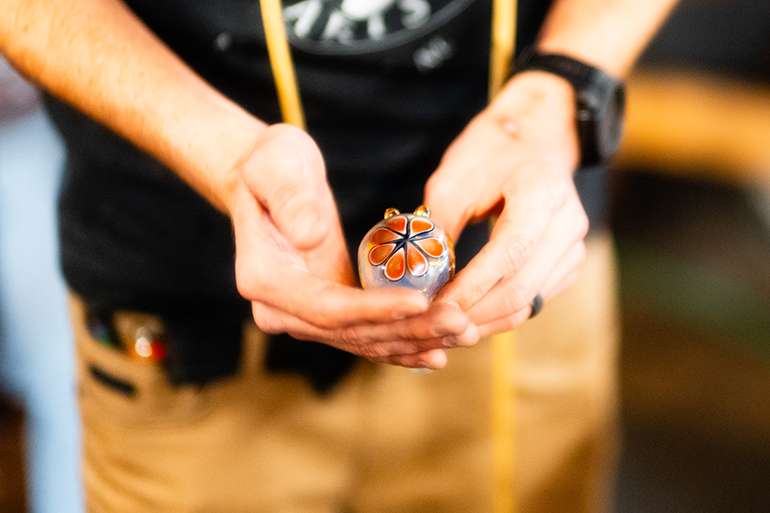
Tearing off the glass rod handle on the opposite side, Cooley set the pipe in his small kiln, which was burning at 1,050 degrees — the proper annealing temperature for glass — to ensure the entire pipe was at the same temperature before attaching the wig-wag design bowl to the pipe’s body.
Using the blowhose, Cooley popped two holes in the wig-wag bowl to create the carburetor hole on the side— a smaller hole that you cover when you light the flower and pull — and the packing indent where the flower will go.
This is where Cooley’s research and development comes in, he said. It took him years of tinkering and personally using his pipes to create what he calls the “golden ratio” of hole sizes between the mouthpiece, carb and bowl to achieve “optimal smoke moveage.”
Cooley added three dots to the empty side of the bowl as grips to make it easier to hold in one hand and attached the bowl to the pipe’s body. After tearing off the glass rod from the mouthpiece, some shaping and touch-ups, Cooley was able to add the new pipe to his collection.
Supporting local glassblowers
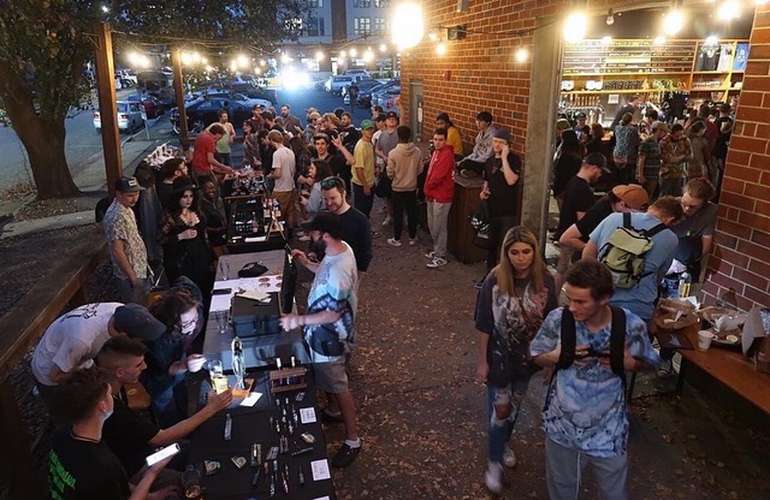
There is an entire industry built around the vessels one uses to smoke wax, weed or CBD flower out of, Cooley said. East Coast Curations, an online-based gallery showcasing functional, nonfunctional and display glass art, created the Carolina Curations show in 2022 to highlight the local artists assuming the medium.
Co-owners York Clinton and Daniel Robertson said the show was meant to bridge the gap between smokers and nonsmokers.
“We wanted to create a show that has something to offer to everyone in attendance,” they said.
Having put on three shows thus far, the duo feels like they’ve made a real impact in bringing a once-siloed community together.
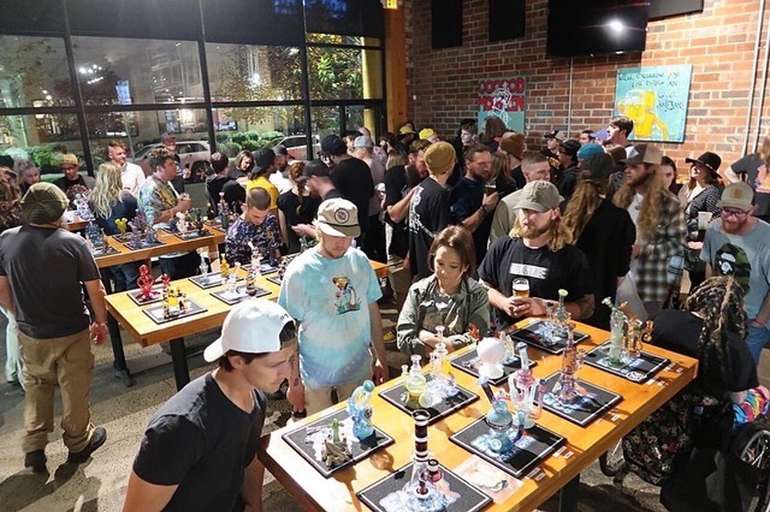
“This event has allowed everyone to come together and appreciate all different types of glass art from these amazing local artists all showcased under one roof.”
As curators, Clinton and Robertson say they’ve seen a rise in business since the arrival of legal CBD and THC products in North Carolina.
“As [CBD/THC] products have started to become more and more popular here in the Carolinas, there definitely seems to be a clear relation between people purchasing these products and in turn, becoming more interested in the glass they’re using to consume different products,” they said in a joint email.
“As glass collectors ourselves, we think it’s a pretty cool concept to know who and where your glass art came from and knowing which specific artists you’re supporting at the end of the day.”
Cooley, who has shown his products at Carolina Curations the past two years, said he hasn’t seen the same.
“I’m not a full-time [artist] so I can’t really speak to that, but I really have not noticed very much
uptick in interest,” he said. “I’ve probably even seen more glassblowers having to sell their stuff and get a full-time job.”
Just because Cooley hasn’t seen the increase in interest, however, doesn’t mean it’s not there. While most of his sales come from word of mouth, his Asheville-based distributor will take his work as quickly as he can make it, sending his products to smoke shops across the country.
Some of his creations are harder to let go of, though. The evidence of that lies in the box of unsold pipes to the left of his torch and the dozens he’s brought back home for further “R&D” — which is Cooley’s way of justifying the use of his own products.
Read more: North Carolina Universities Host Cannabis Research Programs
Even when he makes pipes in bulk, Cooley’s customers can rest assured each piece is unlike the others.
“It’s very hard to make them not unique, or to make the exact same thing two times in a row,” he said. “[You would have to be] like a maestro.”
An artist’s happy place
Cooley admitted that because he isn’t a full-time pipe maker, he was reluctant to share his experience with Queen City Nerve.
“I feel like I’m speaking for a community,” he said. “I just want to make sure I’m not making the community look bad.”
One could scarcely imagine a better spokesperson, however, after experiencing the dedication that Cooley puts into his art firsthand. He can carry on a discussion about the perplexities of flame chemistry and somehow make the science behind it actually interesting.
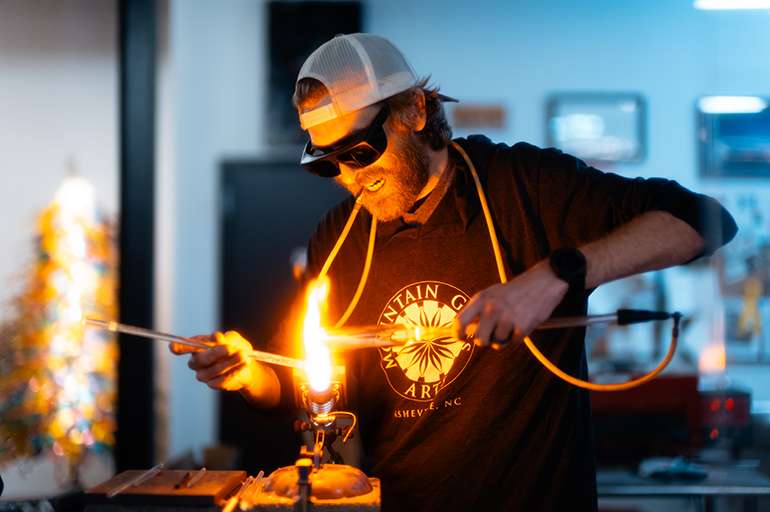
The sporadic nature of his art keeps it from becoming a day job, he said, and keeps his passion for the craft alive. Cooley’s full-time job only allows him time to come to the studio twice a week. Sometimes, on slow days at the office, he closes his eyes and can hear the whoosh of the torch.
“It’s all therapeutic to me,” he said. “I’ll put an album on loop, crank it up and lock in.”
Though he said he could make a batch of pipes per session, he prefers to spend his time carefully creating one pipe and making pieces for the next.
“Since I’ve been here, there is this gallery available to me to market my stuff for me,” he said. “I’ve tried to branch out and make flowers and … pendants.”
Eventually, Cooley wants to make glass sculptures of mythical creatures and chimeras, but that’s a whole different process for another day.
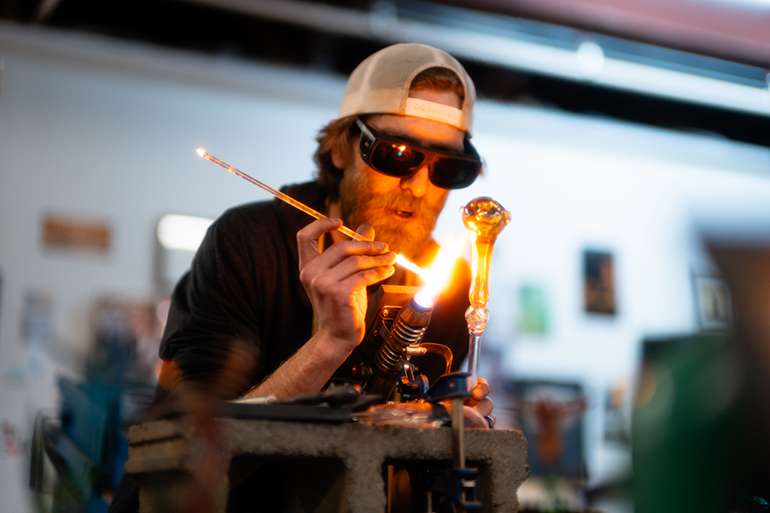
Cooley also shares his passion by teaching one-on-one, three hour lessons in which he walks his students through the process of making a glass leaf pendant. Students can sign up with Cooley by contacting Hot Glass Alley.
“The number one function of glass is to break,” Cooley said. “When I’m working with it, I have to keep that in my head because literally right where I’m about to do all this work, I could absolutely destroy this piece and make it unusable right now in this last thing.
“You have to love the piece that you’re making but you have to be able to roll with the punches at the same time,” he continued. “It can be very unforgiving, but at the same time, it’s the most satisfying thing I’ve ever put myself to.”
And at the end, something beautiful comes out of the mess.
*Chris Cooley is an alias. The artist asked that we keep his real identity anonymous due to lingering stigma around his glasswork and its uses.