Nerve Endings: Don’t Touch Black People’s Hair
...and certainly don't touch my kid's hair

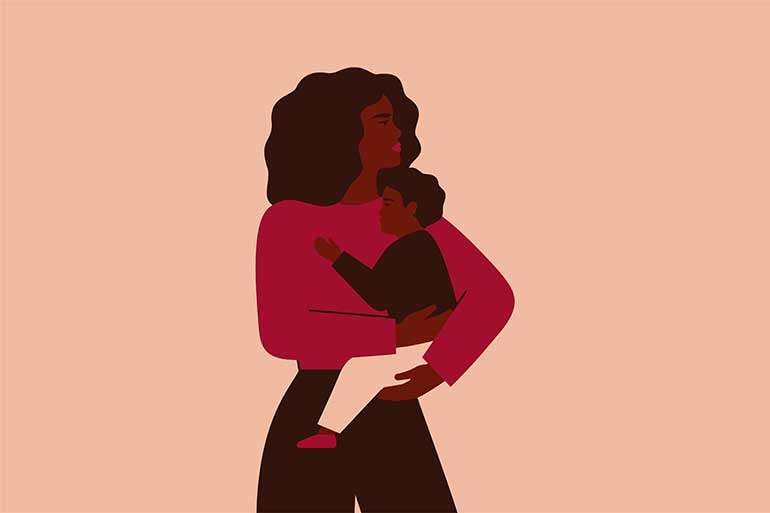
I know it will garner eye rolls from some readers, but it must be said: I have the most exemplary baby boy. First of all, he’s adorable and people love to say so. His general shyness when people try to say hello makes this even more true.
He’s so chill in public; yes, he’s curious about what item I’m grabbing or looking at, but he keeps the calmest demeanor during all of our trips. I’m not sure how long that will last so I’ll enjoy it while I can.
Having said that, it’s still very rare for me to bring my son out on trips to the store. This is for a few reasons, but the biggest is to keep him from getting sick. Though people like to claim — even insist — that everything is “back to normal,” I remain unconvinced. People rarely took one another’s personal spaces into consideration before the pandemic, barely did it during, and they most certainly fail to do so now.
So, it was with some trepidation that I brought my son to Concord Mills mall with me on a recent winter day. I needed to do some shopping, I had the day off, and I thought it might be a fun little outing for us. It started out fun enough, but then things got weird.
Avid reader that I am, I stopped at Books-A-Million first, where I spent way too much money on books (or not enough, depending on who you ask). Then I made my way to Bath & Body Works. The place was mobbed because due to a sale taking place that day, and one does not miss a B&BW sale.
This is where the fun stopped.
My son was rapt with attention in his stroller, which drew a few people’s attention, and one in particular. An older white woman, probably in her seventies, was enraptured with my son and told me so. She then proceeded to enthusiastically tell me how much she loved his super curly hair. I replied as I normally do: “Thank you so much!”
I’m not sure if my response was too inviting or familiar, but I certainly didn’t mean for it to be — I was simply being polite. How she reacted was not the way one would expect a stranger to react: She reached down and touched my son’s hair.
We’re not talking about a simple poke or pat — which still would have been crossing a boundary, let’s be clear — but she toyed and tugged at a particularly coily strand that hung directly in his face, marveling at it almost as if she couldn’t believe it was real.
Flabbergasted, I was too stunned to speak as she departed. I felt a rush of emotions and had a great many thoughts. I immediately texted my fiance, who responded incredulously from work, “WTF is wrong with people?” Once I left the store, I called my brother. I needed to vocally vent to someone and he was available.
He responded, hothead that he is, that the woman was lucky he hadn’t been there. Knowing him, I fully agreed. There were so many reasons this encounter upset me. The first would be obvious to anyone: I didn’t know her and she didn’t know me. I have no problem whatsoever with her complimenting my son, but invading both of our spaces to touch his hair was beyond offensive.
Further to that point, how would I know if she’s sick? How would she know we’re not? I get that some people don’t care about that stuff, but I do. I take our family’s health very seriously and expect no one to intrude on that priority.
The other reason it bothered me is a reason that might not be so obvious to anyone who isn’t Black and hasn’t had to fend off people clamoring to tough their hair: It felt like a microaggression.
For years, Black people have had to tell non-Black people not to touch our hair. Sometimes people ask, oftentimes they don’t; they just go for it. And then, somehow, Black people are the ones in the wrong when they respond aggressively to the unsolicited groping.
Thanks to a white supremacist culture that’s been propped up in this country since long before its official founding, Black people’s naturally kinky, coily, curly hair is often viewed as a spectacle — something that cannot be merely seen to be believed, it has to be experienced. It has to be touched.
And for those same reasons involving white supremacy, Black people are expected to not only be okay with this attention but be flattered by it.
I am certain that there are those out there who would defend this woman and claim that she didn’t mean any harm. Maybe she didn’t. Her intent doesn’t matter to me, however. All that matters to me is how I felt, and none of it was good.
I’m torn about my decision not to say anything. On one hand, I didn’t because I really was just that dumbfounded. By the time I came to my senses, it was over and she was gone. On the other hand, no matter what, it wouldn’t have ended well for me.
Have you ever seen The Color Purple, Steven Spielberg’s 1985 adaptation of Alice Walker’s famous novel from three years previous? There’s a scene in which a white woman marvels at how “clean” a Black woman’s children are, as if Black people are thought to be wholly incapable of being “clean” that to see one in such condition is remarkable.
Read more: Nerve Endings: Navigating Life as a Woman with Tattoos
The woman patronizingly asks the Black woman, Sofia, if she would be her maid, to which Sofia responds “Hell no,” setting off a chain reaction that ends with Sofia, the victim in all this, behind bars. This situation felt like that scene.
I’m astounded, to say the least, that in 2025, Black people still have to fight to be seen as fully autonomous individuals while simultaneously pleading for people to respect our space.
We are people, too — we have emotions and we have triggers just like anyone else. After centuries of disrespect and fighting and pleading, it is a wonder to me how anyone could be surprised when Black people lash out.
All this to say: Stop touching Black people’s hair and respect their space. And don’t touch my son.