‘A Realm of Existence’ Gives Deepest Look Yet at Cerrudo’s Style
Charlotte Ballet's latest show features new, original work from company AD

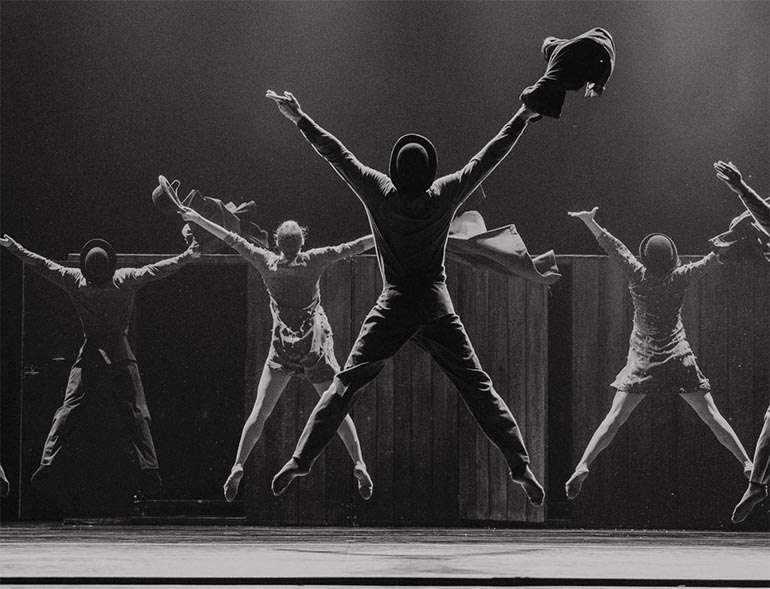
There were four excellent works of what I suppose we would call contemporary ballet featured in Charlotte Ballet’s A Realm of Existence, which ran last weekend at Knight Theater.
Three of these were choreographed by Charlotte Ballet’s artistic director, Alejandro Cerrudo, including his first new, original work created for Charlotte Ballet since taking the reins in 2022. The fourth was a remount of Johan Inger’s “Walking Mad,” a major work that is by turns playful and devastating in its vivisection of the mad, maddening and sublime eldest of the elder gods: erotic desire.
Cerrudo’s three works are themselves a compelling glimpse at the choreographer’s aesthetic inclinations and appropriately accomplished for Charlotte’s premier performing arts organization. Even after past Charlotte Ballet shows curated and choreographed by Cerrudo, A Realm of Existence served as a compelling introduction.
Cerrudo started the program strong with “Dos y Dos y Dos.” Athletic and rigorously physical from the very start (it’s dance, go figure), the work destabilized notions of identity and the self in relation to “the other.”
An effect that persisted through the piece is that of the single body seemingly divided into multiples, most often as a prelude, or reaction to, a duet. There were plenty of proper pair dances, but to me the whole thing read as a duet seen through a kaleidoscope or prism.
Even when confronted with 12 bodies on the stage I couldn’t shake the feeling that I was privy to the fragmentation of selves that results from literally any encounter with the other and the especially fraught negotiation that intimacy triggers.
Read more: Charlotte Ballet’s Beyond the Surface Amazes as It Parties Down (2024)
The work had sweetness and sadness and was quite beautiful, especially when one considers that this is the first piece Cerrudo has made specifically for and with the Charlotte Ballet corps of dancers.
Speaking from my own experience in the performing arts, two things should be kept in mind while taking in a show like A Realm of Existence:
- The relationship between an artistic director and an ensemble is a tricky thing, no matter where you are.
- The work that an audience sees is ultimately only the residue — the remnants of a mysterious and intimate exchange that occurs over the days and weeks spent in the rehearsal room.
In many ways, with performance, the main event is what happens in the studio. That is a whole world into itself and is truly the foundation and primary activity of performance as an artistic practice.
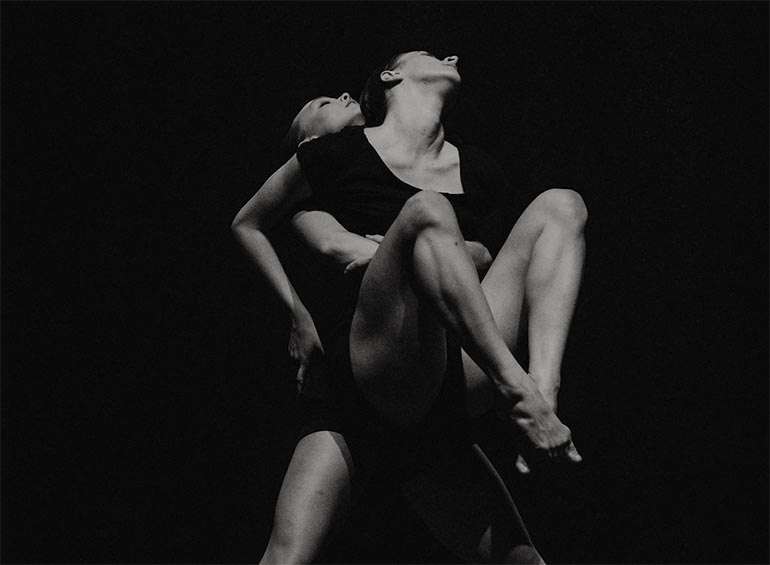
At the end of “Dos y Dos y Dos” we entered a space that suddenly seems to be explicitly about the ensemble as a whole, perhaps even a report on who Cerrudo has discovered he is working with and a vision for their work together moving forward. This moment threw a different light on the whole of what we’ve seen up until now.
And here at the end, the rhythm — both visual and temporal — was achingly exquisite. Like rain on a tin roof. Like someone idly plucking at piano wire. It felt as if we had been led into a shadow land, the imaginative space that exists between the workers and the work.
A slow approach downstage by the entire corps melted into glorious synchronized circuits, almost dervish like. The piece ended in eloquent near silence — the squeal of dancers’ feet on marley the only sound.
The second piece of the evening, “PACOPEPEPLUTO,” was originally created by Cerrudo for Pacific Northwest Ballet, an exercise in taut exuberance played out under a nostalgic selection of songs from the mid-20th century (Dean Martin’s “That’s Amore” is featured, if that tells you anything.)
Maurice Mouzon Jr., Mario Gonzalez and Rees Launer performed in what seemed like (but wasn’t) the nude. They are all, frankly, gorgeous specimens seeming to relish the deliciousness of physical strength, athletic tension and unfettered joy.
There was something charmingly innocent about the proceedings, a pure enjoyment of corporeality that I’d be tempted to label as pagan if it weren’t so emphatically desexualized. “PACOPEPEPLUTO” read to me as decidedly not erotic, especially when compared to literally every other piece in the program.
Read more: Charlotte Ballet’s Alejandro Cerrudo Boldly Breaks Boundaries (2023)
It could be that this work is essentially a series of solos and so lacking in that specific kind of tension that defines the erotic. It could be that it’s more purely comic in tone than anything else on display. Yet comic isn’t exactly the right word; what I’m looking for has more to do with lightness, boldness and a sort of affectless grace.
Or maybe I’m just straighter than I thought and audience members who are really into dudes are vibing. On reflection, it does have a hint of the ancient satyr play about it.
An odd conjunction occurred here between a musical score that was evocative of a certain, mostly wholesome version of performative masculinity from the last century, being executed by contemporary dancers in our new century where lines around “traditional” gender expression are being blurred in some corners and insisted upon to the point of fetishization in others.
Deepening this engagement with the image of the masculine form was a movement vocabulary that met the warm light and deep shadows of the Knight stage to create images that felt timeless. These were mythic, sylvan boys and young men. One wouldn’t be surprised to see them emblazoned on a fifth-century amphora.
OK, I’m comparing nude men to figures depicted on ancient Greek pottery — perhaps I’m not as straight as I thought.
“Cloudless” came next. This work, first choreographed by Cerrudo for Hubbard Street Dance in Chicago in 2013, is just as interested in subverting its symmetry as it is in setting it up.
There was the sense of a broken mirror in this duet, danced by Anna Owen and Adriana Wagenveld — a fractured relationship balanced between the two women underscored by Branimira Ivanova’s costumes, which are close enough in cut and color to suggest a linkage, but with enough subtle differences in detail to keep me from completely identifying these two as the same person.
This strategy was also used to great effect in “Dos Y Dos Y Dos,” making me eager to see more of Cerrudo’s work to confirm or deny that this destabilization of identity is a preoccupation of the choreographer or just something that I’m working through myself.
To my point, one of the joys of A Realm of Existence is watching a single choreographer present three unrelated pieces, of course to see how the work differs but mostly to see where they intersect. This can speak to habit in lesser artists, but more generally with the good ones shows us a secret substratum — the real dance that the maker is trying over and over to make.
Cerrudo’s team stayed fairly simple and contained with regards to costume and lighting throughout the evening, but it all felt thoughtful and intentional, a well-wrought and effective minimalism.
Read more: Alejandro Cerrudo Revives Innovative Works with New Run of Shows (2023)
“Cloudless” had the most explicit gesture toward scenery among the pre-intermission pieces of the evening, and it was actually a lighting thing. Three bouquets of lighting instruments were flown down closer to the action for this dance, forming a sort of ceiling to the piece in addition to casting a soft warm glow on the movement, which has elements that by this point in the evening were becoming signposts through Cerrudo’s inner landscape.
There were bear crawls and moments of extension that slid into something close to sacred iconography, a wide-stanced pictographic pose that could be a reference to Martha Graham or some Paleolithic deity. There were slightly skewed takes on lifts that keep the partner work interesting and, in this piece especially, a sleepy intimacy in soft focus that finally resolved into an embrace that fairly ached with longing.
‘Walking Mad’ and the why of the wall
The second part of A Realm of Existence was dedicated entirely to “Walking Mad,” a work by Swedish choreographer Johan Inger that premiered in Europe in 2001 and which Charlotte Ballet first staged in 2017.
There are all sorts of interesting questions to be asked when it comes to how choreographic work is transmitted when it is performed by companies other than those that created it. There are too many to go into here, but it seems central to me to figure out not just how the form is transmitted but how the first impulse — the way the original dancer took the choreography and transmuted it through their own nervous system, physiology and sensibility to make the dance — gets carried over through the years in different bodies.
That’s where, to my eyes, the real mystery lives. And the mystery is why we show up.
But I digress. “Walking Mad” was hugely popular when Charlotte Ballet first performed it and it remains a stunning piece of work. I saw it here in 2017 and was eager to see it again.
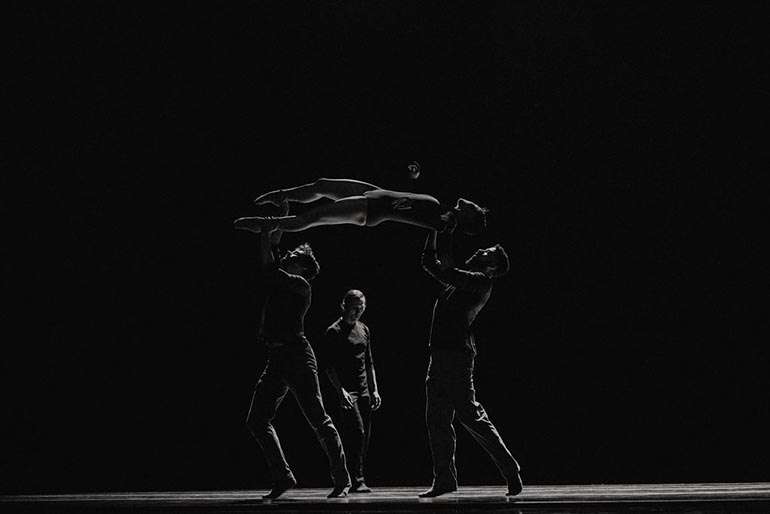
What’s funny, however, is that I forgot how much I hate the first moment of the dance. I won’t bore you with details; the important thing is that what starts as a sort of 101-level absurdism rapidly morphs into a staggering confrontation with the ways desire takes us through the looking glass.
Performed to Ravel’s “Bolero” (with a guest appearance by Arvo Part’s “Für Alina”), the work was a guided tour through the wild disruptive power of sex.
The characters we met along the way include a chorus of rowdy boys in peaked caps that could be birthday hats or dunce’s caps, a gender mysterious chorus of movers enacting a mob of men, and a central pair who move through all this chaos.
There was a rich and ripe sense of humor running through the work that served to temper the throbbing heart of the proceedings; the sublime and surreal horror of the erotic. Inger shows us that the sublimity of sex isn’t confined to pleasure or connection. Sex is wild and ancient beyond all reckoning and it doesn’t care if you like that fact.
At the center of all this was a wooden wall or fence that spanned nearly the entire width of the stage, a character in itself that split and flipped and slid, gliding. It permitted just as enthusiastically as it limited.
And here is perhaps an answer to the “why” of the wall, beyond the simple fact that it was a fun way to divide space and give dancers something to clamber over and around: I wonder at the wall as an avatar for the Saturnian wisdom of limits. Not only do limits create shape and form out of chaos, but (importantly for this work) tension exists at the limit and is central to the mysteries of Eros. The forbidden, the circumscribed has an allure without peer.
Attempts at domesticating sex are either doomed or sad or both. So what does a 21st-century culture that rejects the body and its mysteries even do with sex? Turn it into a costume or an attitude? An identity to cling to without daring to actually become initiated in its unsettling and obscene mysteries?
Carnal knowledge isn’t knowledge as much as it is knowing, and there is a difference. Love is a madness, transformative and devastating. There is no winning against the old gods. They always come out on top. The so-called “rational man” is a ridiculous animal driven to distraction and distortion by these fierce urges.
That absurdity was on full display in the climactic moments of the dance, which leaned heavily on a visual language that seems equal parts Beckett and Magritte. Afterwards we found ourselves in a quiet duet, all tenderness and trembling and care.
It was a masterful shift in tone. Try and fail to pick up the pieces. Devastation. Give me devastation. Pity those who haven’t learned to give in and practice obeisance to the great god Pan and his retinue of succulent filth.
Beckett famously wrote of our existence: “You’re on Earth. There’s no cure for that.” It is a slow-motion cyclone we are stuck in here on Earth — a feast of ecstatic horrors and exquisite devastation. And how lucky, in the midst of that, to live among artists who create experiences rich in meaning and primed for resonance, to help us encounter and process these mysteries, seated together, breathing together, in the dark.
Charlotte Ballet’s next performance will be Carmen, scheduled for May 2-11 at Knight Theater.